
Salamanca and Sullivans Cove, TAS
Salamanca and Sullivans Cove make up the historic waterfront of Hobart, the place where the city began in 1804 and still its liveliest quarter. A curve of sandstone warehouses faces a working harbour of fishing boats, yachts and Antarctic ships, and within a few hundred metres are the best-known market in Tasmania, the state museum, the ferry to MONA and many of the finest hotels and restaurants on the island.
Known For
- Salamanca Place and its Saturday market
- Constitution Dock, Victoria Dock and the working harbour
- Waterfront museums, hotels, bars and restaurants
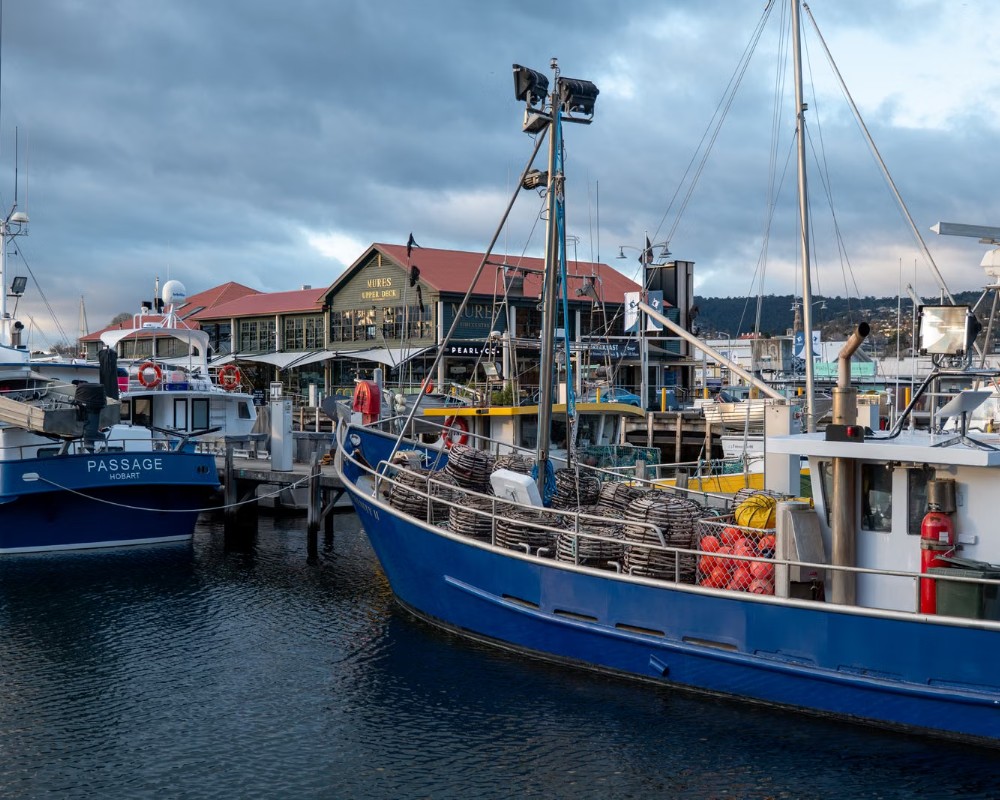
Sullivans Cove is the small bay at the foot of the city centre. Salamanca Place runs along its southern side, backed by the cottages of Battery Point. The docks and piers line the western shore, and Hunter Street, with its old jam factory, closes the northern end. Everything is flat and close together, and the whole precinct can be walked in 20 minutes, though it deserves a day.
This is where most visitors to Hobart spend much of their time, whether or not they are staying here.
Things To Do in Salamanca and Sullivans Cove
Salamanca Place
The warehouses of Salamanca Place were built between the 1830s and 1850s, when Hobart was one of the great whaling ports of the southern oceans. Their golden sandstone walls now hold galleries, craft and design shops, bookshops, bars and restaurants, with plane trees and lawns in front. The Salamanca Arts Centre occupies several of them, with studios, a theatre and exhibition spaces, and Salamanca Square behind has cafes around a fountain. Kelly’s Steps, cut in 1839, climb between the buildings to Battery Point.
Salamanca Market
Held every Saturday since 1972, the market fills the length of Salamanca Place with about 300 stalls from early morning until mid-afternoon. It is known for Tasmanian timber, ceramics, wool, leather and jewellery, for local produce, cheese, honey, whisky and gin, and for its buskers and street food. Come early to beat the crowds, especially when a cruise ship is in port.
The Docks
Constitution Dock is famous as the finishing point of the Sydney to Hobart yacht race, when the fleet ties up here at the end of December. For the rest of the year it shelters fishing boats and the floating fish punts that sell seafood over the side. Victoria Dock, next door, is home to the crayfish and trawler fleet. Along Franklin Wharf, bronze sculptures recall the Antarctic explorers who sailed from Hobart, and the red research and supply ships of the Australian Antarctic program are often moored nearby.
Museums
The Tasmanian Museum and Art Gallery faces Constitution Dock, with free galleries on Aboriginal Tasmania, colonial art, natural history and Antarctica, partly housed in buildings from the 1800s. The Maritime Museum of Tasmania is a block away, and a replica of the huts built by Douglas Mawson’s 1911 Antarctic expedition stands on the waterfront, with proceeds supporting the conservation of the originals.
Cruises and Ferries
Brooke Street Pier, a floating glass-roofed building, is the departure point for the ferry to MONA and for harbour and wilderness cruises, and has a market of Tasmanian products inside. Boats leave the waterfront for trips along the Derwent, to Bruny Island and to the sea cliffs of the Tasman Peninsula. Seaplanes take off from the cove for scenic flights, and a commuter ferry crosses to Bellerive.
Parliament and Parks
Parliament House, built by convicts in the 1830s as a customs house, overlooks lawns that are a popular lunch spot. St David’s Park, a block inland, was the first burial ground of the colony, and its old headstones are set into walls beneath English trees.
Where To Stay
The waterfront has the best concentration of hotels in Tasmania.
In Salamanca, Moss Hotel is a boutique hotel within the old warehouses, Lenna of Hobart occupies a sandstone merchant’s mansion, and the Salamanca Inn has apartment-style suites. Beside Parliament, The Tasman is a luxury hotel in a group of heritage and modern buildings.
On the northern side of the cove, MACq 01 stands on the old Macquarie Wharf with rooms themed on Tasmanian characters, and the Henry Jones Art Hotel fills the former IXL jam factory on Hunter Street. The Grand Chancellor overlooks Victoria Dock, and the Customs House Hotel has rooms above its pub opposite the wharves.
Bed and breakfasts and cottages in Battery Point, a few minutes’ walk uphill, offer a quieter alternative. Saturday nights, late December and the fortnight of Dark Mofo in June are the hardest times to find a room.
Eat & Drink
Seafood is the natural choice. Mures, between the two docks, has a fish and chip hall downstairs and a restaurant above, and the fish punts at Constitution Dock serve scallops, oysters and fish to eat on the wharf. The Drunken Admiral, on Hunter Street, is a long-established seafood restaurant in a nautical setting, and Aloft, on Brooke Street Pier, is one of the leading fine dining rooms in the state.
Salamanca has cafes for every hour. Machine Laundry Cafe and Tricycle Cafe are favourites for breakfast, Retro Cafe has watched the market from its corner for decades, and Daci and Daci Bakers, a short walk away on Murray Street, is known for pastries.
In the evening the warehouses fill with bars and restaurants, from the pub atmosphere of Jack Greene to whisky and wine bars pouring Tasmanian labels. On Friday evenings a free music session in the courtyard of the arts centre has been a local ritual for years. The hotel restaurants, including Peppina at The Tasman and Landscape at the Henry Jones, are open to non-guests.
History
The cove is the country of the muwinina people. In February 1804 Lieutenant-Governor David Collins landed here to found Hobart Town, choosing the site for its fresh water and deep anchorage, and named the cove after a British official. Convicts built wharves, stores and a causeway to Hunter Island, which now lies beneath Hunter Street.
Whaling, sealing, wool and later apples and jam made the port rich. Salamanca Place, named for a victory of the Duke of Wellington, declined into a run-down warehouse district in the twentieth century before artists and the market revived it in the 1970s.
Getting to Salamanca and Sullivans Cove
The waterfront is a five-minute walk from the centre of Hobart. Airport buses stop near Brooke Street Pier, and most city bus routes pass within a few blocks.
Parking is limited and metered, and Salamanca Place is closed to cars on Saturdays for the market. Staying nearby and walking is by far the easiest approach.
Experiences
- City
- Cultural
- Food and Wine
- Historic/Heritage
Popular Activities
- City Sightseeing
- Cruising
- Food and Wine
- Nightlife
- Shopping
About Salamanca and Sullivans Cove
- Locality: Suburb
- Salamanca and Sullivans Cove Postcode: 7004
- State: Tasmania
- Region: Hobart and South
- Latitude: -42.8870
- Longitude: 147.3325
- Timezone: Australia/Hobart
