
Mount Gambier, SA
Mount Gambier is the second-largest city in South Australia, with about 27,000 people, and the capital of the Limestone Coast. It lies roughly halfway between Adelaide and Melbourne, about 440 kilometres from each, and only 17 kilometres from the Victorian border.
The city is built on the slopes of a volcano that last erupted about 5,000 years ago, among the most recent eruptions on the Australian mainland. Its craters hold lakes, the limestone beneath the streets is riddled with caves and sinkholes, and the water that fills them is so clear that divers come from around the world.
In 2022 the main landmarks were given dual names in the language of the Boandik people, so the Blue Lake is also Warwar and the Umpherston Sinkhole is Balumbul. Around the city are pine forests, dairy farms and some of the richest volcanic soil in the country.
Known For
- The Blue Lake, vivid blue from November to March
- Sunken gardens in the Umpherston Sinkhole and Cave Garden
- Volcanic craters, caves and crystal-clear sinkholes
Things To Do in Mount Gambier
Blue Lake / Warwar
The lake fills one of the volcano’s craters and supplies the city’s drinking water. For most of the year it is steel grey. In November it turns an intense turquoise blue within a few days and stays that way until late February or March, when it fades again. The change is caused by tiny crystals of calcite forming in the warming surface water. A 3.6 kilometre path and road circle the rim, with several lookouts. Tours of the old pumping station, which go down the crater wall in a lift, run at limited times and must be booked by phone.
Valley Lake and the Crater Lakes
The neighbouring crater holds the Valley Lake, with a free wildlife park of kangaroos, wallabies and koalas, a boardwalk, playgrounds and barbecues. Walking tracks link it with the Blue Lake and with two smaller craters that are now dry. The climb to Centenary Tower, on the highest point, gives a view over the whole city; the tower opens when its flag is flying.
Umpherston Sinkhole / Balumbul
In the 1880s James Umpherston turned a collapsed cave on his property into a sunken garden, with terraces of hydrangeas and tree ferns and curtains of ivy hanging from the rim. It is free and open all day, and floodlit at night. At dusk brushtail possums come out of the walls to be fed; bring fruit, not bread.
Cave Garden / Thugi
Another sinkhole garden, this one in the centre of the city beside the old town hall, with rose beds, a waterfall after rain and a light show after dark.
Engelbrecht Cave
Beneath a suburban street on the western side, this cave has two chambers open on 30-minute guided tours, with a view of the flooded passages explored by cave divers. Tours run daily and cost about $22 for adults; book ahead.
The Riddoch and the Main Corner
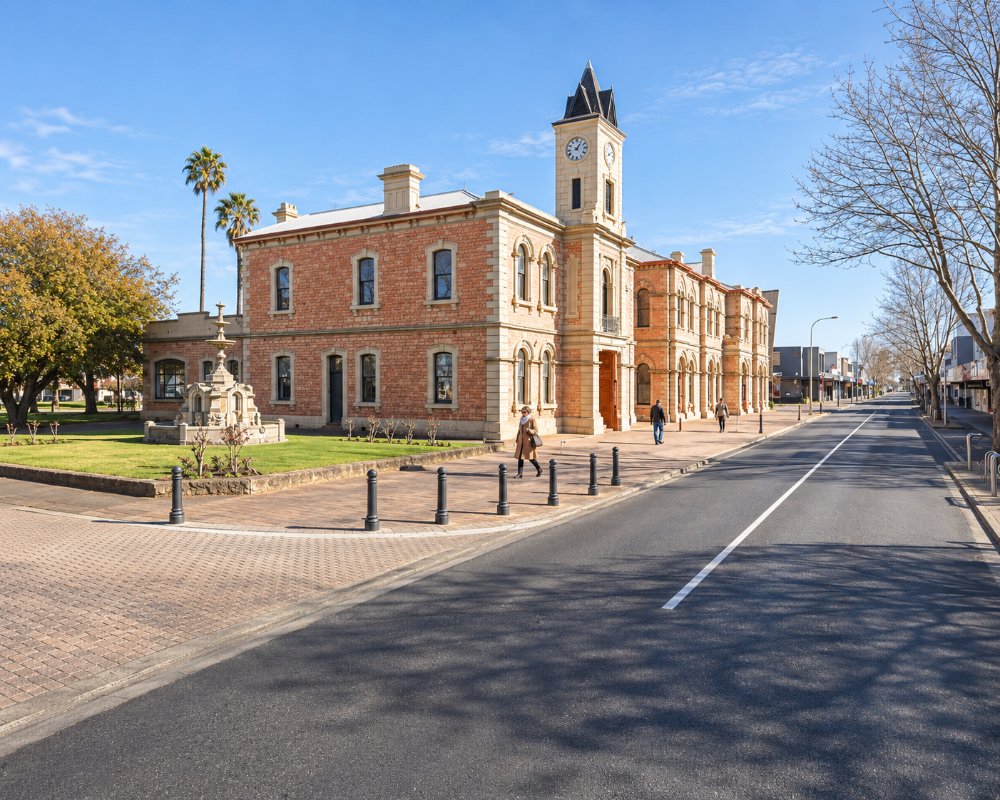
The regional gallery and cultural centre in the old institute at the main corner shows touring exhibitions and screens two free films, one on the volcano and one telling the Boandik story of the giant Craitbul.
Kilsby Sinkhole and Little Blue Lake
Kilsby Sinkhole, on a farm at Moorak south of the city, is a vast chamber of blue water open for guided snorkelling and viewing tours by booking. Little Blue Lake, near Mount Schank, is a sinkhole with stairs and a pontoon where strong swimmers can take a free and very cold dip.
Events
Generations in Jazz brings thousands of young musicians to the city on the first weekend of May. The Blue Lake Fun Run and the Christmas parade are held in November, and the show in late October.
Where To Stay
The city has the widest choice of accommodation between Adelaide and Geelong. The Barn, on the Nelson road, combines rooms with the city’s best known steakhouse; the Commodore, the Mantra, the Presidential and the Tower Motor Inn are among more than a dozen motels, and the Mount Gambier Hotel and the Federal have pub rooms. For something different, the Old Mount Gambier Gaol, a prison until 1995, lets its cells and dormitories to travellers.
There are five caravan parks: the BIG4 Blue Lake Holiday Park beside the crater, Pine Country at Moorak, Mount Gambier Central near the main street, the Limestone Coast Tourist Park and Kalganyi Holiday Park. The showgrounds in Pick Avenue takes self-contained vans at lower rates and has a dump point, but closes around the show in late October.
Eat & Drink
Commercial Street and the streets off it have the cafes: Metro Bakery and Cafe, Presto Eatery, Bricks and Mortar and several more. The Barn Steakhouse is the special-occasion dinner, and Macs Hotel, Jens Hotel and the South Eastern Hotel are reliable for pub meals. Look for local beef, lamb, southern rock lobster in season and wines from the small Mount Gambier wine region.
Day Trips from Mount Gambier
Mount Schank, 12 kilometres south, is a perfect volcanic cone with a path to the crater rim. Port MacDonnell, the state’s southernmost town, has the rock lobster fleet and a maritime museum, and beyond it are the spring-fed Ewens and Piccaninnie ponds and the Glenelg River at Donovans.
West of the city, Carpenter Rocks and Nene Valley are quiet fishing settlements on a wild coast, and Canunda National Park runs north from there to Southend. Inland, Penola and the Coonawarra cellar doors are 35 minutes north, with the forestry towns of Tarpeena and Nangwarry on the way. Tantanoola Caves and Millicent are half an hour north-west.
History
Mount Gambier is on the country of the Boandik, or Bungandidj, people. On 3 December 1800 Lieutenant James Grant, sailing the Lady Nelson along the coast, sighted two mountains and named this one after Admiral Lord Gambier; it was the first place in South Australia named by a European. Stephen Henty climbed the mountain in 1839 and brought his stock across from Portland. Hastings Cunningham laid out the town of Gambierton in 1854, and it became a city a century later.
Getting to Mount Gambier
From Adelaide, the inland route by the Dukes and Riddoch highways takes about four and three quarter hours, and the coast road through Kingston and Millicent a little longer. Melbourne is about five hours away through Hamilton or along the coast via Portland. One airline flies to Adelaide and Melbourne, and coaches run to both cities. Travellers from Victoria may not bring fresh fruit into South Australia.
Experiences
- City
- Historic/Heritage
- Nature based
- Rural/Country
- Self-Drive
Popular Activities
- Bush Walking
- Caving
- Diving
- Shopping
- Sightseeing
- Snorkelling
About Mount Gambier
- Locality: Major urban locality
- Mount Gambier Postcode: 5290
- State: South Australia
- Region: Limestone Coast
- Latitude: -37.82939
- Longitude: 140.78022
- Elevation: 42m
- Timezone: Australia/Adelaide
Accommodation In Mount Gambier
Discover some of the accommodation in and around Mount Gambier
- Amble In Bungalow Bed and Breakfast
- Amble In Cottage Bed and Breakfast
- Apartments On Tolmie
- Arkana Motor Inn
- Arkana Motor Inn Terraces Apartments
- Avalon Motel
- Barn Apartments
- Barn Motel
- Blue Lake Motel
- Braxton House
- Colhurst House Bed & Breakfast
- Comfort Inn Silver Birch
- Commodore On The Park
- Eliza Cottage
- Elizabeth’s on Gray
- Engelbrecht Cottage
- Garden Retreat Bed & Breakfast
- House On Heaver Drive
- Jubilee Motor Inn
- Kalganyi Holiday Park
- Lemon Gum B&B
- Limestone Coast Motor Inn
- Limestone Coast Tourist Park
- Matilda B&B Accommodation
- Metro On Alexander
- Mid City Motel
- Mount Gambier Hotel
- Mount View Motel
- Quality Inn International
