
Tottenham, NSW
Tottenham is a town of about 260 people in Lachlan Shire, 50 km north-west of Tullamore and about 130 km north of Condobolin. Copper was mined here in the early 1900s, and it is now a wheat and wool centre.
Known For
- The centre of New South Wales
- Copper-mining history
- Wheat and wool country
Things To Do in Tottenham
A cairn marks the geographic centre of the state, 34 km west of town on a gravel road. In town, relics of the copper mines and smelter can still be seen.
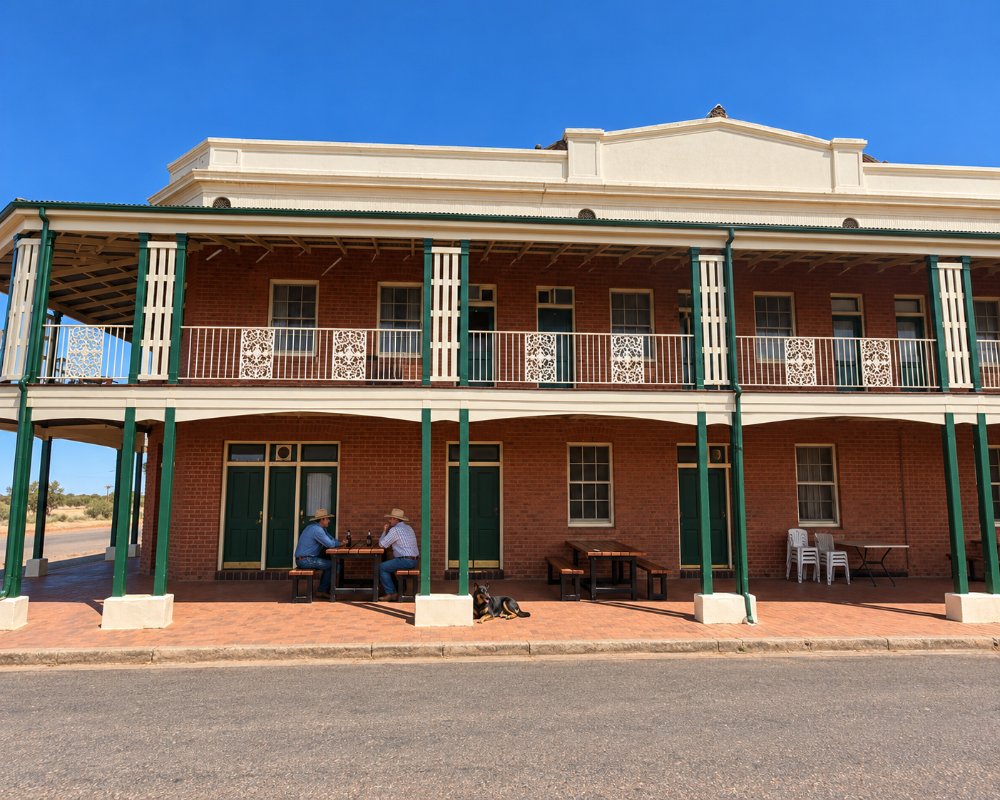
The Tottenham Hotel
The two-storey hotel was built in 1931 and restored. It is the social centre of the town, with a dining room, a beer garden, a balcony and, unusually for a country pub, two glass-backed squash courts.
Heritage walk and murals
The volunteer-run information centre on Umang Street has a walking trail of more than 20 historic sites, and the water tank was painted in 2023 with cockatoos, a goanna and other wildlife. Ask there about the road to the cairn, which is unsealed in parts.
Where To Stay
Tottenham Caravan Park is owned by the council and run by a contracted operator; it has powered and unpowered sites, hut-style rooms and a cabin.
The park has 12 powered and 7 unpowered sites, hut-style rooms, a cabin and a free dump point, and the Tottenham Hotel has 13 rooms. Tullamore’s showground and hotel, about 50 km south-east, also take caravans.
The nearest larger towns are Parkes and Nyngan.
Eat & Drink
The Tottenham Hotel serves meals, and there is a general store and a cafe.
Fuel is sold in the main street, but hours are limited, so fill up in Nyngan, Trangie or Parkes if you can. For a full supermarket, go to Nyngan, Narromine or Condobolin.
History
Tottenham is on Wiradjuri country. Copper mines such as Mount Royal and the Caroline worked from 1903 to the late 1920s, the post office opened in 1907, and the branch railway from Bogan Gate arrived in 1916. In 1988 a cairn of mine slag was built to mark the geographic centre of NSW, and in 2012 Tottenham was named the most outstanding community in NSW and the ACT.
Getting to Tottenham
Tottenham is reached by sealed road from Tullamore or from Nyngan. Roads to the west are mostly gravel.
It is about 506 km from Sydney via Dubbo and Trangie, or via Parkes and the Bogan Way.
Experiences
- Historic/Heritage
- Remote
- Rural/Country
Popular Activities
- Caravan and Camping
- Driving
- Shopping
- Sightseeing
About Tottenham
- Locality: Urban locality
- Tottenham Postcode: 2873
- State: New South Wales
- Region: Country NSW
- Latitude: -32.24404
- Longitude: 147.35603
- Elevation: 245m
- Population: 453
- Median Income: $25012
- Area (Sq/km): 1621.621
- Timezone: Australia/Sydney
