
Hunters Hill and Woolwich, NSW
Hunters Hill and Woolwich share a long, narrow peninsula between the Lane Cove and Parramatta rivers, where the two meet to form Sydney Harbour. About nine kilometres from the centre of Sydney, this is the oldest garden suburb in Australia, a place of sandstone villas, stone walls and old trees that has been protected from redevelopment more successfully than almost anywhere else in the city.
Known For
- Historic sandstone houses and garden streets
- Woolwich Dock and harbour lookouts
- Kellys Bush, site of the first green ban
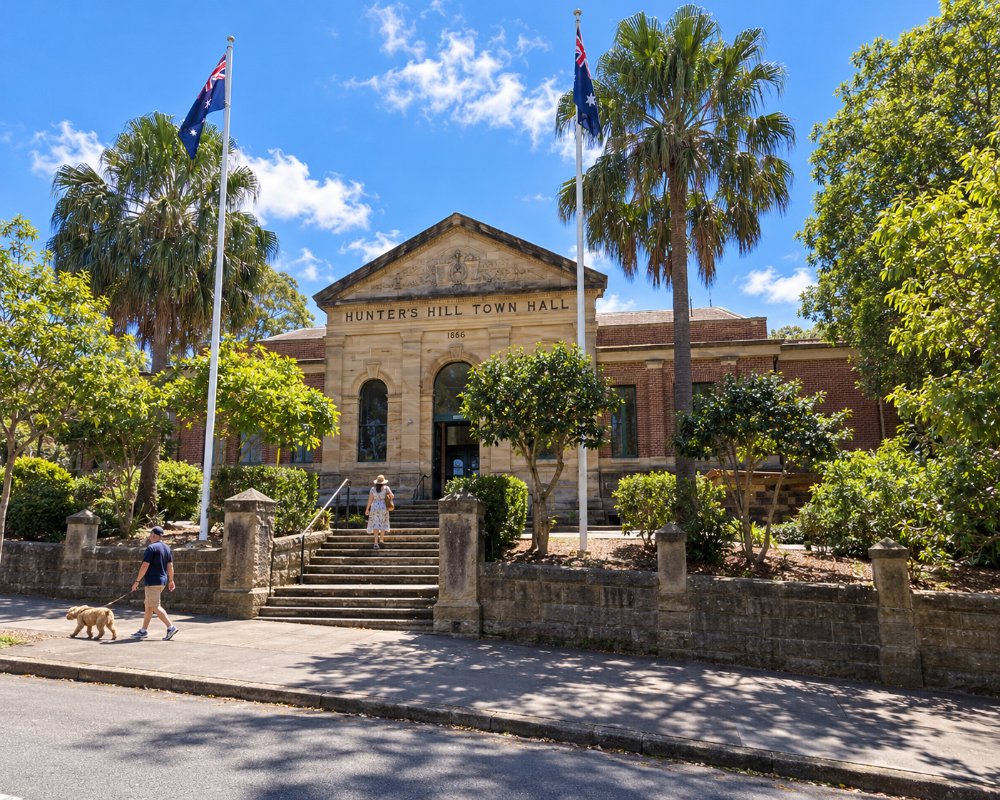
Hunters Hill takes up most of the peninsula, with its small village centre on Alexandra Street. Woolwich is the tip, facing Cockatoo Island and the city. A single road runs the length of the ridge, with short streets falling to the water on both sides.
Things To Do in Hunters Hill and Woolwich
Heritage Walk
About three-quarters of Hunters Hill is listed as a conservation area. Many of its finest houses were built in the 1850s and 1860s by two French brothers, Jules and Didier Joubert, who brought stonemasons from northern Italy to work the local sandstone. A walk along Alexandra Street, Ferry Street and Woolwich Road passes dozens of them, with their wide verandahs, iron lace and deep gardens. Vienna Cottage, a stonemason’s house of 1871 owned by the National Trust, opens on occasional days.
Woolwich Dock and Lookout
At the end of the peninsula, a dry dock was cut into the solid sandstone and opened in 1901 as the largest in Australia, then lengthened to 260 metres by 1918. It is now used by a yacht maintenance yard, and a public path runs along the top of its sheer walls. Above it, Woolwich Lookout and the grassy slope known as the Goat Paddock give broad views up the harbour, and Clarkes Point Reserve on the southern shore looks straight at the Harbour Bridge.
Kellys Bush
This small patch of waterfront bushland has a large place in Australian history. In 1971, when it was about to be cleared for housing, a group of local women asked the builders labourers union for help, and the union refused to let its members work on the site. It was the first green ban, a tactic that went on to save much of historic Sydney. The bush is now a public reserve with walking tracks.
Great North Walk
The long-distance track from Sydney to Newcastle begins its land section at Woolwich wharf, and the first few kilometres through Hunters Hill and Boronia Park make a good half-day walk.
Woolwich Dock Today
The dock is managed by the Harbour Trust, and tradespeople still repair boats in the old dry dock, which visitors can watch from the paths above. The dock and the Goat Paddock are free and open sunrise to sunset, and the dock is wheelchair accessible from Clarke Road.
Where To Stay
There is very little accommodation on the peninsula.
Stay in the city and come by ferry, or look at hotels in North Sydney or around Lane Cove and Ryde.
There is no hotel or motel on the peninsula, and the pubs have no guest rooms. The F8 runs from Circular Quay to Woolwich wharf in about 20 to 25 minutes, so a city hotel works well, and the Royal Pacific Hotel at Lane Cove North and the Macquarie Park hotels are short drives away. Discovery Parks – Lane Cove in Lane Cove National Park at Macquarie Park is the nearest tourist park, though in late 2026 its powered sites were temporarily operating as unpowered. The narrow, steep streets of Woolwich are no place for a van.
Eat & Drink
The Woolwich Pier Hotel, built in 1885, is a grand old pub with wraparound balconies and views to the city, and is the best-known place to eat and drink on the peninsula. A cafe and function venue operate beside the dock. The village on Alexandra Street has cafes, a bakery and a few restaurants, and the Hunters Hill Hotel is the other local pub.
The Woolwich Pier Hotel on Gale Street, established in 1885, has a dining room, balconies with harbour views and live music on Friday nights, and the Hunters Hill Hotel near the Gladesville end has a bistro and opens seven days. The Deckhouse cafe sits in Clarkes Point Reserve beside Woolwich Dock, though it doubles as a function venue, so check before going on weekends.
History
The peninsula is the country of the Wallumedegal people, who knew it as Moocooboola, the meeting of waters. It was named after John Hunter, the second governor of New South Wales. The Joubert brothers promoted it from the 1840s as an elegant riverside retreat, running their own ferries to the city, and it became a municipality in 1861. Woolwich developed around the dock and nearby shipyards.
Getting to Hunters Hill and Woolwich
Ferries from Circular Quay call at Woolwich and at Huntleys Point, taking about 20 minutes. Buses run from the city along Victoria Road and over Gladesville Bridge. By car it is about 20 minutes from the city centre. Balmain is directly across the water.
Woolwich wharf is on the F8 Cockatoo Island route, and on weekdays the Captain Cook Lane Cove River ferry also serves Hunters Hill’s Alexandra Street wharf.
Experiences
- City
- Historic/Heritage
- Relaxation
Popular Activities
- Bush Walking
- City Sightseeing
- Food and Wine
- Sightseeing
About Hunters Hill and Woolwich
- Locality: Suburb
- Hunters Hill and Woolwich Postcode: 2110
- State: New South Wales
- Region: Sydney
- Latitude: -33.8351
- Longitude: 151.1562
- Elevation: 38m
- Timezone: Australia/Sydney
