
Sunbury, VIC
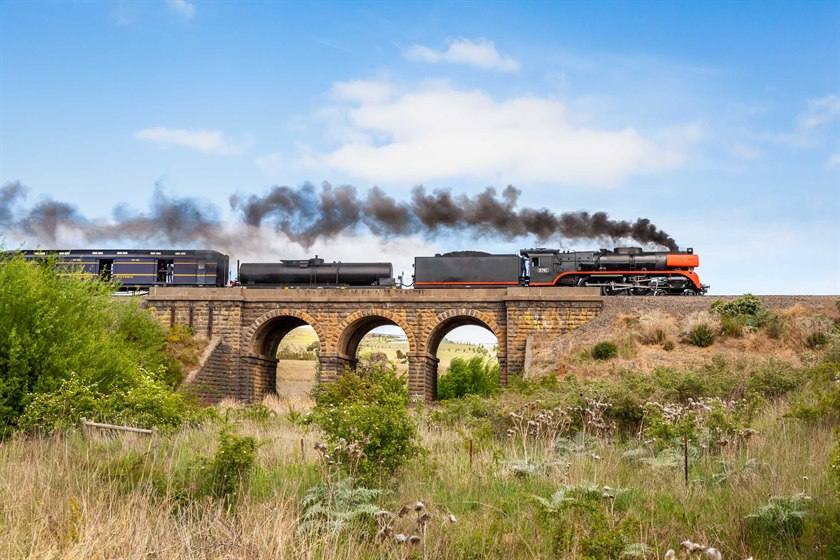
Sunbury is a town of about forty thousand people set among rolling hills and deep creek valleys, forty kilometres north-west of the centre of Melbourne. Though it is now within the metropolitan boundary and linked to the city by suburban train, it still feels like a country town, with a bluestone railway viaduct, a village green and paddocks on every side. It has an unusually rich history for its size. It is one of the oldest settlements in Victoria, the home of the oldest wine region in the state, the birthplace of the most famous trophy in cricket, and the site of the rock festivals that defined a generation.
Known For
- Rupertswood, the mansion where the Ashes were born
- Victoria’s oldest wine region, with historic cellar doors
- The Sunbury Pop Festivals of the 1970s and ancient Aboriginal earth rings
The town sits on Jacksons Creek, which has cut a steep-sided valley through the basalt plain. The old centre lies on the slope above the creek, around the railway station, and newer housing estates spread over the surrounding hills.
Sunbury makes an easy day trip from Melbourne, forty minutes by train, and it is also a natural stop on the way to Gisborne, Mount Macedon and the country beyond.
History and Heritage
Sunbury lies on the Country of the Wurundjeri Woi-wurrung people of the Kulin Nation, and it holds some of the most significant Aboriginal sites near Melbourne. On the hills above Jacksons Creek are several large rings of raised earth, each some twenty metres across, believed to have been made for ceremonies. Known as the Sunbury Rings, they are among very few such earthworks to survive in Victoria.
Among the First
In 1836, only a year after the founding of Melbourne, George Evans and the brothers William and Samuel Jackson drove their sheep up from the bay and took up land along the creek. Evans built a homestead called Emu Bottom, which still stands and is regarded as the oldest in Victoria. The settlement was named after Sunbury-on-Thames in England.
Railway and Wine
Sunbury grew as a stopping place on the road to the goldfields, and in 1859 the railway to Bendigo arrived, crossing the creek on a fine bluestone viaduct. In the 1860s vineyards were planted on the slopes around the town. Two of them, Goona Warra and Craiglee, built handsome bluestone wineries that won medals in Europe and gave the district a high reputation before the industry faded in the early twentieth century. Craiglee was revived in 1976 and Goona Warra in the early 1980s.
Rupertswood and the Ashes
In the 1870s Sir William Clarke, the largest landowner in the colony, built a fifty-room mansion with a tall tower on a hill above the creek and named it Rupertswood. It had its own railway platform, a private army unit and a cricket ground. At Christmas in 1882 the visiting English cricket team, which had come to Australia to avenge a famous defeat, was a guest of the Clarkes. After a friendly match on the lawn, Lady Clarke and her companions burned a bail, placed the ashes in a small urn and presented it to the English captain. That little urn became the symbol of cricket’s oldest rivalry.
The Asylum
A large complex of brick buildings on the hill east of the town began in the 1860s as an industrial school for neglected children and later became a mental asylum and then the Caloola Training Centre, which closed in 1992. Its Victorian wards, set in parkland, are heritage listed.
Sunbury Pop
Over the Australia Day long weekend in 1972, about thirty-five thousand people gathered on a farm beside the creek for a three-day rock festival. It was repeated in each of the following three years. Featuring almost entirely Australian bands, the Sunbury festivals are remembered as the moment when local rock music found its own loud, confident voice.
Attractions in Sunbury
A car is useful, as the sights are spread around the edges of the town.
Rupertswood
The mansion is now part of a school and is not generally open, but its Italianate facade and tower can be seen from the grounds, and it is used for weddings and functions. Open days and tours are held from time to time. A plaque records the story of the Ashes.
Wineries
The Sunbury wine region is small, with a dozen or so producers, and is best known for elegant, peppery shiraz. Craiglee welcomes visitors to its nineteenth century bluestone cellar on set days, while the old Goona Warra winery across Sunbury Road is now closed to visitors, and several newer wineries have restaurants with views across the vines. Opening days vary, so check ahead.
The Town Centre
The main streets around the station have a good number of Victorian buildings, including old hotels, the court house and bluestone churches. The village green hosts markets and events, and the town holds a popular street festival each autumn.
Jacksons Creek
Walking and cycling paths follow the creek through the town, passing under the railway viaduct and through a reserve called the Nook. Further out, the valley deepens into rugged country with basalt cliffs.
Organ Pipes National Park
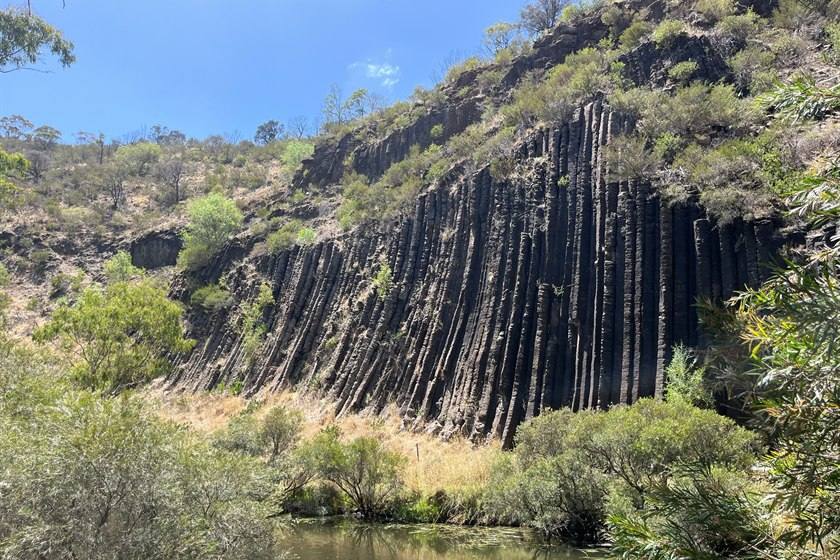
About fifteen minutes south, off the Calder Freeway, this small park protects a gorge where cooling lava formed tall hexagonal columns of basalt that look like the pipes of a giant organ. A short, steep track leads down to them.
Where To Stay
Sunbury has several motels, a few bed and breakfasts and some farm stays in the surrounding district.
These are convenient for visiting the wineries and for Melbourne Airport, which is only twenty minutes away.
The towns of the Macedon Ranges, a short drive north, have a wider choice of guesthouses and cottages.
For a winery weekend, Marnong Estate at Mickleham, about 20 km east by Somerton Road, has cabins and rooms in a restored 1840s homestead, with its own restaurants and cellar door on site. The airport hotels are close: the Novotel and ibis Styles beside Terminal 4, the Parkroyal and the Holiday Inn are about 20 minutes away, and the Quest, Mantra and Quality hotels in Tullamarine have easier parking. For caravans there is no park in Sunbury itself.
The nearest is the Airport Tourist Village at Attwood, about 20 km south-east, with powered sites, cabins and units; Discovery Parks Melbourne at Braybrook, about 30 km south, has powered sites, cabins and a dump point and allows dogs. The Calder Freeway makes Sunbury an easy stop for vans heading on to the Macedon Ranges. Bus route 479 links Sunbury station with the airport terminals, which helps for a night in town before a flight.
Eat & Drink
The winery restaurants are the highlight, offering long lunches of local produce matched with their own wines.
In town, the streets near the station have cafes, bakeries, pubs and a range of casual restaurants. One of the hotels has been trading since the 1850s.
Venues change, so check before making a special trip.
The Royal Hotel at 63 Evans Street, right by the station, runs a bistro at lunch and dinner every day with Graziers steaks, share plates and a kids’ menu, plus a sports bar. The Ball Court Hotel on Macedon Street, a pub with more than 150 years behind it, has a refurbished bistro, a quiet beer garden and pub classics such as its parma burger. Krash & Co at 46 Evans Street has been the town’s early coffee stop since 2016, opening at 6 am, with breakfast tacos and acai bowls. For wine, Craiglee on Sunbury Road pours its peppery shiraz in the 1863 bluestone winery on the first Sunday of most months.
Beyond town, Marnong Estate at Mickleham, about 20 km east, has La Vètta, a hatted Italian restaurant, the relaxed Cucina 3064, the all-day Vista cafe, a cellar door and a farm shop; Witchmount Estate on Leakes Road, Plumpton, about 20 km south-west, serves lunch and dinner among the vines and has a separate cellar door and wine bar; and Arundel Farm Estate at Keilor, about 20 km south-east, runs an Italian restaurant from Thursday to Sunday. Sunbury has several supermarkets and service stations around the town centre.
Getting to Sunbury
Suburban trains on the Sunbury line run from the city through the Metro Tunnel, via Town Hall and State Library stations, in about forty minutes, and regional trains to Bendigo also stop here.
By car, take the Tullamarine Freeway and the Calder Freeway, then the Sunbury exit, a drive of about thirty-five minutes from the city.
The town is fifteen minutes from Melbourne Airport and from Keilor.
Experiences
- City
- Food and Wine
- Historic/Heritage
- Rural/Country
- Self-Drive
Popular Activities
- Bush Walking
- Cycling
- Driving
- Food and Wine
- Sightseeing
- Wine Tasting
- Winery
