
Yeoval, NSW
Yeoval is a small farming town about 45 km north of Molong and 355 km from Sydney, at a crossroads between Dubbo, Wellington and Parkes. It is where the poet A. B. Paterson, known as Banjo, spent his early childhood, and the town honours him with a park full of sculptures. Unexpectedly, it is also home to a monumental bronze portrait of the British sculptor Henry Moore.
Known For
- Banjo Paterson’s childhood home
- The Henry Moore sculpture
- The Animals on Bikes trail
A few hundred people live in Yeoval, among sheep, cattle and wheat country beside Buckinbah Creek. The town was first known as Buckinbah, and its post office opened as Yeoval in 1884.
Things To Do
Banjo Paterson Bush Park
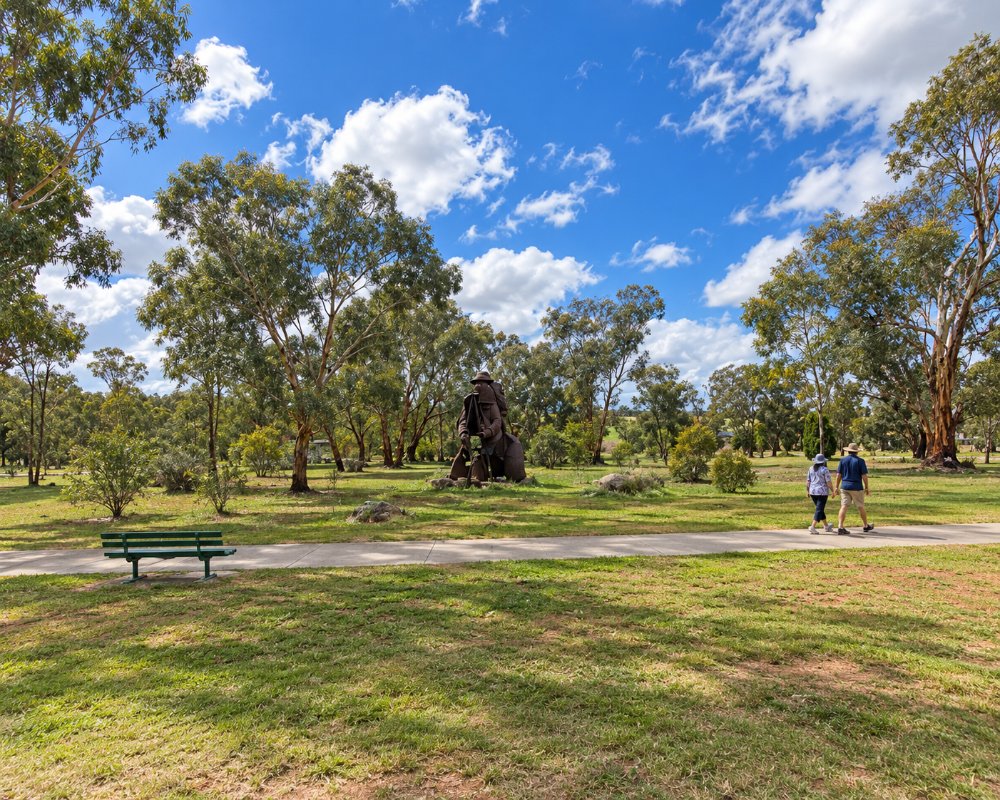
A park beside the creek has sculptures, plaques and an amphitheatre celebrating Paterson and his best-known verses, including Clancy of the Overflow and The Man from Snowy River. Paterson lived on Buckinbah station, just outside the town, from soon after his birth in 1864 until he was about five.
Henry Moore Sculpture
In the bush park stands a six-metre, six-tonne abstract portrait of Henry Moore by the sculptor Drago Marin Cherina, which is one of the more surprising artworks to be found in a small country town.
Banjo Paterson Museum
The Banjo Paterson More Than a Poet museum, on Forbes Street opposite the bush park, displays letters, unpublished poems, photographs and memorabilia, and its volunteer-run Clancy’s Cafe helps fund it.
Animals on Bikes
Yeoval is the midpoint of the paddock sculpture trail between Molong and Dubbo, with dozens of comic metal animals on bicycles and tractors beside the road.
Goobang National Park
South-west of town, this park protects the forested Hervey Range, with lookouts, walking tracks and bush campgrounds.
The Big Hat
A giant sculpture of Banjo Paterson’s hat stands in the bush park across from the museum, donated to the town in 2017 and a favourite photo stop.
Goodrich mine country
Gold, silver and copper were found about 7 km from Yeoval in 1868, and the Goodrich Mine worked on and off until 1971; its scars show in the hills.
History
Yeoval is in the country of the Wiradjuri people.
Buckinbah station was established in the 1830s. Copper and gold were mined in the district from the 1860s, and the village grew around a creek crossing. A branch railway opened in 1925, with the station at North Yeoval, and passenger trains ran until 1974.
Where To Stay
Yeoval has a hotel, and the showground at the end of Warne Street has a caravan stopover with powered sites and showers.
The showground stopover has ensuite showers, a covered area and a coin barbecue for about $24 a night. Goobang National Park, to the west, has an NPWS campground, and Molong and Wellington have caravan parks and motels.
Wellington, Molong and Dubbo have motels.
Eat & Drink
The hotel serves meals, and there is a cafe and a general store.
Clancy’s Cafe, inside the museum, serves coffee and light lunches. Fuel is limited, so fill up in Molong, Dubbo or Wellington.
Getting There
Yeoval is on the Renshaw McGirr Way, about 45 minutes from Wellington and an hour from Dubbo or Orange.
Experiences
- Cultural
- Historic/Heritage
- Rural/Country
Popular Activities
- Bush Walking
- Caravan and Camping
- Driving
- National Park
- Sightseeing
About Yeoval
- Locality: Urban locality
- Yeoval Postcode: 2868
- State: New South Wales
- Region: Country NSW
- Latitude: -32.75183
- Longitude: 148.64903
- Elevation: 386m
- Timezone: Australia/Sydney
