
Wallangarra, QLD
Wallangarra is a small town on the New England Highway right on the border between Queensland and New South Wales, 37 km south of Stanthorpe and almost 900 metres above sea level. It exists because of a railway quarrel. The two colonies built their lines to different gauges, and for more than forty years every passenger travelling between Sydney and Brisbane had to get off here and change trains.
Known For
- The break-of-gauge railway station on the state border
- Cold winters in Queensland’s Granite Belt
- Girraween National Park nearby
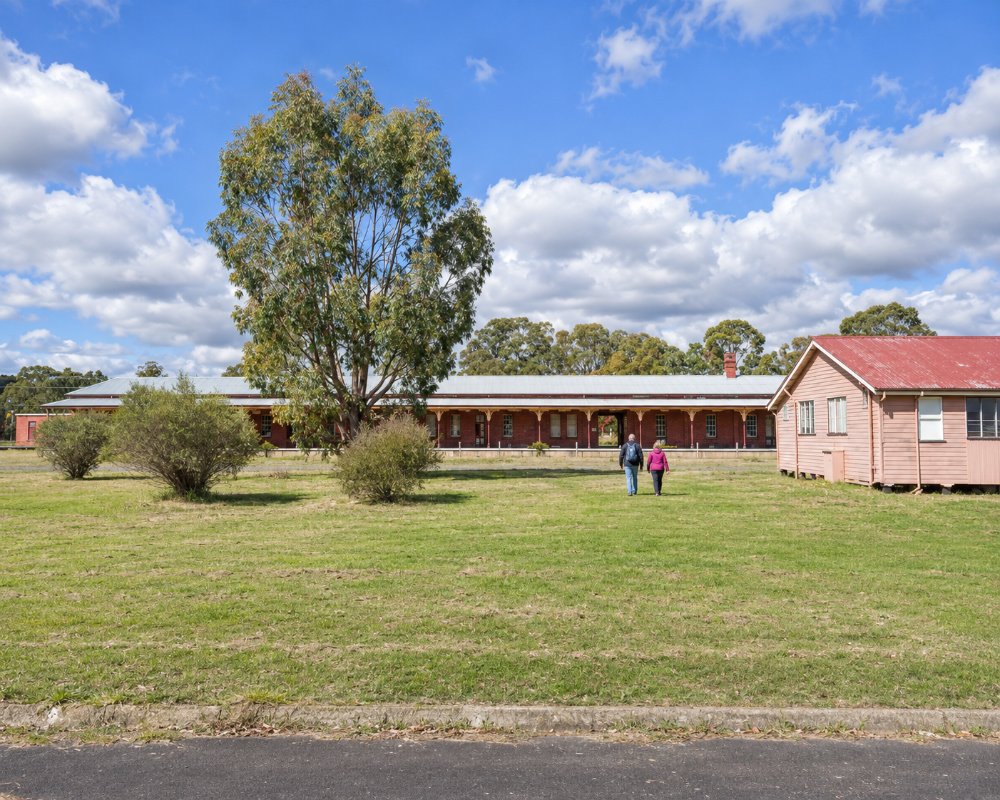
The town lies in high granite country at the southern end of the Granite Belt, with a climate more like the New England tablelands than the rest of Queensland. Winter nights regularly fall below freezing, and snow is seen every few years. Jennings, its twin settlement, sits a few hundred metres away on the New South Wales side of the line.
Things To Do
Wallangarra Railway Station and Museum
The handsome station of 1887 stands on a single island platform astride the border. Queensland’s narrow-gauge trains pulled in on the western side and New South Wales standard-gauge trains on the eastern side, and each side was built to its own colony’s design, so the platform awnings do not match: a curved bullnose roof on the Queensland side and a flat skillion on the other. The building has been closed to the public since 2023 while new tenants restore the old refreshment rooms as a cafe and restaurant, and heritage trains from Warwick now run only as far as Ballandean, where some trips continue by coach to Girraween.
Border Markers
Signs and markers around the station and on the highway show the exact line of the border, and it is an easy place to stand in two states at once. During daylight saving months the two sides of town are an hour apart.
Girraween National Park
Fifteen minutes north, Girraween is a landscape of huge granite domes, balancing boulders and clear creeks, famous for its spring wildflowers. Tracks from the main picnic area lead to the Granite Arch, the Pyramid, with its steep slab climb and precariously balanced rock, and longer walks to Castle Rock and Mount Norman.
Bald Rock and Boonoo Boonoo
Just across the border, Bald Rock National Park protects the largest exposed granite dome in Australia, with a walk to the summit, and neighbouring Boonoo Boonoo has a waterfall that drops more than 200 metres into a gorge.
Granite Belt Wine Country
The vineyards, orchards and cellar doors around Ballandean and Stanthorpe begin about 20 minutes to the north.
History
Wallangarra is in the country of the Kambuwal people and their neighbours. The name is believed to come from an Aboriginal phrase meaning long water or lagoon.
Queensland’s Southern line reached the border in 1887 and the New South Wales line arrived from Tenterfield in January 1888, completing the first rail link between Brisbane and Sydney. Mail, luggage and freight all had to be moved by hand from one train to the other, and a town of railway workers, customs officers and hotel keepers grew up around the station. Until Federation in 1901, customs duty was collected here on goods crossing the border.
The opening of a standard-gauge coastal line through Kyogle in 1930 took away most of the through traffic. During the Second World War the break of gauge made Wallangarra a major army supply and ammunition depot. Regular passenger trains ended in the 1970s and the New South Wales line closed in the late 1980s.
Where To Stay
Wallangarra’s Queensland-side hotel closed in 2013, and accommodation in town is limited.
Girraween has three national park camping areas, and there are many cabins, cottages and vineyard stays around Ballandean and Stanthorpe. Tenterfield, 19 km south in New South Wales, has a good range of motels and bed and breakfasts.
Girra Vista is an ecologically designed cabin in Wallangarra with a 180-degree view across Girraween National Park, a wood fire and an outdoor bathtub on the deck. Girraween’s three camping areas are about 20 km north by road, with Terrawambella best for big caravans and motorhomes, Kambuwal for small vans and camper trailers and Castle Rock for all set-ups; there are no powered sites, and bookings are essential. The Mount Norman day-use area, in the park’s southern section, is 8 km from Wallangarra along Mount Norman Road.
North along the highway, Girraween Environmental Lodge near Ballandean has spa chalets with wood heaters, the Ballandean Pub has a small motel, and Country Style Holiday Park at Glen Aplin, about 26 km north, is the nearest caravan park with powered and drive-through sites and cabins. Tenterfield, 19 km south, has a wider choice of motels and caravan parks. The nearest council dump point is at Apex Park Reserve in Stanthorpe, about 37 km north. Winter nights here often fall below freezing, so caravanners should carry warm bedding and plenty of gas.
Eat & Drink
The station cafe has been closed while the building is restored, so check whether it has reopened before you plan a meal there. The pub on the New South Wales side of the border and the highway roadhouse are the closest places for a meal and fuel, so check their hours. Stanthorpe and Tenterfield have restaurants, bakeries and supermarkets.
The old refreshment rooms at the station are being restored as a café and restaurant, so check whether they have reopened before relying on them. The nearest food stops are north along the highway at Wyberba, about 11 km away: Heavenly Chocolate on Pyramids Road for handmade chocolates and European-style hot chocolate, Balancing Heart Vineyard for wood-fired pizza and wine among granite boulders and a rowboat on the dam, and Pyramids Road Wines for a relaxed tasting with the winemaker.
Ballandean, about 17 km north, has the Ballandean Pub for meals, a beer garden and weekend music, Ballandean Estate Wines for platters by the fire in its Barrelroom, and a general store with fuel. Tenterfield, 19 km south, has bakeries, cafés, pubs and supermarkets, and Stanthorpe, 37 km north, has the widest choice in the region.
Getting There
Wallangarra is on the New England Highway, about 255 km south-west of Brisbane, a drive of roughly three hours via Warwick and Stanthorpe. From the south it is 19 km from Tenterfield.
Long-distance coaches between Brisbane and New England towns pass through. Roads can be icy on winter mornings.
Experiences
- Historic/Heritage
- Rural/Country
- Self-Drive
Popular Activities
- Bush Walking
- Caravan and Camping
- Food and Wine
- National Park
- Sightseeing
About Wallangarra
- Locality: Urban locality
- Wallangarra Postcode: 4383
- State: Queensland
- Region: Southern Queensland Country
- Latitude: -28.90403
- Longitude: 151.92578
- Elevation: 847m
- Timezone: Australia/Brisbane
