
Maroota, NSW
Maroota is a rural district on a high sandstone ridge about 65 kilometres north-west of central Sydney, on Old Northern Road between Glenorie and Wisemans Ferry. It is farming and bushland country, with orchards and flower farms on the ridge top and deep, forested valleys falling away to the Hawkesbury River on both sides.
Known For
- Ridge-top orchards and flower farms
- Valley views on the road to Wisemans Ferry
- Bushland and Aboriginal heritage
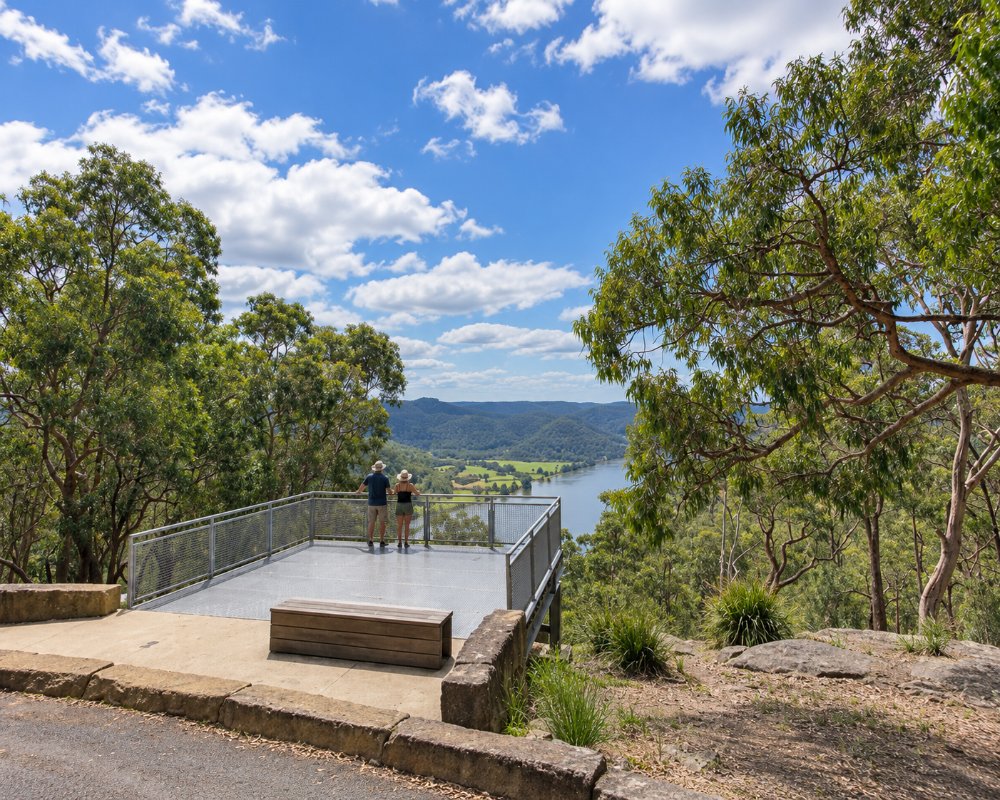
There is no village, just a school, a hall and farms spread along the main road. The ridge narrows as it runs north, and for a few kilometres the road has long views over wild country in both directions.
Things To Do in Maroota
Drive the Ridge
The stretch of Old Northern Road through Maroota is the most scenic part of the drive from Sydney to Wisemans Ferry. At the northern end, just before the road drops off the plateau, Hawkins Lookout gives a sweeping view of the Hawkesbury winding between its cliffs.
Farm Gates
Orchards on the deep sandy soil grow stone fruit and citrus, and there are cut-flower and native plant farms. Stalls at the gate sell produce in season.
Bushland
Much of the surrounding country is protected in reserves and in Marramarra National Park to the east, reached by fire trails that are popular with walkers. The district is rich in Aboriginal engraving and art sites, and Maroota Ridge State Conservation Area, reserved in 2006, protects engravings and rock shelters, though it has no public access or facilities.
Hawkins Lookout
Just off Old Northern Road, about 3 km before the descent to Wisemans Ferry, Hawkins Lookout has picnic tables and a small car park overlooking the village, the Webbs Creek ferry and the Hawkesbury winding between sandstone cliffs. It is named after Freddie Hawkins, who carried the mail from Windsor to Wisemans Ferry in the 1930s, and it sits beside the road, so there is no walk.
Sand and Springs
Maroota sits on the Maroota Sand, a deep river-sand deposit that geologists think may be an ancient course of the Hawkesbury-Nepean. Soldier-settlers who took up land here after the Napoleonic wars gave up on the barren-looking sand, not knowing that groundwater lay just below the surface, and the springs later supported orchards. As the Penrith quarries ran out, Maroota became one of Sydney’s main sources of building sand.
Where To Stay
A few farm stays, bush retreats and cabins take guests.
Wisemans Ferry, 15 minutes north, has a pub, a resort and caravan parks.
At Wisemans Ferry, about 10 km north, the Wisemans Inn Hotel has heritage rooms and a motel wing. NSW Ski Gardens, 1.2 km from the township on River Road, has powered and unpowered caravan sites, hot showers, a laundry, a kiosk and a boat ramp, and allows dogs on a leash. Del Rio Riverside Resort, across the Webbs Creek ferry, has powered and unpowered sites, cabins, villas, a pool and a cafe, and Mill Creek campground in Dharug National Park, across the main ferry, takes tents and camper trailers. Closer to Sydney, NPWS’s Cattai campground has unpowered caravan sites and showers but no dump point, and Ingenia Holidays Sydney Hills at Dural has caravan sites and cabins. Old Northern Road is sealed and suits caravans all the way, but the descent to the ferry is steep and winding, so use a low gear.
Eat & Drink
There is little on the ridge itself, so stop at the bakery in Glenorie on the way up or continue to the pub at Wisemans Ferry.
Glenorie, about 20 km south, has Glenorie Bakery (open every day from 6am to 5pm) and the Glenorie RSL Club’s bistro, along with fuel and basic supplies. North at Wisemans Ferry, the Wisemans Inn Hotel serves pub meals, and Del Rio Riverside’s cafe across the Webbs Creek ferry opens on Friday afternoons and weekends, and daily in the school holidays.
History
Maroota is Dharug country, and its name is said to mean a place of much water, a reference to the springs that rise in the sandstone. The road along the ridge was built by convicts in the 1820s as part of the Great North Road. In recent decades the deep sand deposits have been quarried to supply the building industry in Sydney.
The Hills Shire records the name from 1827 and gives its meaning as much water, from the springs in the sand. A post office opened as Weaver’s by 1927, was renamed Maroota in 1956 and closed in 1969, and sand mining grew from the late 20th century as the Castlereagh quarries near Penrith ran out.
Getting to Maroota
Drive via Dural and Glenorie along Old Northern Road, about an hour and ten minutes from the city centre. Public transport is limited to occasional and school buses.
Experiences
- City
- Nature based
- Rural/Country
- Self-Drive
Popular Activities
- Bush Walking
- Caravan and Camping
- Driving
- Sightseeing
About Maroota
- Locality: Rural locality
- Maroota Postcode: 2756
- State: New South Wales
- Region: Sydney
- Latitude: -33.46039
- Longitude: 150.99483
- Elevation: 220m
- Population: 617
- Median Income: $35776
- Area (Sq/km): 57.114
- Timezone: Australia/Sydney
