
Carnarvon Gorge, QLD
Carnarvon Gorge is the best-known section of Carnarvon National Park, in the sandstone ranges of central Queensland about 720 km north-west of Brisbane. Towering white cliffs enclose a permanent creek lined with fan palms, cycads and tree ferns, and the side canyons hide mossy grottoes and some of the finest Aboriginal rock art in Australia. Far from any town, it is one of the great walking destinations of the outback.
Known For
- The main gorge walk along Carnarvon Creek
- Aboriginal stencil art at the Art Gallery and Cathedral Cave
- The Moss Garden, Amphitheatre and Wards Canyon
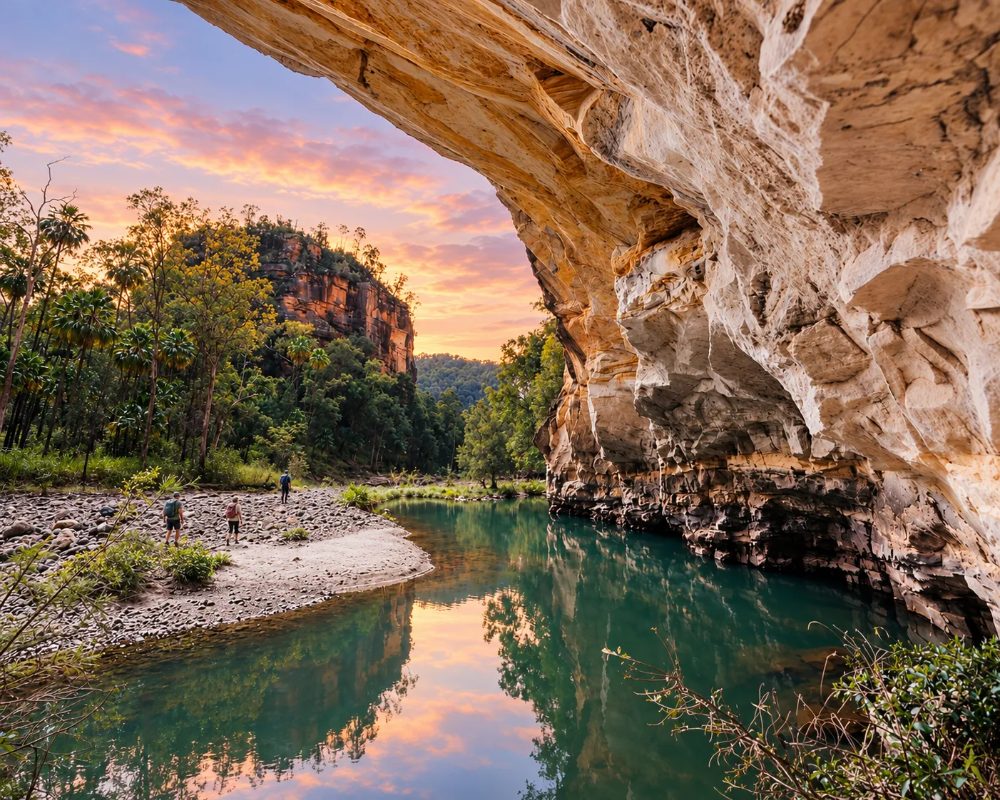
The gorge is an oasis. Above the cliffs lies dry eucalypt woodland, but down on the creek the air is cool and damp, and plants survive here that vanished from the surrounding country long ago. Platypus live in the creek, gliders and wallabies are common around the campgrounds, and more than 170 bird species have been recorded. The walking season is April to October, when days are mild and nights can drop below freezing.
Things To Do
Main Gorge Track
The main track follows Carnarvon Creek upstream from the visitor centre for 9.7 km to Big Bend, crossing the creek many times on stepping stones. It is mostly flat and well graded. Side tracks branch off to the main sights, so most walkers choose a turnaround point to suit their fitness. Walking to the Art Gallery and back, taking in the side trips on the return, is about 14 km and a full day.
Moss Garden
The first side trip, 3.5 km from the start, climbs to a small waterfall where water seeps constantly from the sandstone, feeding a wall of mosses, liverworts and ferns.
Amphitheatre
A steel ladder leads up through a narrow crack in the cliff to a 60-metre-deep chamber open to the sky (the Amphitheatre walk has been closed since April 2025 after severe weather damage, so check the park alerts before you go), carved out by running water. The acoustics and the silence make it a favourite.
Wards Canyon
This cool side gorge, closed since April 2025 after severe weather damage, shelters a colony of king ferns, giant ferns with fronds several metres long that are otherwise found on the coast hundreds of kilometres away.
Art Gallery
About 5.4 km up the gorge, a 62-metre sandstone wall carries more than 2,000 engravings, ochre stencils and freehand paintings: hands, boomerangs, axes, nets and many engravings. A boardwalk protects the site. It is a place of great significance to the Bidjara and Karingbal people, and visitors are asked not to touch the rock.
Cathedral Cave and Big Bend
Further on, Cathedral Cave is a huge overhang with another large panel of art. Just beyond, Boowinda Gorge is a narrow, sculpted side canyon, and Big Bend has a walkers’ camp beneath a sheer cliff.
Boolimba Bluff and Short Walks
The only track to the top of the cliffs climbs steeply to Boolimba Bluff, 6.4 km return, and is best done at sunrise. Short walks near the park entrance include the Nature Trail, a good place to look for platypus at dawn and dusk, the Rock Pool, where swimming is allowed, and Mickey Creek Gorge.
Guided walks and night tours
Walking with a local guide adds a lot to the gorge, from the geology and plants to the stories behind the rock art. Australian Nature Guides, the long-running guiding business at the gorge, runs a half-day Lower Gorge Explorer, a longer Off The Beaten Track walk, a spotlighting Night Safari for gliders and possums, and astronomy evenings. Tours run in the main season and fill early in the school holidays, so book ahead.
History
The gorge has been a place of ceremony and burial for Aboriginal people for many thousands of years, and it remains deeply important to the Bidjara, Karingbal and neighbouring peoples.
The explorer Thomas Mitchell named the Carnarvon Range in 1846. Pastoralists followed in the 1860s, and the rugged country became known as a hideout for cattle duffers. The gorge was first protected as a national park in 1932, and the park has since grown to almost 300,000 hectares across several sections.
Where To Stay
Accommodation is clustered along the access road just outside the park boundary.
The choices are a wilderness lodge with cabins and a restaurant, a holiday park with cabins, safari tents and powered sites, and a hilltop bush camping area for self-contained travellers. The national park’s own campground near the visitor centre opens only during the Queensland Easter, winter and spring school holidays, and must be booked. All fill quickly in winter, so reserve well ahead.
The holiday park is BIG4 Carnarvon Gorge Holiday Park, formerly Takarakka Bush Resort, on 100 acres beside Carnarvon Creek about five minutes’ drive from the start of the walks. It is the only place open all year, with cabins, canvas Taka Tents (some with ensuites), powered and unpowered sites and a camp kitchen; pets are not allowed. Sandstone Park, run by neighbouring Bandana Station, has about 60 large drive-through sites on a ridge with wide views. All are unpowered and there are no showers, but there are toilets, drinking water, a dump point and a fire pit at each site.
It is the only pet-friendly option, with kennels to hire while you walk in the park, and usually opens from about March to the spring school holidays. The Carnarvon Gorge Wilderness Lodge, about 3 km from the gorge, has 28 safari-style ensuite cabins, a saltwater pool and two barbecue kitchens; it closes over summer. The national park camping area has flush toilets and free gas barbecues but no showers or campfires, and Big Bend is a walk-in camp 9.7 km up the main track.
Eat & Drink
The lodge has a restaurant and bar, and the holiday park has a convenience shop and, from April to September, a café, restaurant and bar. There are no other shops and no fuel at the gorge. The nearest supplies are at Rolleston and Injune, each more than 100 km away, so bring what you need.
Food at the gorge is seasonal. From April to September the holiday park’s café serves breakfast, coffee and light lunches daily, and its restaurant and bar open for dinner Wednesday to Sunday; outside those months only the convenience shop trades, and the café and restaurant are closed until April 2027. Check whether the lodge restaurant is serving before you go. Free gas barbecues and picnic tables are provided at the day-use area near the visitor centre and at the Rock Pool. Rolleston, about 100 km north, has a service station with a small grocery, a pub and a coffee cart in Beazley Park from April to September; Injune, about 150 km south, is the last fuel stop from the south. Emerald and Roma have the nearest big supermarkets.
Getting There
The turn-off is on the Carnarvon Highway, about 60 km south of Rolleston and 110 km north of Injune. From there it is 45 km to the park, on a road that is now sealed apart from the last half-kilometre, with raised culverts at the two Carnarvon Creek crossings, though floodways can still close it after heavy rain.
From Brisbane, allow nine hours via Roma. From Rockhampton it is about five hours, and from Emerald about three. There is no public transport.
Experiences
- Active
- Cultural
- Nature based
- Remote
Popular Activities
- Bush Walking
- Caravan and Camping
- National Park
- Wilderness
- Wildlife
About Carnarvon Gorge
- Locality: National park
- Carnarvon Gorge Postcode: 4722
- State: Queensland
- Region: Capricorn
- Latitude: -25.06200
- Longitude: 148.23000
- Timezone: Australia/Brisbane
