
Bibbulmun Track, WA
The Bibbulmun Track is one of the world’s great long-distance walks, running about 1,000 km from Kalamunda in the Perth Hills to Albany on the south coast. Along the way it passes through jarrah and marri forest, tall karri and tingle country, granite outcrops, river valleys and finally a long stretch of wild coastline between Walpole and Albany.
Walking the whole track takes most people six to eight weeks, but far more walkers do it in day walks, overnight trips or a section at a time. It’s free to walk, there are no permits, and a shelter and campsite waits at the end of each day’s walk.
The track is named after the Bibbulmun people, a Noongar group of the south-west forests, and its route crosses the country of several Noongar groups on its way south. It’s marked all the way with yellow triangles bearing the Waugal, the Noongar rainbow serpent.
Known For
- About 1,000 km from Kalamunda to Albany
- 49 campsites with three-sided shelters
- Waugal trail markers
- Karri and tingle forest and the south coast
- Track towns along the way
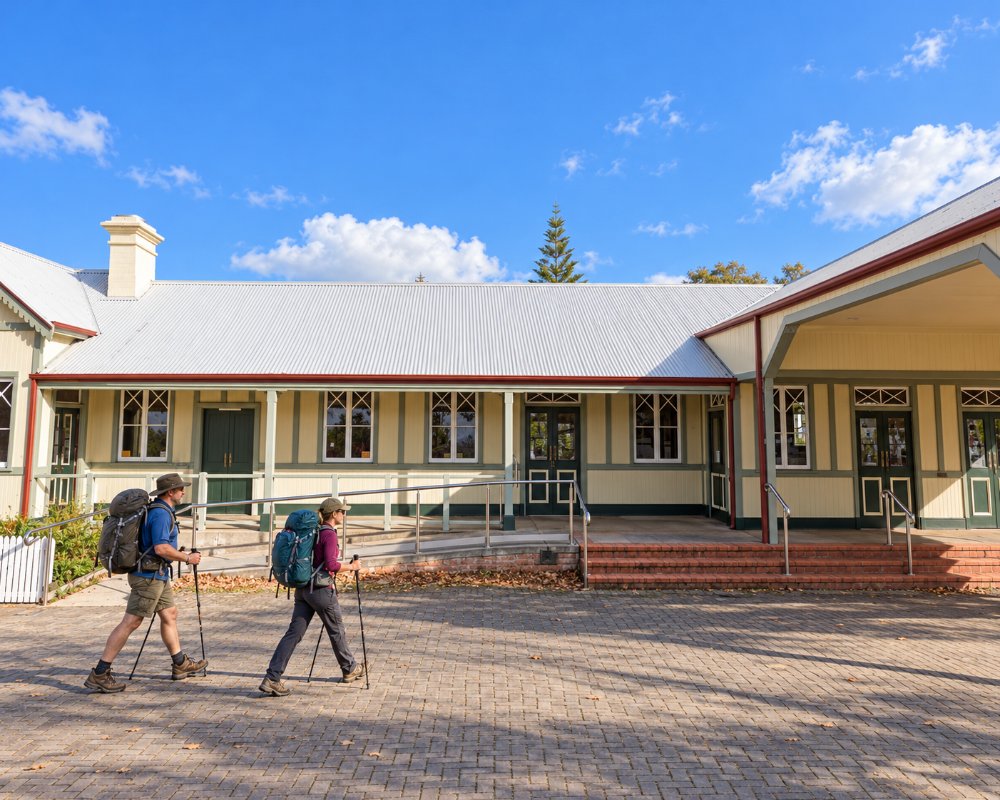
Walking the Track
Sections and Track Towns
The track is divided into nine sections, from the Darling Range near Perth to the final leg between Denmark and Albany. Track towns, where walkers can restock and sleep in a bed, include Kalamunda, Mundaring, Dwellingup, Collie, Balingup, Donnelly River Village, Pemberton, Northcliffe, Walpole, Peaceful Bay, Denmark and Albany. Many walkers send food parcels ahead to these towns.
Campsites
There are 49 campsites along the track, roughly a day’s walk apart. Each has a three-sided timber shelter, tent sites, a pit toilet and a rainwater tank. They can’t be booked and are shared on a first-come basis. Treat the water before drinking. Some campsites have year-round campfire bans, and fuel stoves can’t be used on total fire ban days.
Best Day and Short Walks
Good short walks include the forest sections around Dwellingup and Balingup, the karri country around Pemberton and Donnelly River, and the coastal stretches near Walpole, Peaceful Bay and Denmark. The Bibbulmun Track Foundation publishes guidebooks, maps and suggested walks for every section.
When to Walk
Spring, from September to November, is the most popular time, with wildflowers and mild weather. Autumn is also good. Most end-to-end walkers go between April and November, as summer is hot, dry and brings high fire danger. Campsites can be crowded in school holidays when school groups are out.
Before You Go
Prescribed burns and track works can close sections at short notice, usually with a signposted diversion. Restoration work was under way on the coastal section between Mandalay Beach and Long Point near Walpole in 2026. Check the Foundation’s track updates and DBCA’s park alerts before setting out, and let someone know your plans.
Where To Stay
The campsites are walk-in only, with no vehicle access. Walkers doing day sections, and caravanners who want to sample the track, can base themselves at caravan parks in the track towns, including Dwellingup, Collie, Balingup, Pemberton, Walpole, Denmark and Albany. Most track towns also have B&Bs, cabins, cottages or a pub with rooms, and several offer walker shuttles to and from trailheads.
Eat & Drink
There are no shops on the track between towns, so carry your food. Each track town has at least a general store or café, and the bigger towns of Collie, Pemberton, Denmark and Albany have supermarkets, bakeries and pubs. Walkers often time their arrival in town for a proper meal.
History
In 1972 bushwalker Geoff Schafer proposed a walking track from Perth to Albany. The name Bibbulmun was suggested in 1974, and the first track, from Kalamunda to Northcliffe, was officially opened in October 1979 for Western Australia’s 150th anniversary.
In the late 1980s the track was moved away from bauxite mining in the hills, extended to Walpole and marked with the Waugal. It was then completely rebuilt in the 1990s, with new campsites and shelters, and the new track was opened all the way to Albany on 13 September 1998. The Bibbulmun Track Foundation, formed in 1997, works with the parks service to look after it. Bushfires have destroyed several campsites over the years, including four between Northcliffe and Walpole in 2015, all since rebuilt.
Getting to the Bibbulmun Track
The northern terminus is in Kalamunda, about 25 km east of the Perth CBD, and is reachable by Transperth bus. The southern terminus is at the old railway station in Albany, about 420 km south-east of Perth by road. Transwa coaches link Perth with Albany and many of the southern track towns, and several shuttle services drop walkers at trailheads.
Experiences
- Eco Tourism
- Nature based
Popular Activities
- Bush Walking
- National Park
- Wildlife
About Bibbulmun Track
- Locality: Walking trail
- Bibbulmun Track Postcode: 6330
- State: Western Australia
- Region: Margaret River & the South West
- Latitude: -35.027
- Longitude: 117.884
- Timezone: Australia/Perth
