
Gulaga National Park, NSW
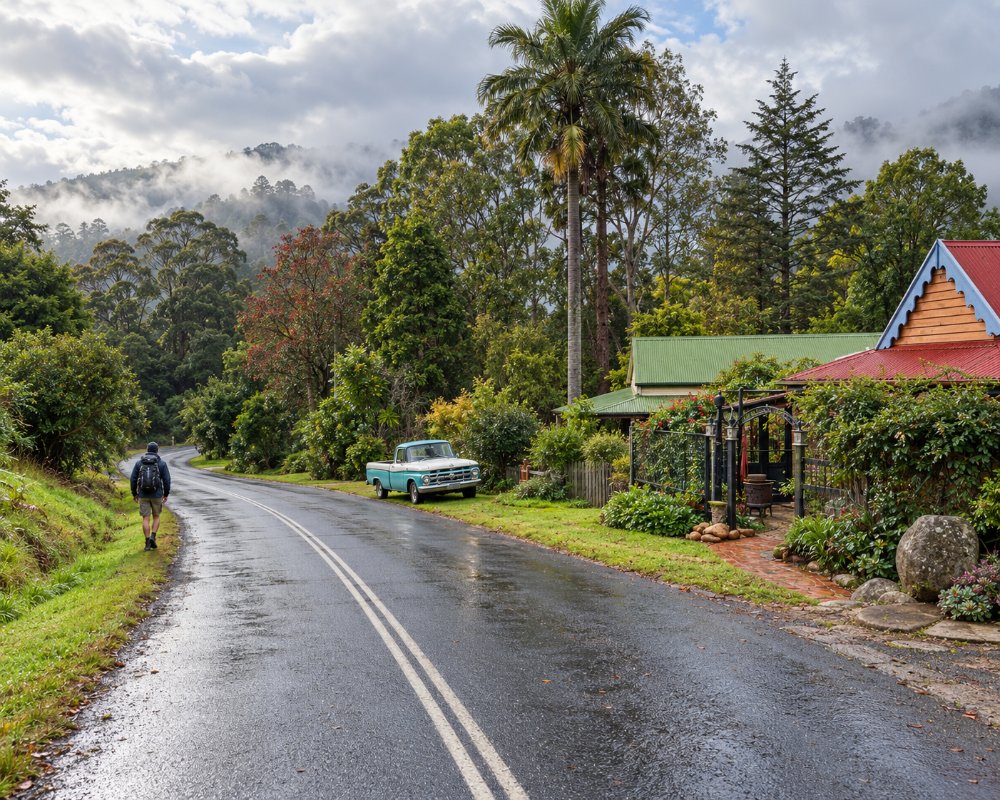
Gulaga National Park surrounds Gulaga, the 806-metre mountain that rises behind Central Tilba and Tilba Tilba on the far South Coast. Captain Cook called it Mount Dromedary. To the Yuin people it is the mother mountain, the place of their origin, and one of the most sacred sites on the coast. The park was handed back to its traditional owners in 2006 and is managed jointly with the National Parks and Wildlife Service.
Known For
- The sacred mother mountain of the Yuin people
- A long forest walk to the summit
- Rainforest and granite tors
Things To Do in Gulaga National Park
The Summit Walk
The track starts beside Pam’s Store, the old village store at Tilba Tilba, and follows a steep road built for gold miners in 1894. It climbs steadily for about seven kilometres through tall eucalypt forest that turns to cool rainforest near the top. Allow five hours for the return walk. The summit itself is forested and has no wide view; the reward is the forest and the feel of the place.
The Tors
Near the saddle below the summit stand groups of huge, rounded granite boulders. They are of great spiritual importance, and visitors are asked to stay on the marked track, not to climb on the rocks and to behave as they would in any sacred place.
Guided Walks
Yuin guides offer cultural tours of the mountain and nearby country, which is the best way to understand it.
Wallaga Lake
The park also takes in the forested shores of Wallaga Lake, north of Bermagui, good for kayaking and bird watching.
Gulaga creation experience
Ngaran Ngaran Culture Awareness, an NPWS-licensed operator led by Yuin guides, runs a two-day guided experience on the mountain, in which Traditional Custodians share the creation stories of Gulaga and the knowledge passed down in their families. It runs from October to May, and bookings are essential.
Halfway Rock and the Battery Trail
At Halfway Rock on the summit track, the Battery Trail branches off for 1.6 km to the foundations of the gold mine manager’s house and the remains of the old workings. About half an hour after rejoining the main track you reach the saddle and its tors. The full walk is about 14 km return and graded hard.
Where To Stay
There is no camping in the park.
The closest low-cost camping is the council-owned Mystery Bay Camping Area, about 10 km north-east of Central Tilba, with unpowered sites, a caretaker and first come, first served bookings. In Narooma, about 18 km north, BIG4 Narooma Easts Holiday Park, Discovery Parks Narooma Beach and Surfbeach Holiday Park take caravans and have cabins. On the Wallaga Lake side, BIG4 Wallaga Lake Holiday Park, across the road from Camel Rock beach, and Ingenia Holidays Bermagui, on the lake at 891 Wallaga Lake Road, have powered sites and cabins, and Foxglove and Co at Tilba Tilba has garden rooms.
The Tilba villages, Narooma and Bermagui have guesthouses, motels and holiday parks.
Eat & Drink
There is nothing to buy in the park, and the store at the start of the track is closed at last report, so carry plenty of water and food for the summit walk. Central Tilba, 2 km north of the trackhead, is the place to eat: the Dromedary Hotel is open seven days for lunch and dinner and is home to Tilba Brewing Co, Bate Street has cafes for breakfast, cream teas and lunch, and Tilba Real Dairy at the old ABC Cheese Factory sells cheese, yoghurt and honey. Fuel and supermarkets are in Narooma and Bermagui.
History
In Yuin tradition Gulaga is the mother, and Barunguba, Montague Island, and Najanuga, a small hill near the coast, are her sons. Gold was mined on the mountain from the 1870s to the early 1900s, and traces of the workings remain beside the track.
The park was created in January 2001, covers 4,673 hectares and takes in the former Wallaga Lake National Park. It was handed back to the Yuin people in May 2006 and is jointly managed with NPWS. The New Mount Dromedary Company mine closed in 1911.
Getting to Gulaga National Park
Leave the Princes Highway on the Tilba loop road, 15 kilometres south of Narooma, and park at the Tilba Tilba rugby field, where parking is free, a short walk from the start of the track.
Tilba Tilba is about 360 km from Sydney by the Princes Highway, and the Tilba loop road, Corkhill Drive, is sealed but narrow.
Experiences
- Active
- Cultural
- Eco Tourism
- Nature based
Popular Activities
- Bird Watching
- Bush Walking
- Caravan and Camping
- Kayaking
- National Park
- Rainforest
- Sightseeing
- Wildlife
About Gulaga National Park
- Locality: National Park
- Gulaga National Park Postcode: 2546
- State: New South Wales
- Region: South Coast
- Latitude: -36.3000
- Longitude: 150.0200
- Timezone: Australia/Sydney
