
Inskip Point, QLD
Inskip Point is a narrow finger of sand that reaches north from Rainbow Beach towards the southern tip of K’gari (Fraser Island), with the open ocean on one side and the calm water of Tin Can Inlet on the other. It is known for two things: the vehicle barges that shuttle across the channel to the island, and some of the most popular beach camping in Queensland, strung along the peninsula under casuarinas and cypress pines.
Known For
- The ten-minute barge crossing to K’gari
- Beach camping with ocean on one side and a calm inlet on the other
- Fishing, dolphins and sunsets over Tin Can Inlet
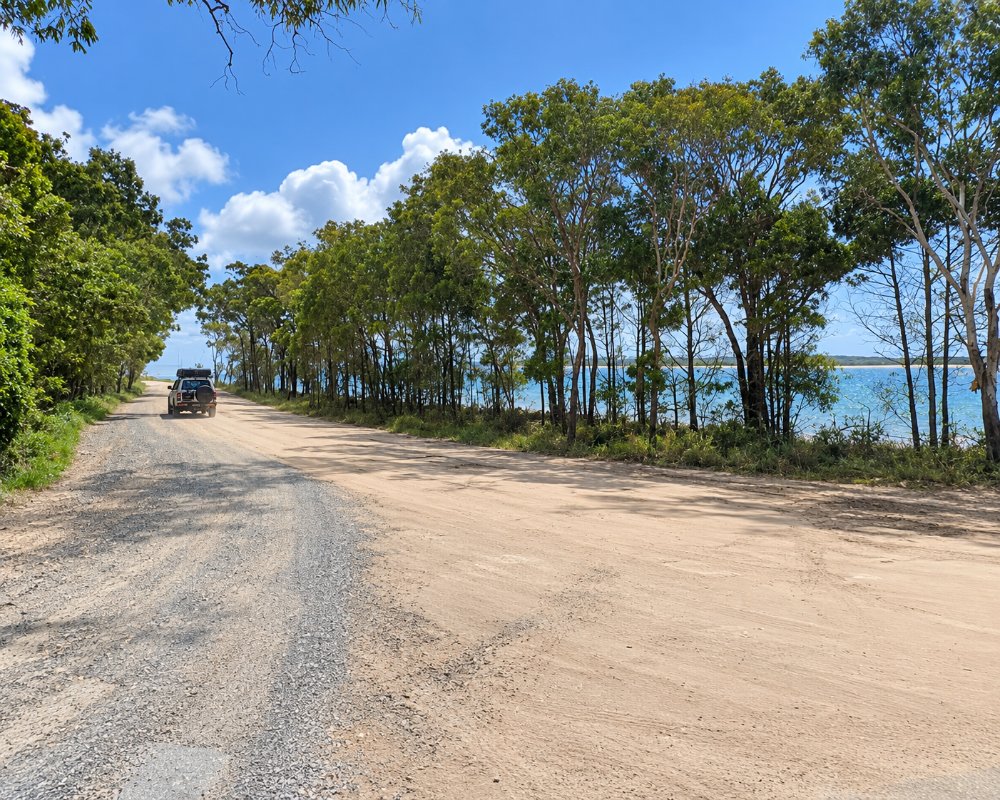
The peninsula is about ten kilometres long and only a few hundred metres wide. It is part of the Inskip Peninsula Recreation Area, managed by Queensland Parks. The eastern shore is surf beach; the western shore is sheltered, with shallow water where children can swim and dolphins often cruise past. At the very tip, the channel to K’gari is barely a kilometre across.
Things To Do at Inskip Point
Cross to K’gari
Vehicle barges run back and forth to Hook Point on the island throughout the day, taking about ten minutes. There is no jetty; the barge drops its ramp on the sand and vehicles drive straight on. A four-wheel drive is needed to reach the landing and to travel on the island, along with a vehicle permit. Check the barge operator’s advice on times before leaving, as crossings are affected by tides and sea conditions, and lower tyre pressures before driving onto the soft sand at the point.
Camp
Seven camping areas are spread along the peninsula: Sarawak West, Pelican Bay, M.V. Sarawak, S.S. Dorrigo, Dorrigo South, M.V. Beagle and M.V. Natone, most of them named after ships wrecked nearby. Sarawak West has limited 2WD access, but since the late-2025 realignment only Sarawak West and S.S. Dorrigo take caravans, and then only high-clearance vans towed by a high-clearance 4WD; the rest need a 4WD. Facilities are limited to non-flush toilets in most areas (Pelican Bay and Dorrigo South have none, so a portable toilet is compulsory there), so campers bring their own water and power. It is one of the few national park camping areas in the region where dogs are allowed on a leash. Sites must be booked ahead and fill at Easter, Christmas and long weekends.
Fish and swim
The surf side produces tailor, dart, whiting and bream, and the channel at the point is known for bigger fish on the turn of the tide. On the inlet side the water is calm and warm, good for paddling and for small boats, though the current near the point is strong.
Wildlife
Dolphins, turtles and dugongs use the channel, and pelicans and terns rest on the sandbanks. The peninsula’s dry scrub is one of the last homes of the black-breasted button-quail, a rare ground bird, so keep to marked tracks.
Stay safe on the sand
The peninsula is shaped by strong currents, and sections of shoreline occasionally slump into the sea; in 2015 a landslip at one camping area swallowed a caravan and a car. Erosion on the ocean side has since moved some camp boundaries inland. Camp behind the marked lines and follow ranger advice.
The barge landing in 2026
Erosion at the tip has merged the entry and exit tracks to the barge landing into a single narrow lane shared by traffic in both directions. It is tightest at high tide, so QPWS advises travelling only within two hours either side of low tide and allowing extra time. Fishing, swimming and parking near the barge ramp are prohibited. Mantaray Barges runs on demand to Hook Point every day from 6am. The last barge leaves Inskip at 4.45pm and the last return from K’gari is at 5pm, with earlier starts over Christmas. Walk-on passengers are carried, and fares can be paid in cash on board (no EFTPOS), though booking is preferred.
Camping changes after Cyclone Alfred
In 2025, ex-Tropical Cyclone Alfred, storm surges and ongoing erosion cut into the ocean side of the peninsula. QPWS has since moved the camping boundaries 20 metres back from the treeline. The beachfront sites at M.V. Sarawak (including the area known as Millionaire’s Row) and M.V. Beagle are gone, along with the old Natone entrance track. Hazardous-tree and maintenance works are closing individual areas in turn until March 2027. M.V. Sarawak is closed 23 Nov to 4 Dec 2026, S.S. Dorrigo and Dorrigo South 1 to 12 Feb 2027, and M.V. Beagle and M.V. Natone 1 to 12 Mar 2027.
Where To Stay
Camping is the only accommodation on the peninsula.
Rainbow Beach, 15 minutes south, has resorts, apartments, hostels and a caravan park, and Tin Can Bay is 45 minutes away by road.
QPWS describes Sarawak West, the last area from the peninsula entrance, as an open camp behind the foredunes with no marked sites. It has non-flush toilets, generators and campfires are allowed (conditions apply), and it is popular with larger groups. S.S. Dorrigo is the other area still suited to high-clearance caravans. Pelican Bay, off Bullock Point Road, is a small high-clearance 4WD camp with boat access and no toilets. M.V. Natone now suits only small tents and high-clearance 4WDs. Stays are limited to 29 nights, and pets other than leashed dogs are not allowed. The QPWS Rainbow Beach information centre is closed 5 to 24 November 2026.
Permits can also be bought at the Mantaray Barges office at 1/66 Rainbow Beach Road. In Rainbow Beach, about 13 km south, Rainbow Beach Holiday Village is in the town centre, with powered caravan and RV sites, unpowered tent sites, chalets and spa villas. A second holiday park sits at Carlo Point on Tin Can Inlet (FC5 to confirm its current name). Gympie Regional Council’s dump point for portable toilets and RVs is on Clarkson Drive, Rainbow Beach, beside a drinking-water station, on the left as you head out towards Inskip.
Eat & Drink
There are no shops or drinking water at Inskip. Stock up on food, water, ice and fuel in Rainbow Beach before driving out.
There is no food, shop or drinking water anywhere on the peninsula. The nearest cafes, pubs and supermarket are in Rainbow Beach, about 13 km south along Inskip Avenue (see the Rainbow Beach page). Fill water containers at the Clarkson Drive water station on the way out. Mantaray Barges has a toilet on board but sells no food. Across the channel, the nearest island store is at Eurong, about 30 minutes up the beach from Hook Point.
History
The peninsula is the country of the Kabi Kabi and Butchulla peoples, who crossed the narrow channel to K’gari by canoe. It was named after a naval officer in the nineteenth century. Pilots and lighthouse keepers were stationed here to guide ships across the dangerous Wide Bay Bar into the Great Sandy Strait, and several vessels came to grief on the surrounding shoals.
Getting to Inskip Point
From Rainbow Beach, follow Inskip Avenue north for about 13 kilometres on a sealed road that ends near the last camping areas; the final stretch to the barge landing is soft sand. Rainbow Beach is about 75 kilometres from Gympie.
Experiences
- Caravan and Camping
- Nature based
- Self-Drive
Popular Activities
- Beach
- Bird Watching
- Caravan and Camping
- Fishing
- Fishing - Beach
- Off Road Driving
- Swimming
About Inskip Point
- Locality: Rural locality
- Inskip Point Postcode: 4581
- State: Queensland
- Region: Fraser Coast
- Latitude: -25.82773
- Longitude: 153.06720
- Elevation: 11m
- Timezone: Australia/Brisbane
