
Great Sandy Strait, QLD
The Great Sandy Strait is the long, shallow passage of water that separates K’gari (Fraser Island) from the mainland. It runs for about 70 kilometres from Hervey Bay in the north to Tin Can Bay and the Wide Bay Bar in the south, a maze of channels, sandbanks, mangrove islands and seagrass meadows. Sheltered from the ocean and lightly settled, it is one of the most important wetlands in Australia and one of the most peaceful places to spend a few days on a boat.
Known For
- A sheltered waterway ideal for houseboats and kayaks
- Dugongs, turtles, dolphins and migratory shorebirds
- Quiet fishing villages and island anchorages
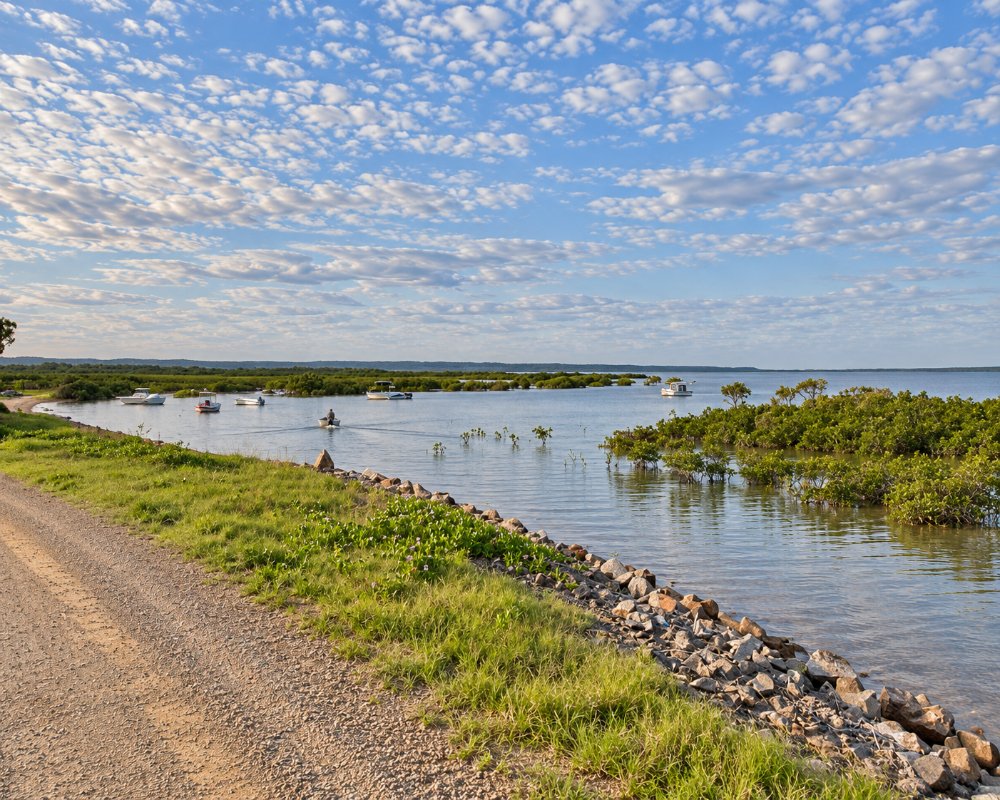
The strait was formed when sand carried north along the coast built K’gari and trapped a shallow sea behind it. The Mary River enters about halfway along, at River Heads. Tides flow in from both ends and meet in the middle, so the water is always moving, and at low tide vast sand and mud flats are exposed. The whole area lies within the Great Sandy Marine Park and has been listed under the Ramsar convention as a wetland of international importance since 1999.
Things To Do in the Great Sandy Strait
Hire a houseboat
Houseboats can be hired at Tin Can Bay and at Carlo Point near Rainbow Beach for trips of a few days to a week, while Hervey Bay’s marina offers bareboat yachts and catamarans instead, and no boat licence is required. Anchor in the lee of K’gari at spots such as Garrys Anchorage, swim off the back deck, fish for dinner and go ashore on empty beaches. The hire companies give a full briefing on the channels and tides.
Fishing and crabbing
The strait is a celebrated fishery for whiting, flathead, bream, mangrove jack, threadfin and, in the cooler months, tailor and mackerel, with mud crabs and sand crabs in the creeks. Boat ramps at River Heads, Boonooroo, Maaroom, Poona, Tinnanbar and Tin Can Bay give access. Marine park zones, including go-slow areas for dugongs and turtles and some closed green zones, must be observed.
Watch the wildlife
The seagrass beds support one of the largest dugong populations on the east coast, along with green and loggerhead turtles. Australian humpback dolphins and bottlenose dolphins are resident. Between September and April the tidal flats host tens of thousands of migratory shorebirds, among them the eastern curlew, which fly from as far away as Siberia and Alaska.
Paddle
Sea kayakers can explore the mangrove creeks and island shores, camping at national park sites on the western side of K’gari. Tides and wind need careful planning, and sandflies and mosquitoes can be fierce, so take repellent and long sleeves.
Cruises
Cruises from the marina at Urangan and from Kingfisher Bay explore the northern strait and its islands, looking for dolphins and dugongs, and some call at the old quarantine station and lighthouse sites on the islands.
Day cruises and boat hire from Urangan
Great Sandy Straits Marina, inside Urangan Boat Harbour, is the base for most strait cruises. Whalesong Cruises runs whale-watching, west-coast K’gari and sunset trips, and Blue Dolphin Marine Tours runs a half-day sailing trip to find wild dolphins. Watermark Sailing Charters, Tasman Venture and K’gari Escape Charters also leave from the marina. The Boat Shed hires new Polycraft boats straight from the marina, so there is no ramp or trailer to deal with.
Houseboating from Tin Can Bay
Tin Can Bay Houseboats leaves from its own dock in Tin Can Bay, with a minimum two-night hire. The fee includes a small tender, and you need only a driver’s licence. A skipper gives a full briefing and takes you out into the strait before handing over. The onboard navigation has pre-set routes and marked overnight anchorages up the strait, as far as a day anchorage off Kingfisher Bay Resort.
Where To Stay
On the water, a houseboat or your own vessel is the way to stay. On the western shore of K’gari there are boat-access camping areas and the resort at Kingfisher Bay.
On the mainland side, the small villages of Boonooroo, Maaroom, Poona and Tinnanbar have caravan parks and holiday houses, and Hervey Bay and Tin Can Bay have a full range of accommodation at either end.
On K’gari’s western shore, QPWS camping areas suit boat travellers. Garry’s Anchorage, on the south-west coast, has shady sites reached by boat, with picnic tables and no other facilities. Ungowa, nearby, takes 4WDs and off-road camper trailers and has toilets and cold-water washing-up. Wathumba, near the northern end of the west coast, is fenced and can be reached by boat at high tide. All QPWS sites must be booked in advance. Kingfisher Bay Resort, about 50 minutes by ferry from River Heads, has hotel rooms, villas and holiday houses.
On the mainland side, Poona Palms Holiday Park and Maaroom Caravan Park have powered sites and cabins near the boat ramps and take pets. At the southern end, Gympie Regional Council’s dump point on Clarkson Drive, Rainbow Beach, serves boaties and campers heading for Carlo Point and Inskip.
Eat & Drink
There are no shops on the water. Provision in Hervey Bay or Tin Can Bay, carry plenty of drinking water and plan to cook on board. The villages have only basic stores.
There is nothing to buy on the water. The best waterside meals are at either end. At the Urangan marina, Cafe Balaena focuses on fresh local seafood, and takeaway is sold in the marina’s tourist terminal. On K’gari, Kingfisher Bay Resort (a day anchorage for houseboats) has the Sand Bar and Bistro, the Sunset Bar, the Dune Restaurant, the Sand and Wood Restaurant, the Maheno Bar and a village store. At Tin Can Bay, the dolphin-feeding centre at Norman Point has a cafe serving breakfast and brunch. The mainland villages have only small stores, so provision in Hervey Bay or Tin Can Bay.
History
The strait is the heart of Butchulla sea country, and middens, fish traps and scarred trees line its shores. From the 1840s it was the shipping route to Maryborough, then one of Queensland’s busiest ports, and immigrant ships, timber vessels and coastal steamers threaded its channels with the help of pilots and a chain of lights. The Wide Bay Bar at its southern end remains one of the more hazardous bar crossings on the coast.
Getting to the Great Sandy Strait
The northern strait is reached from Urangan and River Heads at Hervey Bay, the middle from the villages south-east of Maryborough, and the southern end from Tin Can Bay and Inskip Point near Rainbow Beach. Barges to K’gari cross the strait at River Heads and Inskip Point.
Experiences
- Eco Tourism
- Nature based
- Relaxation
Popular Activities
- Bird Watching
- Cruising
- Fishing
- Fishing - Estuary
- Kayaking
- Sailing
- Wildlife
About Great Sandy Strait
- Locality: Rural locality
- Great Sandy Strait Postcode: 4655
- State: Queensland
- Region: Fraser Coast
- Latitude: -25.50848
- Longitude: 152.91471
- Elevation: 9m
- Timezone: Australia/Brisbane
