
Adelaide Central Market and Chinatown, SA
If one place sums up how Adelaide likes to live, it is the Central Market. Since 1869 growers, butchers, bakers and cheesemakers have sold under this roof one block west of Victoria Square, and locals still do their weekly shopping here alongside the tourists. Chinatown opens off one side and Gouger Street, the city’s longest-running restaurant strip, runs along another, so the whole precinct is devoted to eating.
Known For
- One of the largest undercover fresh produce markets in the southern hemisphere
- Chinatown’s Moonta Street and its food courts
- Gouger Street, a kilometre of restaurants
The market fills most of the block between Gouger and Grote streets. More than 70 traders work from permanent stalls, many run by the same families for three or four generations. The mix reflects the waves of migrants who settled in South Australia: Italian and Greek delicatessens, German smallgoods, Asian grocers, and newer stalls selling native ingredients.
A major expansion on the site of the old arcade next door is now due to open before Easter 2027, adding about 50 traders and, for the first time, Sunday trading. Until then the market keeps its traditional hours: Tuesday to Saturday, closed Sunday and Monday, and open until 9 pm on Fridays. Check the market’s website for the current days.
Things To Do in Adelaide Central Market and Chinatown
Graze Through the Market
Arrive hungry. Long-standing favourites include Lucia’s, which opened in 1957 and claims the state’s first pizza bar; Smelly Cheese Co. and Say Cheese for local and imported cheeses; Charlesworth Nuts; Con’s Fine Foods; The Mushroom Man; and Something Wild, which sells kangaroo, native herbs and green ant gin. Les Deux Coqs does French pastries, and Zuma Caffe and the Big Table are popular for breakfast.
Take a Market Tour
Guided tasting tours run most trading mornings and are a good way to meet the stallholders and hear the history. They usually last about two hours and need booking ahead. Cooking classes and seasonal events are held in the market kitchen.
Chinatown and Moonta Street
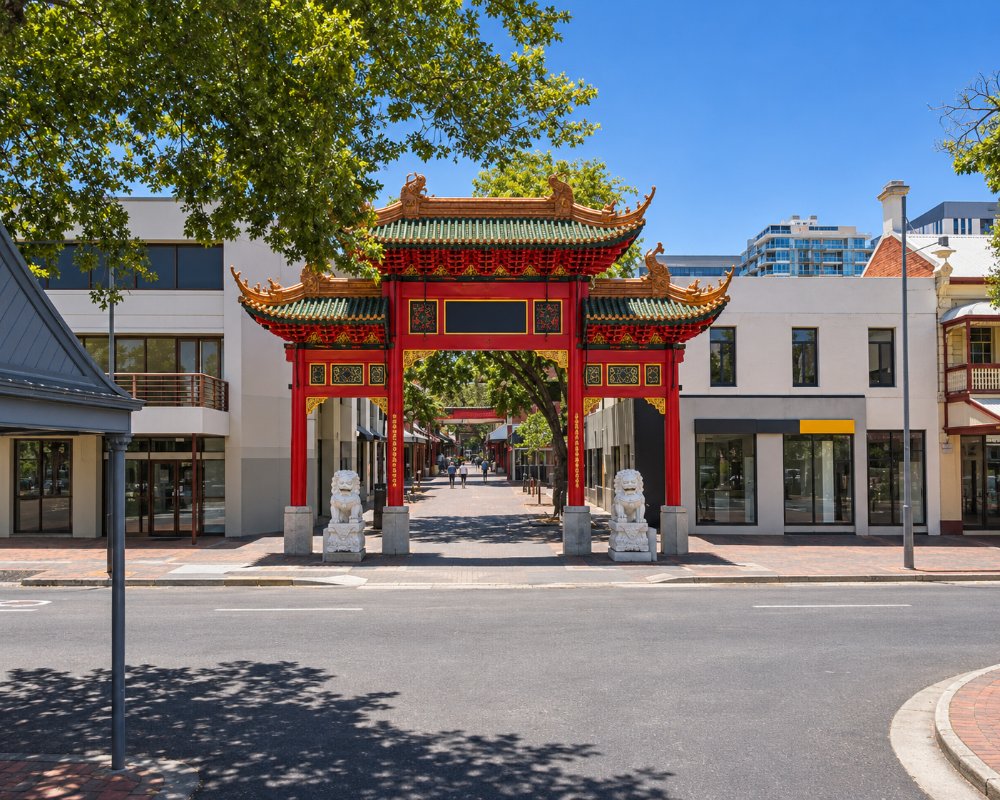
Two tall paifang gates guarded by stone lions mark the ends of Moonta Street, a short pedestrian mall of Chinese, Vietnamese, Malaysian and Korean restaurants, bubble tea shops and grocers. The food courts on either side are busy from late morning with cheap laksa, dumplings and roast duck. Lunar New Year brings lion dances and a street party.
Gouger Street
Running west from Victoria Square, Gouger Street has been the city’s place to eat out since the 1970s. Seafood, Argentinian grills, Thai, Sichuan, Japanese and Italian kitchens sit side by side with tables on the footpath. It is busiest on Friday and Saturday nights.
Her Majesty’s Theatre
On Grote Street, across from the market, this theatre of 1913 was rebuilt behind its original facade and reopened in 2020. It hosts touring musicals, comedy and festival shows.
Victoria Square and the Courts
The grand law courts at the square’s southern end, the fountain and the Glenelg tram stop are two minutes from the market. On summer evenings and during festivals the square often hosts free events.
Where To Stay
The Hilton Adelaide stands on Victoria Square, directly beside the market and Gouger Street. Hotel Indigo Adelaide Markets, on Market Street, is a newer design hotel with a rooftop bar and pool, and the Adelaide Marriott in the old General Post Office is across the square.
Cheaper rooms are found in the streets to the south, where there are several backpacker hostels, small hotels and serviced apartments around Gilles, Carrington and Wright streets. A large hotel is planned as part of the market expansion. This part of town is well placed for the tram, the market car park and the interstate bus station on Franklin Street.
Peppers Waymouth, about five minutes’ walk north of the market on Waymouth Street, is being rebranded as Mövenpick Adelaide from December 2026. For a tighter budget, the Adelaide Central YHA at 135 Waymouth Street is a central hostel about ten minutes’ walk away, and the ibis Adelaide on Grenfell Street is a reliable mid-priced choice within 15 minutes on foot. Hotel Grand Chancellor Adelaide has recently refurbished its rooms. Staying in this south-west corner of the grid puts you close to the market’s early opening, the Gouger Street restaurants and the tram along King William Street, while the Peel Street and Leigh Street bars are only a few blocks north.
Rooms fill quickly during the Fringe, WOMADelaide and the Supercars weekend in late November, so book early. The multi-storey car parks in the centre do not suit caravans or large motorhomes: stay at the Levi Adelaide Caravan Park at Vale Park, about 5 km north-east, or West Beach Parks, about 10 km west by the sea, and come in by bus or tram.
Eat & Drink
Inside the market, eat at the counters: a bowl of pasta at Lucia’s, a bratwurst, oysters, a Malaysian laksa or a plate of cheese and bread put together from different stalls. On Gouger Street, Ying Chow has served northern Chinese dishes to late-night crowds for decades, Concubine does modern Chinese, Gaucho’s is the place for steak, Star of Siam for Thai, and Paul’s on Gouger for fish and chips. T-Chow on Moonta Street is a yum cha institution.
For a drink, small wine bars and pubs line the side streets, the rooftop at Hotel Indigo looks over the market roof, and the laneway bars of Peel and Leigh streets are ten minutes’ walk north.
The precinct is in the middle of its biggest change in decades. The market’s expansion into the new Market Square building next door is opening in stages from early December 2026 and should be fully open by Easter 2027, doubling the size of the market and bringing Sunday trading. Gouger Street is also in line for a $15 million upgrade, with staged works and site fencing from late 2026, so allow a little extra time to find your way. The old market hall keeps trading as usual throughout.
Eating inside the market
Lucia’s still serves pasta and pizza at its counter and sells the family’s own sauces and pestos, made since 1957. Les Deux Coqs, under new owners since 2025, has glossy fruit tarts on one side of the counter and terrines and pâté en croûte on the other; the duck mousse and the canelés are the favourites. Market Bread Bar has added pastries and Greek sweets such as baklava rolls to its sourdough and gluten-free loaves, and Jamu, the bright pink stall, makes smoothies, bowls and cold-pressed juices for a lighter lunch.
Produce to take home
Smelly Cheese Co. stocks a huge range of local and imported cheeses and is happy to offer tastings before you buy. Charlesworth Nuts sells nuts, dried fruit and chocolates by weight. The Olive Tree, at stall 61, sells only South Australian wine, refills your own bottles with Clare Valley olive oil and tawny, and often has free tastings with visiting winemakers on Friday nights. House of Health Collective runs four certified organic stalls where you can bring your own containers for oats, rice, nuts, oils and nut butters.
Gouger Street and Chinatown
Concubine, at 132 Gouger Street, serves modern Chinese dishes at dinner from Tuesday to Sunday. Gaucho’s serves Argentinian-style steaks and is often named among the best steak restaurants in Australia; book for weekends. Star of Siam, at 67 Gouger Street, is a long-established Thai restaurant. On Moonta Street, T-Chow serves Chinese dishes it says are rarely seen elsewhere in Australia, and the food courts either side of the mall are the place for a quick, cheap bowl of laksa or noodles.
Drinks nearby
The market itself is mostly a daytime place, but good bars are a short walk away. Lady Burra Brewhouse, in Topham Mall about five minutes north, brews its own beer on site. Prohibition Liquor Co. pours its gins in a tasting room on Gilbert Street, a few blocks south-east, on Friday and Saturday evenings. Leigh Street Wine Room and the small bars of Peel Street are about ten minutes’ walk north, and the Grace Emily on Waymouth Street has live music most nights.
History
The first market was held on this site on 23 January 1869, when a group of market gardeners set up their carts between Gouger and Grote streets and sold out by six in the morning. The city council built permanent sheds soon after, and the red-brick facade on Grote Street dates from 1900.
Chinese traders have been part of the market since the nineteenth century, and after the 1970s migrants from Vietnam, Malaysia and Hong Kong opened restaurants and grocers in the streets beside it. Moonta Street was closed to traffic and the gates were put up in the 1980s.
Getting to Adelaide Central Market and Chinatown
The market is a five minute walk west of the Victoria Square tram stop, and trams are free within the city. Many city buses stop on Grote Street, and the free City Connector passes the door. A multi-storey car park sits above the market, with a cheap first hour on trading days. From Rundle Mall it is a 15 minute walk.
Experiences
- City
- Cultural
- Food and Wine
Popular Activities
- City Sightseeing
- Food and Wine
- Shopping
About Adelaide Central Market and Chinatown
- Locality: Suburb
- Adelaide Central Market and Chinatown Postcode: 5000
- State: South Australia
- Region: Adelaide
- Latitude: -34.92960
- Longitude: 138.59770
- Timezone: Australia/Adelaide
