
Shark Bay, WA
Shark Bay is a vast, shallow embayment on the coast of Western Australia, about 830 km north of Perth, where two long peninsulas and a chain of islands enclose more than two million hectares of turquoise water, red dunes and white beaches. It was the first place in Western Australia to be added to the World Heritage List, in 1991, and is one of very few places on Earth to satisfy all four of the natural criteria for listing.
Known For
- The stromatolites of Hamelin Pool
- Wild dolphins at Monkey Mia
- Dugongs, seagrass meadows and Shell Beach
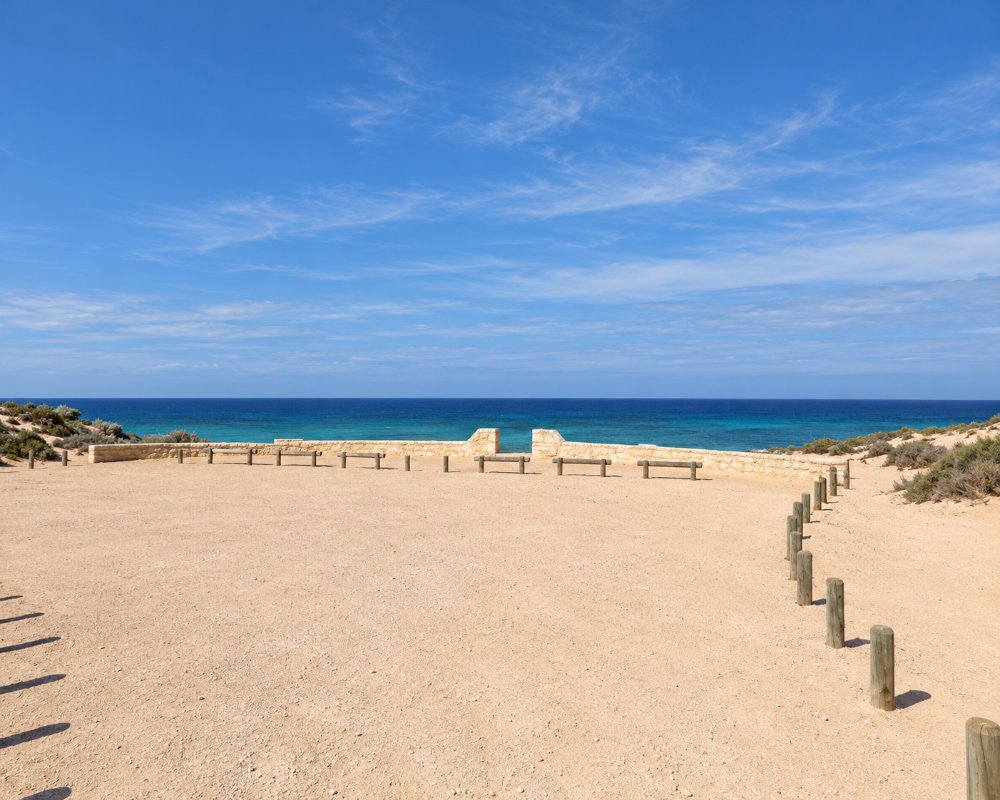
The bay is Gutharraguda, meaning two waters, to the Malgana people, the traditional owners. It marks the meeting point of tropical and temperate climates, which gives it an unusual mix of plants and animals. Its seagrass beds are the largest in the world and feed around 10,000 dugongs, roughly one in eight of the world population. The only town is Denham, on the Peron Peninsula.
Things To Do
Hamelin Pool Stromatolites
At the southern end of the bay, extremely salty water has allowed colonies of microbes to build stromatolites, rocky mounds that grow less than a millimetre a year. They are living examples of the earliest life on Earth, which first appeared some 3.5 billion years ago. The viewing boardwalk was destroyed by Cyclone Seroja in 2021, and a new one has been under construction since July 2026, due around mid-2027.
Shell Beach
On the road to Denham, this beach is made up entirely of tiny white cockle shells, piled up to ten metres deep and stretching for many kilometres. The water is very salty, clear and shallow. Compacted shell was once quarried in blocks for building, and several old buildings in Denham are made of it.
Eagle Bluff
A clifftop boardwalk south of Denham looks straight down into clear shallows where sharks, rays, turtles and sometimes dugongs can be seen swimming over the seagrass.
Monkey Mia
At Monkey Mia, 25 km from Denham, wild bottlenose dolphins have been coming to the beach to interact with people since the 1960s. Rangers supervise a carefully controlled feeding most mornings, when only a couple of adult females, currently Piccolo and Kiya, are offered fish. Wildlife cruises from the jetty look for dugongs, turtles and dolphins further out.
Francois Peron National Park
The northern end of the Peron Peninsula is a wilderness of deep red sand cliffs, white beaches and blue water, reached by soft sand tracks that need a high-clearance four-wheel drive. Cape Peron and Skipjack Point have lookouts over waters busy with manta rays, sharks and dugongs. The old Peron Homestead, accessible by ordinary car, has an artesian hot tub.
Steep Point and Dirk Hartog Island
Steep Point, the westernmost point of the Australian mainland, lies at the end of a long four-wheel-drive track on the bay’s western arm, beside the towering Zuytdorp Cliffs. Offshore is Dirk Hartog Island, the site of the first recorded European landing in Western Australia in 1616, now a national park.
History
Malgana, Nhanda and Yingkarta people have lived around the bay for at least 30,000 years, and shell middens and fish traps line its shores.
The Dutch captain Dirk Hartog landed in 1616. The English navigator William Dampier gave the bay its name in 1699, after the many sharks he saw, and made the first scientific collection of Australian plants here. French expeditions under Baudin and Freycinet followed in the early 1800s, leaving many French place names.
Pearling began in the 1850s and Denham grew up as a pearling camp, followed by sheep stations, sandalwood cutting and fishing. Since World Heritage listing, several former stations have become national parks, and a major conservation program has been removing feral animals and returning native mammals to the area.
When To Visit
May to September brings mild days and calm mornings, the best conditions for walking the lookouts and driving the sand tracks of Francois Peron National Park. Wildflowers line Shark Bay Road from late winter into spring, and humpback whales pass offshore from about June to October. Summer is hot and the afternoon southerly can blow hard, though the water is at its warmest. Book well ahead for the winter school holidays, when Denham and Monkey Mia fill up.
Where To Stay
Denham has motels, holiday apartments, caravan parks and a hotel, and Monkey Mia has a beachfront resort with rooms, villas and campsites.
There is also a caravan park with rooms at Hamelin Pool, and a caravan park at Nanga, now run as Nanga Shark Bay Caravan Park, and bush campsites in Francois Peron National Park and along the coast south of Denham, which need to be booked. Everything fills up in the winter school holidays.
Eat & Drink
Denham has the bay’s pubs and restaurants: the Shark Bay Hotel and the Heritage Resort serve local whiting and seafood by the water, The Old Pearler is a small BYO seafood restaurant in a shell-block building, and there’s a bakery, cafés, takeaway pizza and a fish factory selling the local catch. Monkey Mia’s resort has the Boughshed restaurant and the Monkey Bar beer garden, and the café at the Hamelin Pool Telegraph Station and the Overlander Roadhouse serve meals on the way in. Away from these places there is very little, so carry water and food on day trips.
Getting There
Turn off the North West Coastal Highway at the Overlander Roadhouse, about 280 km north of Geraldton. From there the sealed Shark Bay Road runs 130 km to Denham, passing Hamelin Pool and Shell Beach. The drive from Perth takes about nine hours.
Flights connect Perth with Shark Bay Airport, between Denham and Monkey Mia. The most comfortable months are April to October. Summer is hot and windy.
Experiences
- Eco Tourism
- Nature based
- Remote
- Self-Drive
Popular Activities
- Beach
- Fishing
- National Park
- Off Road Driving
- Snorkelling
- Wildlife
- World Heritage
About Shark Bay
- Locality: Rural locality
- Shark Bay Postcode: 6537
- State: Western Australia
- Region: Exmouth & the Coral Coast
- Latitude: -25.930
- Longitude: 113.530
- Timezone: Australia/Perth
