
Rockhampton Botanic Gardens and Zoo, QLD
The Rockhampton Botanic Gardens lie beside Murray Lagoon on the southern side of Rockhampton, about four kilometres from the city centre. They were established in 1869 and are among the oldest and best-preserved public gardens in Queensland. A free zoo sits inside them.
Known For
- Heritage gardens with trees 150 years old
- A free zoo with a family of chimpanzees
- A shady lunch under the fig trees
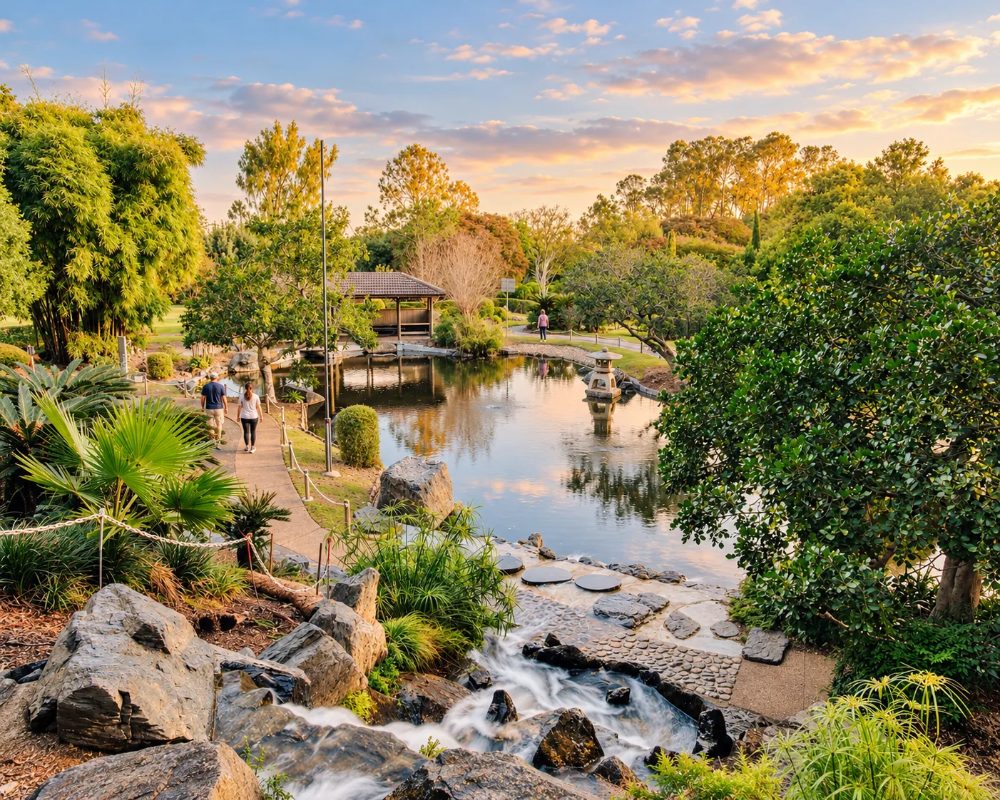
The gardens cover about 33 hectares and are on the state heritage register. They are open from early morning until evening every day, and entry and parking are free.
Things To Do in Rockhampton Botanic Gardens and Zoo
Walk the gardens
Avenues of bunya pines, kauris and palms planted in the 1800s lead through lawns and garden beds to the lagoon. Enormous banyan figs spread over the central area. There is a fernery, a collection of tropical fruit trees and plenty of labelled specimens for plant lovers.
Japanese garden
A formal Japanese garden with a pond, bridges and clipped shrubs marks Rockhampton’s sister-city relationship with Ibusuki in Japan.
Rockhampton Zoo
The zoo is small, well kept and free, open every day from 9 am to late afternoon. Its chimpanzees are the stars, a group that has bred successfully here. There are also koalas, wombats, meerkats, otters, freshwater and saltwater crocodiles, and a large walk-through aviary. Keeper talks are held through the day.
Murray Lagoon
The lagoon beside the gardens is busy with waterbirds, including magpie geese, pelicans and ibis.
War memorial
The city’s cenotaph stands in the gardens, the focus of the Anzac Day service.
The new zoo entrance
A new Visitor Hub opened in July 2025, the year the zoo marked its centenary. It gives the zoo a proper front door, with sculptures of an eagle, kangaroos and koalas, reptiles in glass enclosures along the wall, and new toilets, and it sets up a new walking route through the zoo. A new eagle enclosure and a refurbished Australian animals exhibit, now home to a short-beaked echidna, have followed, and the perentie enclosure reopened in 2026. Keepers give talks and feeds daily, and Junior Zookeeper sessions for 8 to 15 year olds run in the school holidays.
Where To Stay
The gardens are a short drive from the motels of Gladstone Road and the hotels of the city centre.
The closest beds are on the south side of the city. Southside Holiday Village on Lower Dawson Road (the Bruce Highway) is about 4 km away and is the only caravan park south of the river, with cabins, villas and grassy sites. The Denison Boutique Hotel, in an 1885 building opposite the Great Western Hotel on Denison Street, has 18 suites with spa baths and is about 4 km from the gardens. Citywalk Motor Inn, just off the Bruce Highway near the centre, is a budget motel with modern rooms.
For river views, the Edge Apartment Hotel and Motel 98 on Victoria Parade are about 5 km away in the CBD. North of the river, Discovery Parks Rockhampton on Yaamba Road and the free self-contained campground at Kershaw Gardens (48 hours) are about 10 km away. The nearest free dump point is behind the visitor information centre at the Tropic of Capricorn Spire, 176 Gladstone Road, Allenstown, about 2 km from the gardens.
Eat & Drink
The tearooms under the fig trees serve breakfast, lunch and coffee, and there are picnic tables and barbecues.
The Gardens Tearooms, at 100 Spencer Street inside the gardens, are open every day for breakfast, lunch, coffee and ice cream, and run high teas under the fig trees. The new Visitor Hub at the zoo entrance has no cafe, so the tearooms are the only food in the grounds. Close by, the Allenstown Hotel on Upper Dawson Road, about 2 km away, has the Graziers Steakhouse and a bistro, and the Great Western Hotel on Stanley Street, about 3 km away, is the city’s best-known steak pub.
History
The gardens are on Darumbal country. They were laid out from 1869 by their first curator, who planted many of the trees that stand today, and for decades trialled crops and ornamentals for the tropics. The zoo grew from a small collection of animals kept here from the early 1900s.
Getting to Rockhampton Botanic Gardens and Zoo
The entrance is on Spencer Street in the suburb of The Range. Follow the signs from Gladstone Road, the highway through the south of the city.
Experiences
- City
- Historic/Heritage
- Nature based
- Relaxation
Popular Activities
- Bird Watching
- Sightseeing
- Wildlife
About Rockhampton Botanic Gardens and Zoo
- Locality: Suburb
- Rockhampton Botanic Gardens and Zoo Postcode: 4700
- State: Queensland
- Region: Capricorn
- Latitude: -23.4010
- Longitude: 150.4930
- Timezone: Australia/Brisbane
