
Mornington Peninsula National Park, VIC
Mornington Peninsula National Park protects the wild ocean coast of the Mornington Peninsula, a strip of cliffs, rock platforms, surf beaches and coastal scrub running from near Portsea to Flinders, facing Bass Strait. Cape Schanck, its best-known spot, is about 100 km from Melbourne, and inland the park takes in Greens Bush, the largest remaining area of native bush on the peninsula.
It is the rugged other face of the peninsula: where the bay side is calm and family-friendly, the ocean side is all crashing surf, basalt headlands and dramatic walks. The beaches are beautiful but dangerous, so swim only between the flags at patrolled beaches.
Known For
- Cape Schanck lighthouse and boardwalk
- Bushrangers Bay and the Coastal Walk
- Wild surf beaches on Bass Strait
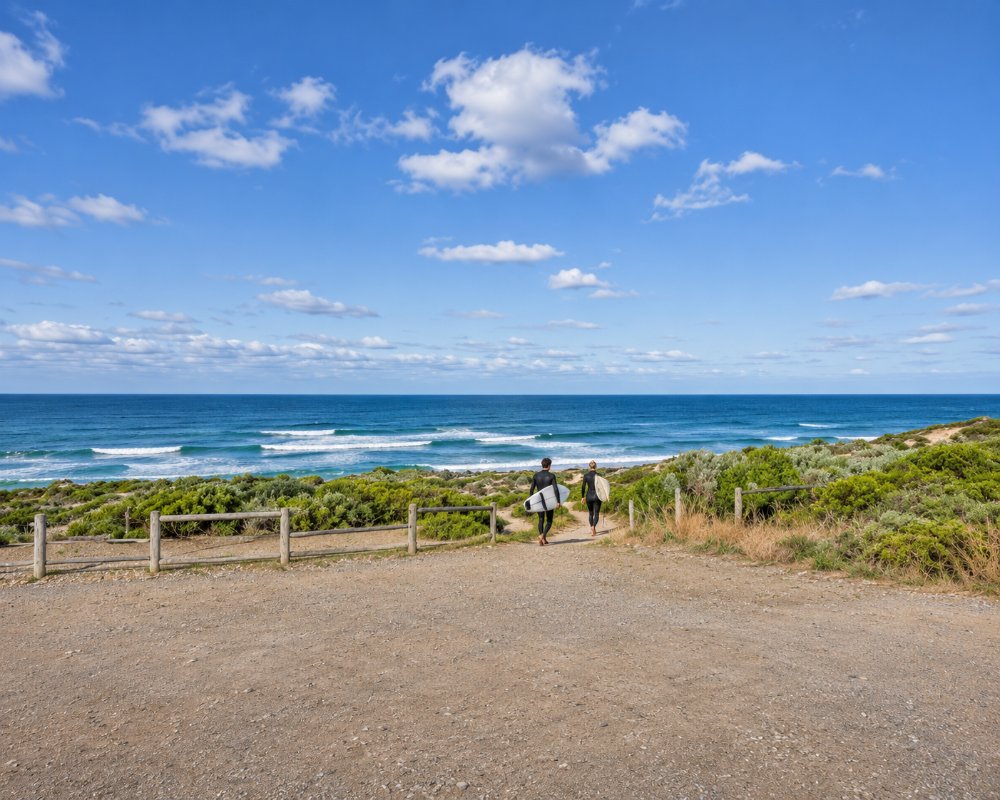
On a big swell the coast here is spectacular, with waves exploding against the basalt and spray drifting over the heath. On calm days the rock platforms are a world of pools, kelp and crabs, and from the clifftops you can sometimes see whales passing in winter.
Things To Do in the Park
Cape Schanck
At the southern tip of the peninsula, a boardwalk and stairs of about 1.6 km lead from the car park past the 1859 lighthouse down to a rock platform, with lookouts over Pulpit Rock and the Devils Desk. A kiosk operates at the cape.
Bushrangers Bay
The track to Bushrangers Bay runs about 2.6 km one way from the Cape Schanck car park, or about 4.8 km return from the Boneo Road car park, through coastal scrub to a secluded beach backed by basalt cliffs. It is best at low tide; the beach is unpatrolled, so do not swim.
The Coastal Walk
The Coastal Walk follows the clifftops and beaches from Cape Schanck to London Bridge near Portsea, about 26 km, usually walked over two days or in sections. The first leg from Cape Schanck to Gunnamatta is about 4.5 km. Shorter walks include the Farnsworth Track (about 1.5 km one way) from London Bridge, the Fingal Beach walk and the Coppins Track from Sorrento ocean beach.
Two Bays Walking Trail
The Two Bays Walking Trail runs about 26 km from Dromana on Port Phillip through Arthurs Seat State Park and Greens Bush to Cape Schanck on Bass Strait, waymarked with a blue wren symbol. Allow about seven hours one way. Greens Bush, off Greens Road, is a good place to see kangaroos.
The Ocean Beaches
Gunnamatta is a famous surf beach for experienced surfers, and St Andrews, Rye and Sorrento ocean beaches are stunning places to walk. The rock pools at Sorrento ocean beach suit families at low tide. London Bridge, a rock arch near Portsea, is one of the most photographed sights on the coast.
Greens Bush
Inland from the coast, Greens Bush at Main Ridge is the largest area of native bush left on the peninsula and has its biggest population of eastern grey kangaroos, best seen early or late in the day. Three easy loops start from the Baldrys car park: the Baldrys Short Circuit (about 1.6 km), the Baldrys Long Circuit (about 3.6 km) and the Long Point Circuit (about 4 km). The Two Bays Walking Trail also runs through on its way to Cape Schanck.
Where To Stay
There is no camping in the national park. The Cape Schanck Lightstation keepers’ cottages and the RACV Cape Schanck Resort offer places to stay nearby, and the towns of Rye, Sorrento, Blairgowrie and Flinders have hotels, B&Bs and holiday parks.
For caravans and campers, the foreshore campgrounds at Rye, Sorrento, Rosebud and McCrae on the bay side are the classic peninsula holiday, open from late October to late April and booked through the Mornington Peninsula Shire.
Closest to the cape, Peppers Moonah Links Resort at Fingal, about 5 km north of Cape Schanck, has rooms looking over its two championship golf courses, and Peninsula Hot Springs, also at Fingal, has glamping tents and an eco lodge in its grounds. At the eastern end of the park, Quarters at Flinders Hotel has 40 rooms and the 26-room Motel Flinders has dog-friendly rooms (dogs still cannot come into the park), and Hart’s Farm at Shoreham is a bed and breakfast on a small farm.
For caravans outside the foreshore season, Amberlee Family Holidays at Rosebud has ensuite powered sites, cabins and villas, and Peninsula Holiday Park at Dromana has powered sites on concrete slabs and cabins. On the Western Port side, the Point Leo Foreshore Reserve, about 12 km north of Flinders, keeps its 45 powered sites open all year, and the Shoreham Foreshore Reserve has 98 unpowered sites from September to May, with a few for vans of up to about 6 m. Big rigs are best left at camp, with the tow vehicle used for day trips to the beaches.
Eat & Drink
There is a kiosk at Cape Schanck. Otherwise, the cafes and pubs of Rye, Sorrento and Flinders are close by, and the restaurants at Peninsula Hot Springs and Alba Thermal Springs at Fingal are a short drive away.
Beyond the kiosk at Cape Schanck there is no food in the park, so carry water and snacks on the Coastal Walk and the Two Bays trail. At Fingal, about 5 km north of the cape, Peninsula Hot Springs has the Bath House Cafe, Alba Thermal Springs has its restaurant Thyme, and Peppers Moonah Links has Pebbles Restaurant. RACV Cape Schanck Resort’s Cape, Samphire and Mantellina restaurants sit right beside the park, and at the eastern end the Flinders Hotel serves lunch and dinner daily. Rye and Sorrento, a few minutes from the back beaches, have the most cafes.
History
This is Bunurong Country. Lieutenant James Grant named Cape Schanck in 1800 after Captain John Schank, and the lighthouse was built in 1859. The park began as the Cape Schanck Coastal Park in 1975, became a national park in 1988 and took its present name in 1995, and has grown since to protect most of the peninsula’s ocean coast.
Getting to the Park
Cape Schanck is about 100 km from Melbourne via the Mornington Peninsula Freeway and Boneo Road, around an hour and a quarter. A car is the best way to reach the ocean beaches; PTV bus 788 from Frankston station runs along the bay side to Rye and Sorrento, from where you can walk across to the back beaches.
Safety: the ocean beaches have strong rips, undertow and sudden big waves. Gunnamatta has a rip every few hundred metres and is one of the busiest rescue beaches in Victoria; St Andrews and Rye Ocean Beach are unpatrolled. Portsea, Sorrento and Gunnamatta are patrolled in the summer holidays. Dogs are not allowed anywhere in the park, and the cliffs are unstable, so keep to the tracks.
Experiences
- Eco Tourism
- Nature based
- Self-Drive
Popular Activities
- Beach
- Bird Watching
- Bush Walking
- National Park
- Surfing
- Wildlife
About Mornington Peninsula National Park
- Locality: Rural locality
- Mornington Peninsula National Park Postcode: 3939
- State: Victoria
- Region: Mornington Peninsula
- Latitude: -38.4445
- Longitude: 144.8640
- Timezone: Australia/Melbourne
