
Kapunda, SA
Kapunda is a town of about 2,900 people on the northern edge of the Barossa, 77 km from Adelaide and 20 minutes from Nuriootpa. It was here, in 1844, that Australia’s first successful metal mine opened, and the copper it produced helped save the young colony of South Australia from bankruptcy.
Known For
- Australia’s first commercial copper mine
- Map the Miner and the mine trail
- Sir Sidney Kidman, the cattle king
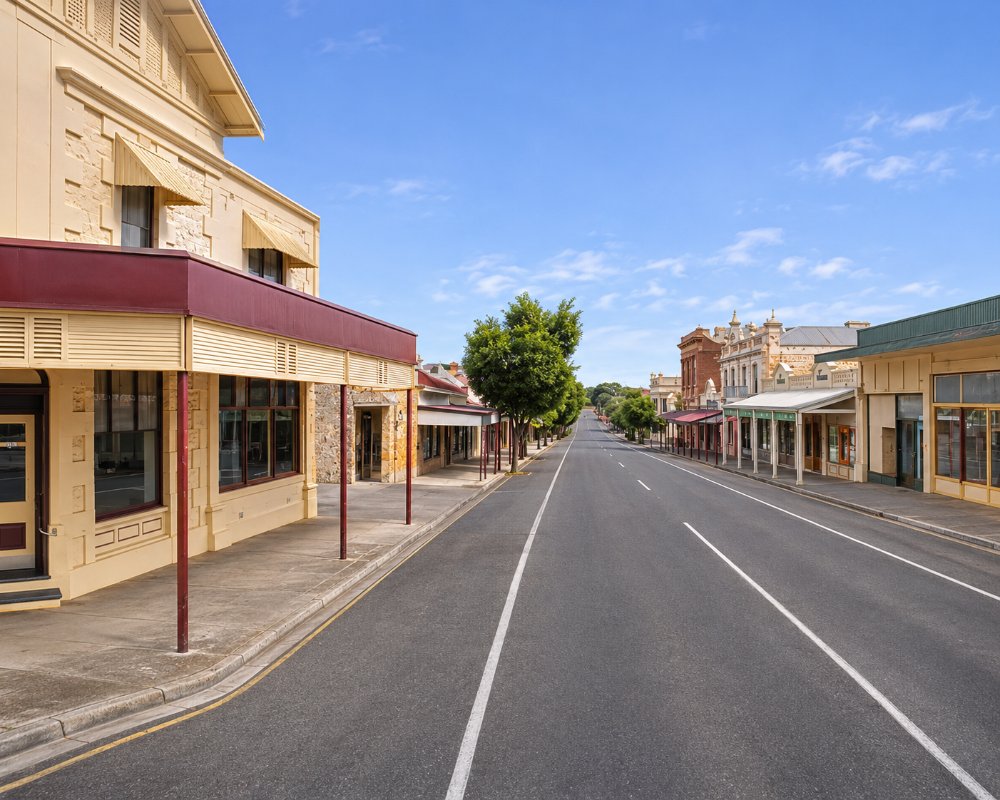
The town that grew up around the mine is one of the best preserved in the state. Its main street is a long run of two-storey stone shops and hotels with iron lace verandahs, and the back streets are full of miners’ cottages, churches and grand houses. Murals and a painted silo have been added in recent years. Kapunda sits in rolling wheat and sheep country rather than vineyards, and it is quieter and cheaper than the Barossa towns, which makes it a rewarding half-day trip or an alternative base.
Begin at the visitor information centre in the main street, where the heritage trail starts and maps are available.
Things To Do in Kapunda
Map the Miner
At the southern entrance to the town stands a seven-metre figure of a Cornish miner, known as Map Kernow, the son of Cornwall. First unveiled in 1988, it was destroyed by fire in 2006 and rebuilt by its sculptor within a year.
Kapunda Mine Historic Site
The old mine, on the edge of town, is open and free to explore on a signposted trail. Paths lead past the open cuts, stained green and blue with copper, the tall stone chimney, the mine manager’s house and a lookout over the workings. Allow an hour, and keep to the paths.
Kapunda Museum and Bagot’s Fortune
The museum fills a former Baptist church of 1866 with three floors of the town’s history, and Bagot’s Fortune, in the old printing office opposite, explains the mine and the Cornish miners who worked it. Both are run by volunteers and usually open in the afternoon; one ticket covers both.
Heritage Trail
A ten-kilometre trail, which can be driven, cycled or walked in sections, links about 50 sites, among them the fine Catholic and Anglican churches, the old railway station and the miners’ cottages.
Murals and Silo Art
A mural trail of more than a dozen works runs along and around the main street, and the disused silos on Hancock Road were painted in 2025 with a huge copper mining scene.
Sir Sidney Kidman
The cattle king, who came to control more land than anyone in the British Empire, lived at Kapunda and held his famous horse sales behind the North Kapunda Hotel, where up to 3,000 horses changed hands in a week. He gave his house, Eringa, to the state in 1921 and it became part of the high school. The building was badly damaged by fire in 2022.
The Pines Reserve
Seven kilometres north, the town’s old reservoir is now a conservation reserve with two short walking trails, picnic shelters and room to park a caravan.
Anlaby
Near Hamilton, 15 minutes north, Anlaby is the oldest merino stud in the state, with a celebrated garden that opened to the public for a spring festival each October until the last one, in 2026; guided house and garden tours can still be booked.
Main Street
Walk the length of the main street to take in the two hotels of 1849, the old banks, the institute and the rows of verandahed shops, most of them built with money from the mine. The sale yards where Kidman sold his horses were behind the North Kapunda Hotel, and plaques along the footpath mark the sites.
Baker’s Flat and the Miners
The Cornish miners lived in stone cottages near the workings, many of which survive. The Irish labourers who came to cart ore built their own village of whitewashed cabins on Baker’s Flat, south of the mine, and stayed on as squatters for generations after the mine closed. Nothing remains above ground, but the story is told at the museum.
Gundry’s Hill Lookout
A short drive or a steep walk from the main street, the lookout gives a view over the town’s roofs and spires to the mine and the wheat country beyond. It is best late in the day.
Kapunda Marble
The hills around the town also produced a fine pale marble, which was used in Parliament House in Adelaide.
Visitor Information
The Light Country Visitor Information Centre, in the main street, has heritage trail maps, a display on the history of the town and advice on both the Barossa and the Clare Valley, and it stocks the guide to the mural trail. Allow at least half a day in Kapunda, and a full day if you want to walk the mine trail, see both museums and drive out to the reserve.
Where To Stay
Rooms are available in the old hotels of the main street and in bed and breakfasts in the town’s stone houses.
The Kapunda Tourist Park, in a quiet reserve near the centre, has powered sites and cabins, including accessible ones. There is a public dump point at the trotting track on Hancock Road.
The Kapunda Tourist Park is in Dutton Park on Baker Street, a short walk from the main street, with powered and unpowered sites, cottages, bush cabins and standard cabins, and it is a handy base for walkers on the Heysen and Mawson trails. The dump point at 41 Hancock Road takes grey and black water and has drinking water, but no toilets or showers. Kapunda is a good place to stop and service a van before heading north to Clare or east to the Riverland.
For something grander, Oldham House on Jeffs Street is a hosted bed and breakfast in a large old home with a flower garden and two suites, the Dutton and the Bagot, one with an open fire in its lounge and a spa bath in the house; continental breakfast provisions are included. The Station at Kapunda, the restored railway station of 1860 on Railway Parade, is let as a single house for groups of 10 to 14 and is also used for weddings and murder-mystery nights. About 15 km south, The Barns of Freeling has silo suites and stone barn studios for couples on a working farm, and the Barossa towns, 20 to 30 minutes away, have many more choices.
Eat & Drink
The Sir John Franklin and the North Kapunda, both hotels of 1849, serve meals; the North Kapunda, often described as the most haunted pub in Australia, reopened under new owners at the start of 2026. Bakeries and cafes trade along the main street.
Kapunda has four hotels and a small but growing food scene along Main Street. The North Kapunda Hotel reopened in January 2026 after almost a year closed, with the dining room reworked and the old building stripped back to show its heritage; alongside pub classics such as schnitzels and steaks, it serves dishes brought in from local Vietnamese, Chinese, Taiwanese, Indian and Greek kitchens. The Sir John Franklin, known locally as the SIRJ, at 57 Main Street, has booth seating in its dining room, a long list of beers on tap, a dog-friendly beer garden and takeaway.
The Clare Castle Hotel at 105 Main Street is an old-school country pub with no poker machines, wood fires, a beer garden and a children’s playground, regular live music and a drive-through bottle shop; meals are served from Wednesday to Sunday.
Com Viet, Vietnamese by Maggie, at 48 Main Street, won two plates in the 2026 Australian Dining Awards and offers dine-in, takeaway and cooking classes; it is closed on Tuesday and Wednesday. The Kapunda Bakehouse is the place for kitchener buns, meat pies and chocolate doughnuts.
The Foodland supermarket covers groceries, and there is fuel in town.
Day Trips
Kapunda is well placed for the country between the Barossa and the Clare Valley. Freeling, 15 minutes south, is the town used for the television series McLeod’s Daughters. Greenock and the palm-lined road to Seppeltsfield are 20 minutes south-east, and Nuriootpa and Tanunda are a little further. To the north, Eudunda, the birthplace of the author Colin Thiele, is 25 minutes away, and the small farming towns of Tarlee and Riverton lead on to the vineyards of Clare. Marrabel, half an hour north, holds one of the best-known rodeos in Australia each October.
When To Visit
Spring is the best season, when the crops are green and the Kapunda and Light Show is on, on the last weekend of October. Autumn is mild and settled. Summer days on these plains are hot and dry, so plan to walk the mine trail early, and winter is cool and green. The museums keep short hours, mostly in the afternoon, so an overnight stay or an afternoon visit works better than a morning one.
History
This is Ngadjuri country, and the name is thought to come from a Ngadjuri word for a spring. In 1842 Francis Dutton and Charles Bagot each found green copper ore on neighbouring sheep runs, and they began mining in 1844. Cornish miners, Welsh smelters and Irish labourers followed, and at its peak the mine employed about 340 men and boys. The railway from Gawler arrived in 1860. The mine closed in 1878, having produced copper worth more than a million pounds, and Kapunda settled into life as a farming town.
The district’s agricultural show is held in late October.
Getting to Kapunda
From Adelaide, take the Northern Expressway and the Thiele Highway through Freeling, about an hour and ten minutes. From the Barossa, the road from Nuriootpa through Greenock takes 20 minutes. The Clare Valley is 45 minutes north.
Experiences
- Food and Wine
- Historic/Heritage
- Rural/Country
- Self-Drive
Popular Activities
- Bush Walking
- Caravan and Camping
- Driving
- Food and Wine
- Sightseeing
About Kapunda
- Locality: Suburb
- Kapunda Postcode: 5373
- State: South Australia
- Region: Barossa
- Latitude: -34.34145
- Longitude: 138.91489
- Timezone: Australia/Adelaide
Accommodation In Kapunda
Discover some of the accommodation in and around Kapunda
