
Cockle Creek, TAS
Cockle Creek is the end of the road, the southernmost point in Australia that can be reached by car. It lies on the shore of Recherche Bay in the far south of Tasmania, about 150 kilometres and two hours’ drive from Hobart, where the gravel stops at a small bridge and the Southwest National Park begins. Beyond are only walking tracks, wild beaches and the Southern Ocean.
Known For
- The end of the most southerly road in Australia
- The day walk to South Cape Bay
- Bush camping on the calm shores of Recherche Bay
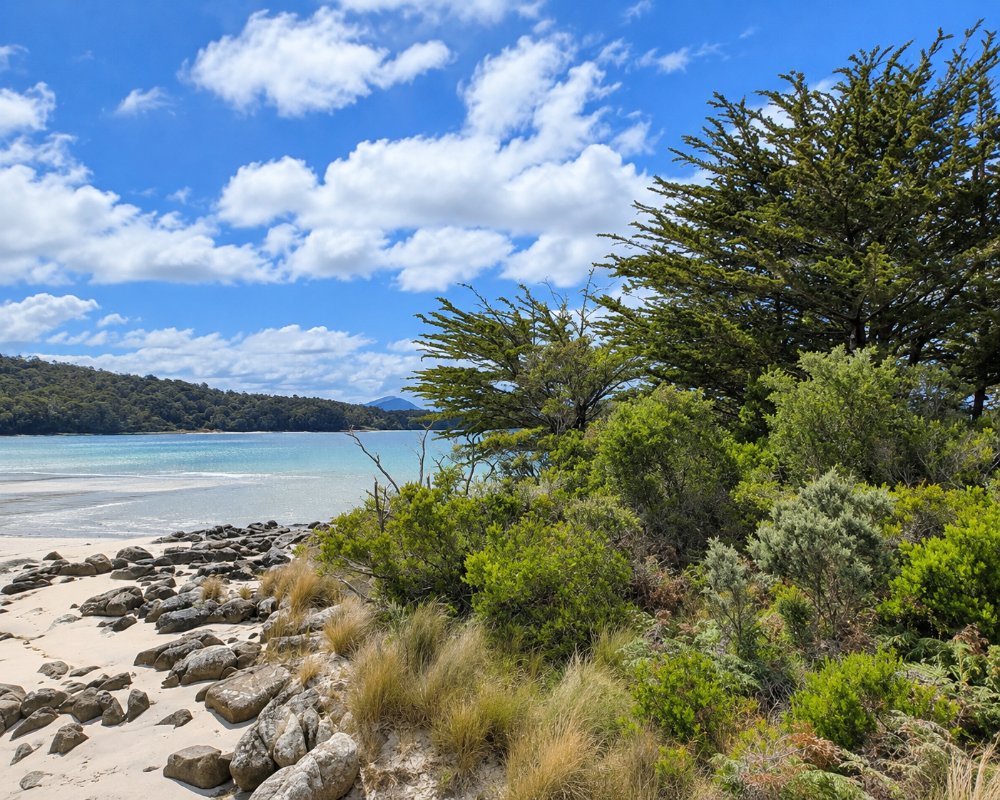
There is no town here, only a scattering of camp grounds along a string of white beaches, a few old shacks, a ranger station and a bronze sculpture of a whale. The bay is sheltered and shallow, its water clear and startlingly blue over the sand. Forested hills rise behind, and the peaks of the south-west can be seen across the water.
Cockle Creek rewards those who make the long drive with a real sense of remoteness. Come prepared, as there are no shops, no fuel and no mobile coverage.
Things To Do at Cockle Creek
South Cape Bay Walk
The track to South Cape Bay is one of the great day walks of Tasmania, and the first stage of the South Coast Track, an 85-kilometre wilderness route to Melaleuca. It runs for about 7.7 kilometres each way, much of it on boardwalk across open buttongrass plains and through coastal forest, before emerging on dark cliffs above a surf beach that faces nothing but ocean until Antarctica. Allow four hours return. The walk is mostly level, but the weather can turn cold and wet at any time of year.
Fishers Point
An easier walk follows the shoreline from the end of the road around to Fishers Point, about two hours return. It passes small coves and rock platforms and ends at a navigation light and the ruins of a pilot station built in 1843. On the way is the whale sculpture, a life-size bronze of a young southern right whale, recalling the animals that once crowded the bay in winter.
Beaches and Paddling
The beaches of Recherche Bay are among the most beautiful in the state, with fine white sand, tea-coloured creeks and calm water. They are ideal for swimming on a warm day, though the water is cold, and for kayaking, snorkelling and beachcombing. Dolphins and seals visit the bay, and southern right whales are again seen between June and October.
Fishing
Anglers catch flathead, Australian salmon and bream from the beaches and from small boats launched across the sand. Abalone and crayfish are taken by divers with a licence. Fishing rules and bag limits apply and are strictly enforced.
History on the Shore
Interpretive signs around the bay tell of the French scientific expedition that anchored here in 1792 and 1793, the bay whalers of the 1830s and 1840s, and the timber and coal settlements that followed. Stone foundations, graves and old tramway routes survive in the bush.
Where To Stay
Accommodation at Cockle Creek is camping only.
Parks lists five camping areas north of the bridge (Gillams Beach, Finns Beach, Catamaran, Ramsgate and Cockle Creek), all free and open to caravans, where generators may run until 10 pm and fires must be in your own fire pot. South of the bridge, Boltons Green has about ten sites with rough access and few flat spots, and only fuel stoves are allowed. There is no dump point and no rubbish collection: the nearest dump points are at Port Huon, Franklin and Huonville. Fuel is sold at Southport and then Dover, and the last 24-hour fuel is at Huonville.
Free camp grounds line the bay on both sides of the bridge. Those to the north are in the Recherche Bay Nature Recreation Area, where dogs on leads are permitted. Those south of the bridge are in the national park, where a parks pass is required and pets are not allowed. Facilities are limited to pit toilets and, at some sites, tank water, so campers need to be self-sufficient. Fires are restricted.
The sites are suitable for tents, camper trailers and small caravans, though the last 20 kilometres of road are gravel and can be rough. Summer holidays and Easter are busy.
The nearest roofed accommodation is at Southport and Dover, 40 minutes to an hour north, and there are cabins near the Hastings caves.
The Ranger Quarters at Cockle Creek is not staffed all year, but volunteer campground caretakers are usually on hand in summer. Each campground has a toilet, and there are more near the Ranger Quarters. The tank water at Boltons Green is untreated and must be boiled for several minutes, so bring your own drinking water. Seasonal campfire bans apply on reserved land in the far south from spring (they began on 26 October in 2026), so check the fire rules for your campground before lighting a fire pot.
For a roof over your head, The Oystershack on Tongue Road at Hastings is an off-grid studio overlooking Hastings Bay, close to the caves and thermal pool, and Lady of the Woods at Raminea is an organic, self-contained retreat beside the forest. Rock Lobster and Seaclusion are holiday houses with bay views on Kingfish Beach Road at Southport. Dover, about an hour’s drive north, has the widest choice, including Ashdowns of Dover bed and breakfast, cabins over Port Esperance Bay at Driftwood, and Dover Caravan Park, which has powered sites, on-site vans and ensuite cabins.
Eat & Drink
There is nowhere to buy food or drink at Cockle Creek. Bring everything you need, including drinking water, and take all rubbish away.
The last shops and fuel are at Southport and Dover, where there are also a hotel, cafes and a general store. Stock up in Geeveston or Huonville for a wider choice.
The closest food is at Southport, about 30 km back up the road, where Rocket at the End of the Road, a summer pop-up cafe open from about November to April, serves coffee, chai, home baking and ice cream. The visitor centre at Hastings Caves, about 35 km away, sells coffee and light snacks. Dover, about an hour north, has the Dover Top Shop for burgers and seafood, the Dover RSL with meals seven days, and Post Office 6985 for wood-fired pizza later in the week.
History
Recherche Bay is the country of the Lyluequonny people. In 1792 the ships of Bruni d’Entrecasteaux, searching for the lost explorer La Perouse, sheltered here for several weeks. Their scientists made friendly contact with the Aboriginal people, planted a garden and carried out early experiments on the earth’s magnetic field. The bay is named after one of the ships.
In the 1830s several shore whaling stations operated around the bay, and a rough township grew up at Cockle Creek, with timber mills and later coal mines. By the early twentieth century the industries had gone and the settlement faded away. The south-west was declared a national park and, in 1982, a World Heritage area.
Getting to Cockle Creek
From Hobart, follow the Huon Highway south through Huonville, Geeveston and Dover to Southport, then take the road past Lune River. The final 20 kilometres are unsealed. Allow two hours without stops.
There is no public transport. A bus service for bushwalkers operates on demand in the walking season. Check road and weather conditions before leaving.
Experiences
- Caravan and Camping
- Historic/Heritage
- Nature based
- Remote
- Self-Drive
Popular Activities
- Beach
- Bird Watching
- Bush Walking
- Caravan and Camping
- Fishing
- Kayaking
- National Park
- Wilderness
About Cockle Creek
- Locality: Rural locality
- Cockle Creek Postcode: 7109
- State: Tasmania
- Region: Hobart and South
- Latitude: -43.54302
- Longitude: 146.89121
- Elevation: 9m
- Timezone: Australia/Hobart
