
Noosa National Park, QLD
Noosa National Park begins where Hastings Street ends. Its headland section covers the rocky point between Noosa Heads and Sunshine Beach, a few hundred hectares of rainforest, woodland and heath edged by small bays and some of the best point surf in Australia. It is one of the most visited national parks in the country, and for good reason: within ten minutes of leaving the shops you can be watching dolphins from a clifftop track.
Known For
- The coastal walk from Noosa Heads to Hell’s Gates
- Tea Tree Bay, Granite Bay and a string of point breaks
- Koalas, dolphins, turtles and whales
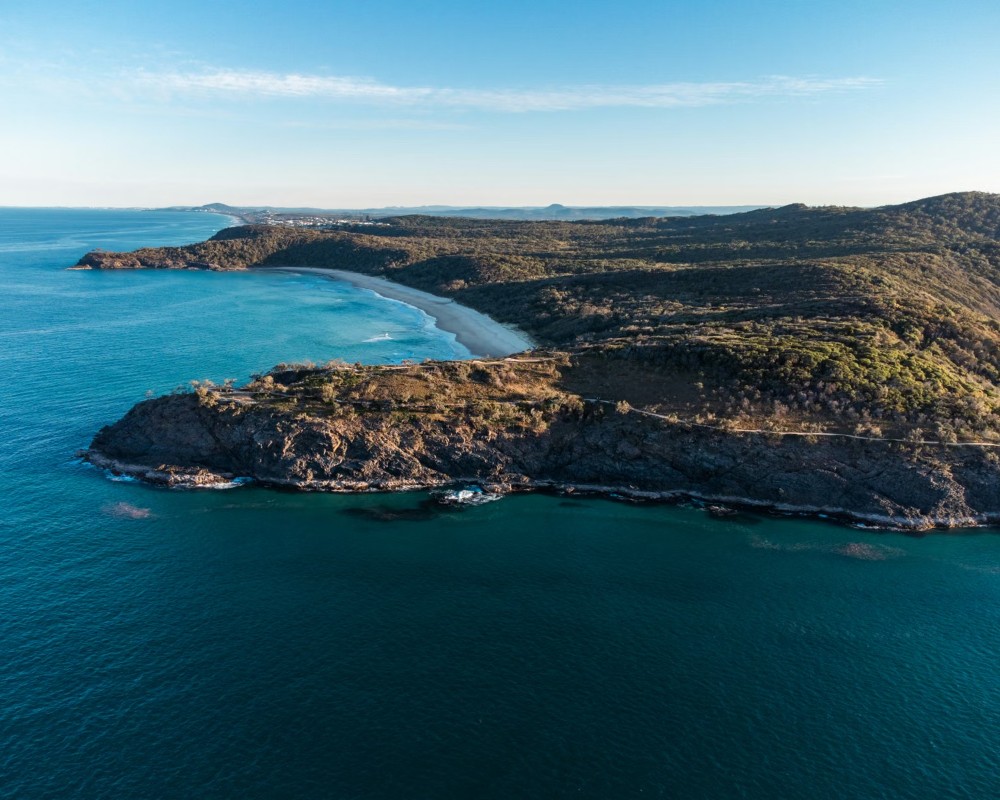
The headland rises to about 150 metres at Noosa Hill and is wrapped on three sides by the sea. On the sheltered northern shore, pandanus palms lean over small sandy coves; on the exposed eastern side, cliffs drop to the open ocean and the long, wild beach of Alexandria Bay. Other, quieter sections of the park protect the heath and lake country further south, near Peregian Beach.
Entry is free and there is no camping. Parking at the park entrance is very limited, so most people walk in along the boardwalk from the end of Hastings Street, a pleasant ten to fifteen minutes.
Things To Do in Noosa National Park
The Coastal Walk
The park’s signature track follows the shore for about five and a half kilometres from the day-use area to Sunshine Beach. The first kilometre, to Dolphin Point, is sealed and suitable for prams and wheelchairs, passing the Boiling Pot lookout and Tea Tree Bay. Beyond that it becomes a bush track to Granite Bay, the Fairy Pools and the dramatic cleft of Hell’s Gates, then drops to Alexandria Bay and climbs over to Sunshine Beach. Allow two hours one way, or turn back at Hell’s Gates for a return walk of about seven kilometres.
Bays and swimming
Tea Tree Bay is the prettiest spot for a swim, a small beach under the trees about 15 minutes from the entrance. None of the bays is patrolled, and conditions change quickly, so take care. The Fairy Pools, two natural rock pools near Granite Bay, are best at low tide in calm seas and should be avoided when waves are breaking over the rocks. Alexandria Bay has strong rips.
Surfing
The right-hand point breaks along the northern shore, from First Point at Main Beach through Little Cove, Boiling Pot and Tea Tree to Granite Bay, are famous for long, clean waves when a cyclone swell arrives in summer and autumn. The area was declared a World Surfing Reserve in 2020. On a good day, the track is lined with spectators.
Inland tracks
The Palm Grove Circuit is an easy loop of about a kilometre through rainforest near the entrance. The Tanglewood Track crosses the headland through woodland to Hell’s Gates and makes a quieter return leg from the coast, and a steeper path climbs Noosa Hill.
Wildlife
Koalas live in the eucalypts near the entrance and along the coastal track; rangers often mark where one has been seen that day. Look for dolphins and turtles from Dolphin Point and Hell’s Gates all year, and for humpback whales from June to October. Brush-turkeys, goannas and glossy black-cockatoos are also common.
A rebuilt Coastal Walk
A major upgrade of the Coastal Walk between Dolphin Point and the Fairy Pools was finished at Easter 2025, with new surfacing, rock retaining walls and better beach access at Tea Tree Bay and Alexandria Bay. The park now has more than 1.4 million visits a year, so start early for a quieter walk and an easier park.
Where To Stay
There is no accommodation or camping in the park.
Noosa Heads, at the park gate, has hotels, resorts and apartments, with Little Cove the closest of all. Sunshine Beach is the base for the southern end, and Noosaville has more moderately priced options a short bus ride away.
For the closest beds to the track, Peppers Noosa Resort and Villas on Viewland Drive backs onto the park, and Netanya Noosa is the last beachfront resort on Hastings Street before the boardwalk to the entrance. At the southern end, La Mer and Costa Nova on Belmore Terrace, Sunshine Beach, are a short walk from the track’s southern access.
Vans and motorhomes cannot stay overnight near the park. The Park Road car park at the entrance has a four-hour limit and is a tow-away zone from 10pm to 4am, and parking is banned overnight from Noosa Woods to the Spit. The nearest powered sites are at the council’s Noosa River Holiday Park at Munna Point, Noosaville, about 4 km away; in the summer holidays the free Go Noosa Loop bus is the easiest way to reach the entrance.
Eat & Drink
There is no cafe or kiosk in the park; the day-use area has picnic tables, barbecues, drinking water and toilets. Take water on the longer walks, as there is none past the entrance. Hastings Street’s cafes and restaurants are a short stroll from the gate, and Sunshine Beach has more at the other end.
The nearest meals are about a kilometre away at the national park end of Hastings Street: Locale for Italian, Sails for seafood with a bay view, and the Noosa Heads Surf Life Saving Club restaurant and bar on Main Beach. Park and Cove, at Peppers Noosa on Viewland Drive, is also close by. At the Sunshine Beach end, the surf club and The Deck cafe on Duke Street are a few minutes from the track.
History
The headland is the country of the Kabi Kabi people, who fished and gathered shellfish around its bays. It was set aside as a town reserve in 1879 and became a national park in 1939, largely through the efforts of local residents. In the 1960s a proposal to build a road around the headland to Alexandria Bay was defeated after a long community campaign, one of the early conservation victories in Queensland, and the park has since been enlarged several times.
Getting to Noosa National Park
From Hastings Street, follow the boardwalk east past Little Cove to the park entrance, about a kilometre. The small car park on Park Road is usually full by early morning. The southern end is reached from the top of Sunshine Beach. Noosa Heads is about 140 kilometres north of Brisbane.
Experiences
- Active
- Eco Tourism
- Nature based
Popular Activities
- Beach
- Bird Watching
- Bush Walking
- National Park
- Surfing
- Swimming
- Wildlife
About Noosa National Park
- Locality: National park
- Noosa National Park Postcode: 4567
- State: Queensland
- Region: Sunshine Coast
- Latitude: -26.3800
- Longitude: 153.1050
- Timezone: Australia/Brisbane
