
Adventure Bay, TAS
Adventure Bay is the main settlement on Bruny Island, a sheltered sweep of white sand on the eastern side of South Bruny, about two hours from Hobart by road and ferry. Famous navigators from Cook to Bligh anchored here, and today it is the base for the island’s best-known coastal walk, for wildlife cruises beneath towering sea cliffs and for spotting the white wallabies found almost nowhere else.
Known For
- Landing place of Cook, Bligh and other early explorers
- The Fluted Cape walk and wilderness cruises
- White wallabies, penguins and seals
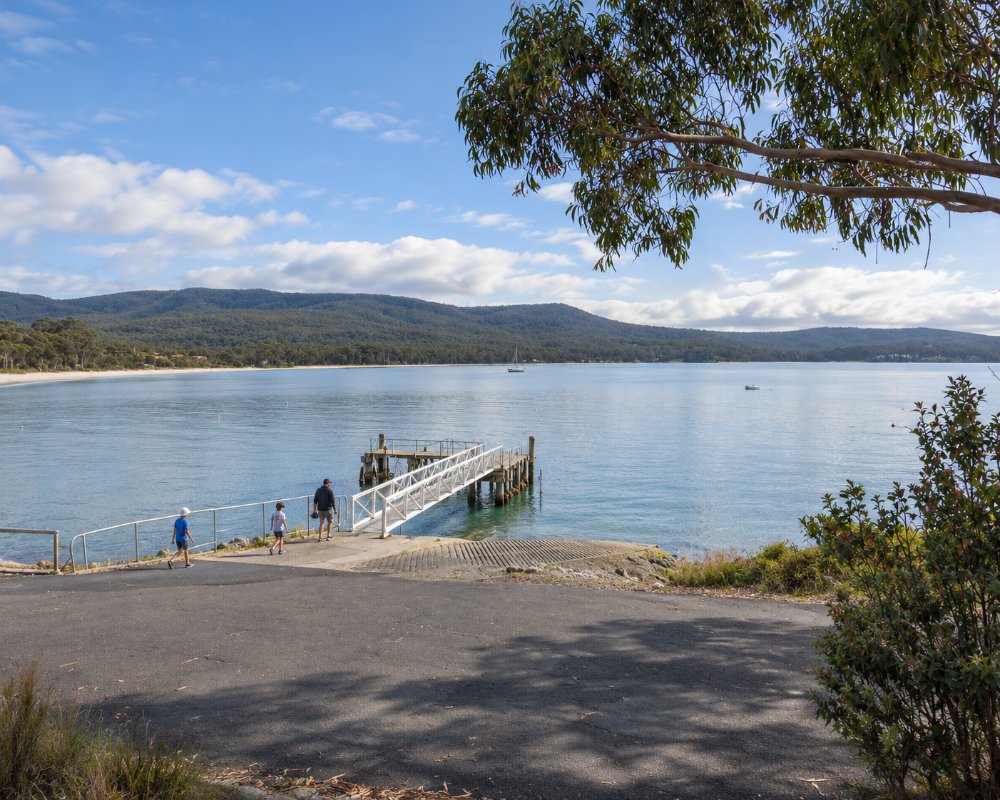
The village is strung along the road behind the beach, with holiday houses, a general store, a caravan park, a small museum and a jetty. Forested hills rise behind it, and South Bruny National Park begins at the southern end of the bay, where the land climbs to the cliffs of Fluted Cape. The narrow isthmus known as the Neck, which joins the two halves of the island, is 15 minutes north.
Adventure Bay is the most convenient place to stay on South Bruny, and it has enough to fill two or three unhurried days.
Things To Do in Adventure Bay
The Beach and Bay
The bay is a long crescent of pale sand and clear, cold water, sheltered from the prevailing westerly weather. It is safe for swimming and paddling, and kayaks can be launched from the beach. At the northern end, Two Tree Point is where early ships took on fresh water; the two eucalypts there are thought to be the same trees shown in a painting from Bligh’s visit.
Fluted Cape and Grass Point
From the southern end of the beach, an easy track follows the shore to Grass Point, the site of a nineteenth-century whaling station, about an hour and a half return. From there a steeper circuit climbs to the top of Fluted Cape, where dolerite columns drop 270 metres to the sea, before looping back through forest. The full walk takes two and a half to three hours and is one of the finest short walks in Tasmania. There are no fences at the cliff edge, so take great care.
Wilderness Cruises
Fast boats leave the Adventure Bay jetty for a three-hour cruise down the wild southern coast of Bruny, passing beneath some of the highest sea cliffs in Australia, through sea caves and past blowholes to a colony of fur seals at the edge of the Southern Ocean. Dolphins, albatross and migrating whales are often seen. Waterproof coats are supplied, and bookings are essential.
Wildlife
A small population of rare white Bennetts wallabies lives around Adventure Bay, and they are most easily seen grazing near the national park entrance and the caravan park at dusk. At the Neck, a timber stairway climbs to a lookout over the isthmus, and a viewing platform at its base allows visitors to watch little penguins and shearwaters come ashore after dark in the warmer months. Echidnas, quolls and all twelve of the bird species found only in Tasmania live on the island.
Bligh Museum
The Bligh Museum of Pacific Exploration, a small brick building near the beach, displays maps, documents and relics relating to the voyages of Tasman, Furneaux, Cook, Bligh and d’Entrecasteaux, all of whom visited the bay.
Rainforest and Produce
A short nature walk at Mavista leads through cool, ferny rainforest beside a creek. The island’s food producers, including an oyster farm, a cheese maker, a berry farm and a chocolate maker, are within a short drive.
Where To Stay
Adventure Bay has the widest choice of accommodation on Bruny Island.
Taking a caravan or motorhome to Bruny is straightforward. The vehicle ferry from Kettering carries them every day; there are no bookings for a set sailing, so you join the queue, and the fare for a car towing a van is roughly double that for a car alone. The caravan park at Adventure Bay has powered and unpowered sites. Of the national park campgrounds, The Neck takes caravans and campervans, Jetty Beach is reached by a narrow unsealed road, and Cloudy Corner is reached only by four-wheel drive along the beach and is not for caravans. Parks camping on Bruny moved to flat fees per site and an online booking system in November 2026, so book before you go. Fuel is sold at the Adventure Bay general store.
A caravan and cabin park sits at the southern end of the bay, close to the beach and the walking tracks, with cabins, powered sites and camping. Dozens of holiday houses, cottages and eco retreats line the bay and the hills behind, ranging from classic shacks to architect-designed hideaways.
National park camp grounds are found elsewhere on South Bruny, at Cloudy Bay and Jetty Beach. There are no large hotels on the island.
Book well in advance for summer, Easter and long weekends, and remember to allow for the ferry timetable.
The caravan park is the Bruny Island Holiday Park, at 786 Adventure Bay Road across the road from the beach. Now under new family owners, it has bay-view villas, family cabins and powered and unpowered sites, and it welcomes well-behaved pets. Lumeah Guest House, at 3A Lumeah Road near Quiet Corner beach, is a four-bedroom guest house built in 1888, with two living areas, an open fire and leafy gardens, a short walk from the shops and the cruise centre. Adventure Bay Retreat, on Hayes Road, is a self-contained stay in coastal bush where white wallabies often graze, and Bruny Island Haven, also on Hayes Road, has two luxury self-contained units for couples or families.
Mavista Cottage, on Resolution Road, is a small studio for couples beside the rainforest near the Mavista walk. For larger groups, Bruny Island Lodge on Lighthouse Road, about 35 minutes away, sleeps up to 24 on 860 acres of bush. The official Bruny Island visitor map, handed out at the ferry, marks the island’s dump points, toilets and boat ramps.
Eat & Drink
The general store sells groceries, fuel and takeaway food, and a cafe at the cruise terminal serves breakfast, lunch and coffee. A berry farm just north of the village offers ice cream, pancakes and pick-your-own fruit in summer.
Evening options are limited, so many visitors cook for themselves. The island hotel at Alonnah, 20 minutes west, serves pub meals, and the oyster bar and cheese company near Great Bay are popular lunch stops on the way from the ferry.
Mari Bruny, at 710 Adventure Bay Road opposite the beach, is a family-run cafe and restaurant with an all-day menu of Australian standards and Asian dishes, from breakfast through to dinner; bring your own wine or beer, and takeaway is available. The restaurant at the Bruny Island Cruises centre, 1005 Adventure Bay Road, takes meal orders from 11am to 3pm, with Tasmanian fish, gourmet rolls, pumpkin soup and local wine and beer. The berry farm is the Bruny Island Raspberry Farm on Lockleys Road, where everything is homemade from fruit grown on the property: scones, crepes, milkshakes, ice cream and preserves; hours follow the season.
Bruny Island Chocolate Company, also in Adventure Bay, makes cream fudge and hand-rolled truffles and opens daily from 10am to 4pm. About 20 minutes away on Isthmus Bay, south of the Neck, The Izzy Bar serves wood-fired pizza and garden-led plates with local wine, cider and cocktails. Bruny Island Premium Wines at Lunawanna, Australia’s southernmost vineyard, serves lunch and tastings daily. The Adventure Bay General Store is the only place on Bruny that sells petrol and diesel, so plan fuel stops around it.
History
Bruny Island is lunawanna-alonnah, the country of the Nuenonne people, and Truganini was born here around 1812. Tobias Furneaux anchored in the bay in 1773 and named it after his ship. James Cook followed in 1777 and William Bligh in 1788 and 1792, when he planted the first apple trees in Tasmania.
Whalers set up shore stations in the 1820s, followed by timber-getters, whose tramways ran into the hills. The mills closed in the mid-twentieth century, and the village turned to holidaymakers.
Getting to Adventure Bay
Drive 35 kilometres south from Hobart to Kettering, where a vehicle ferry crosses to Bruny Island in about 20 minutes. From the island terminal it is a 40-kilometre drive across the Neck to Adventure Bay, mostly on sealed road.
There is no public transport on the island. Day tours run from Hobart, and ferry queues can be long on summer weekends.
Experiences
- Caravan and Camping
- Food and Wine
- Historic/Heritage
- Island
- Nature based
- Relaxation
- Self-Drive
Popular Activities
- Beach
- Bush Walking
- Caravan and Camping
- Cruising
- Food and Wine
- National Park
- Swimming
- Wildlife
About Adventure Bay
- Locality: Rural locality
- Adventure Bay Postcode: 7150
- State: Tasmania
- Region: Hobart and South
- Latitude: -43.35579
- Longitude: 147.32612
- Elevation: 16m
- Timezone: Australia/Hobart
