
Salamanca and Sullivans Cove, TAS
Salamanca and Sullivans Cove make up the historic waterfront of Hobart, the place where the city began in 1804 and still its liveliest quarter. A curve of sandstone warehouses faces a working harbour of fishing boats, yachts and Antarctic ships, and within a few hundred metres are the best-known market in Tasmania, the state museum, the ferry to MONA and many of the finest hotels and restaurants on the island.
Known For
- Salamanca Place and its Saturday market
- Constitution Dock, Victoria Dock and the working harbour
- Waterfront museums, hotels, bars and restaurants
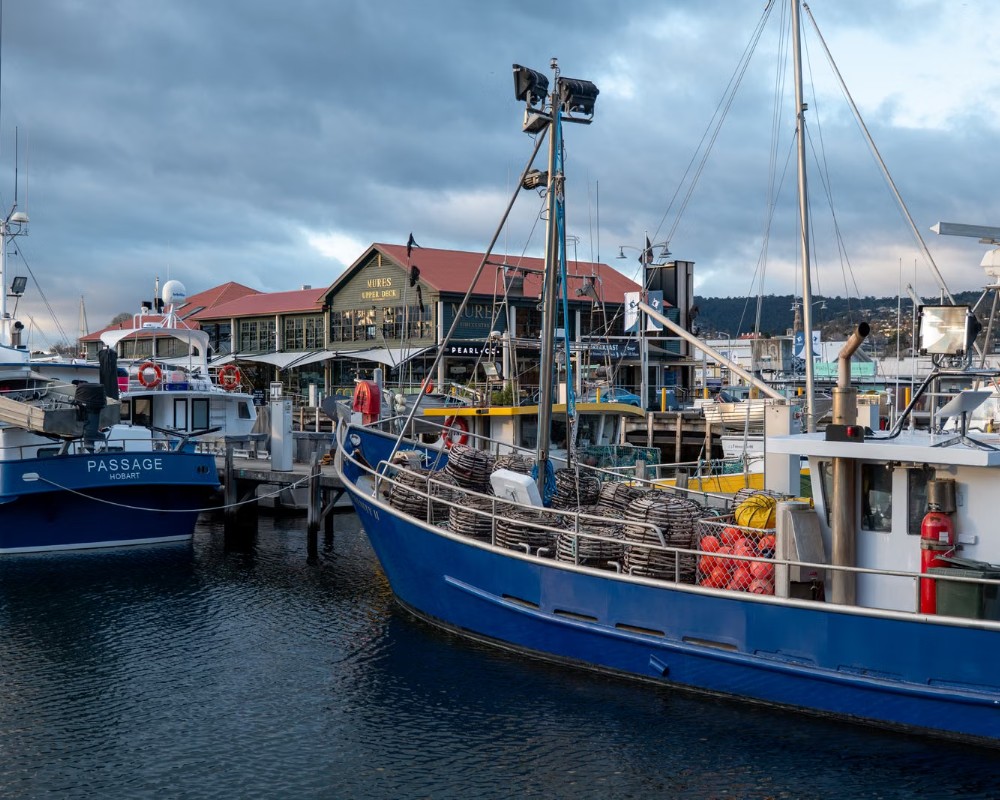
Sullivans Cove is the small bay at the foot of the city centre. Salamanca Place runs along its southern side, backed by the cottages of Battery Point. The docks and piers line the western shore, and Hunter Street, with its old jam factory, closes the northern end. Everything is flat and close together, and the whole precinct can be walked in 20 minutes, though it deserves a day.
This is where most visitors to Hobart spend much of their time, whether or not they are staying here.
Things To Do in Salamanca and Sullivans Cove
Salamanca Place
The warehouses of Salamanca Place were built between the 1830s and 1850s, when Hobart was one of the great whaling ports of the southern oceans. Their golden sandstone walls now hold galleries, craft and design shops, bookshops, bars and restaurants, with plane trees and lawns in front. The Salamanca Arts Centre occupies several of them, with studios, a theatre and exhibition spaces, and Salamanca Square behind has cafes around a fountain. Kelly’s Steps, cut in 1839, climb between the buildings to Battery Point.
Salamanca Market
Held every Saturday since 1972, the market fills the length of Salamanca Place with about 300 stalls from early morning until mid-afternoon. It is known for Tasmanian timber, ceramics, wool, leather and jewellery, for local produce, cheese, honey, whisky and gin, and for its buskers and street food. Come early to beat the crowds, especially when a cruise ship is in port.
The Docks
Constitution Dock is famous as the finishing point of the Sydney to Hobart yacht race, when the fleet ties up here at the end of December. For the rest of the year it shelters fishing boats and the floating fish punts that sell seafood over the side. Victoria Dock, next door, is home to the crayfish and trawler fleet. Along Franklin Wharf, bronze sculptures recall the Antarctic explorers who sailed from Hobart, and the red research and supply ships of the Australian Antarctic program are often moored nearby.
Museums
The Tasmanian Museum and Art Gallery faces Constitution Dock, with free galleries on Aboriginal Tasmania, colonial art, natural history and Antarctica, partly housed in buildings from the 1800s. The Maritime Museum of Tasmania is a block away, and a replica of the huts built by Douglas Mawson’s 1911 Antarctic expedition stands on the waterfront, with proceeds supporting the conservation of the originals.
Cruises and Ferries
Brooke Street Pier, a floating glass-roofed building, is the departure point for the ferry to MONA and for harbour and wilderness cruises, and has a market of Tasmanian products inside. Boats leave the waterfront for trips along the Derwent, to Bruny Island and to the sea cliffs of the Tasman Peninsula. Seaplanes take off from the cove for scenic flights, and a commuter ferry crosses to Bellerive.
Parliament and Parks
Parliament House, built by convicts in the 1830s as a customs house, overlooks lawns that are a popular lunch spot. St David’s Park, a block inland, was the first burial ground of the colony, and its old headstones are set into walls beneath English trees.
Where To Stay
The waterfront has the best concentration of hotels in Tasmania.
In Salamanca, Moss Hotel is a boutique hotel within the old warehouses, Lenna of Hobart occupies a sandstone merchant’s mansion, and the Salamanca Inn has apartment-style suites. Beside Parliament, The Tasman is a luxury hotel in a group of heritage and modern buildings.
On the northern side of the cove, MACq 01 stands on the old Macquarie Wharf with rooms themed on Tasmanian characters, and the Henry Jones Art Hotel fills the former IXL jam factory on Hunter Street. The Grand Chancellor overlooks Victoria Dock, and the Customs House Hotel has rooms above its pub opposite the wharves.
Bed and breakfasts and cottages in Battery Point, a few minutes’ walk uphill, offer a quieter alternative. Saturday nights, late December and the fortnight of Dark Mofo in June are the hardest times to find a room.
Self-contained rooms are easy to find close to the water. Zero Davey Boutique Apartments, on the waterfront in Sullivans Cove, has deluxe studios and water-view studios, and the Salamanca Wharf Hotel offers apartment-style rooms a short walk from Salamanca Place. The Old Woolstore Apartment Hotel on Macquarie Street, a few blocks inland, suits families, with apartments, its own restaurant and bar, and on-site car parking, a real help in an area where parking is scarce.
For a night with the art, the Pavilions at Mona are 30 minutes up the river by ferry, with breakfast and museum entry included in the stay.
There is no caravan park or camping ground near the waterfront. The Hobart Showground Motorhome and Caravan Park at Glenorchy, about 10 minutes’ drive north, takes caravans, fifth-wheelers, slide-ons and motorhomes (but not tents) on powered and unpowered sites, with a ten-day maximum stay and a dump point for paying guests, and buses into the city stop a short walk away. Discovery Parks Hobart, at Risdon on the eastern shore, has powered sites and cabins about 15 minutes’ drive from the cove.
Book well ahead for the Taste of Summer week over New Year and for Dark Mofo in June.
Eat & Drink
Seafood is the natural choice. Mures, between the two docks, has a fish and chip hall downstairs and a restaurant above, and the fish punts at Constitution Dock serve scallops, oysters and fish to eat on the wharf. The Drunken Admiral, on Hunter Street, is a long-established seafood restaurant in a nautical setting, and Aloft, on Brooke Street Pier, is one of the leading fine dining rooms in the state.
Salamanca has cafes for every hour. Machine Laundry Cafe and Tricycle Cafe are favourites for breakfast, Retro Cafe has watched the market from its corner for decades, and Daci and Daci Bakers, a short walk away on Murray Street, is known for pastries.
In the evening the warehouses fill with bars and restaurants, from the pub atmosphere of Jack Greene to whisky and wine bars pouring Tasmanian labels. On Friday evenings a free music session in the courtyard of the arts centre has been a local ritual for years. The hotel restaurants, including Peppina at The Tasman and Landscape at the Henry Jones, are open to non-guests.
Sullivans Cove has the greatest concentration of places to eat and drink in Tasmania, much of it within sight of the boats that land the seafood. Family businesses that have fed the docks for decades sit beside hotel dining rooms, a floating fine-dining room and, since mid-2026, a late-night pizza and cocktail bar behind Salamanca Place. The Taste of Summer food and drink festival fills Princes Wharf No. 1 from 27 December 2026 to 3 January 2027, and the Saturday market is the place to graze on local produce.
Seafood on the docks
Mures, a third-generation family business that catches its own fish, fills a building on Victoria Dock. The Upper Deck restaurant looks out over the fishing fleet, while the Lower Deck is a family-friendly bistro, cafe and fishmonger serving fish and chips from breakfast until dinner every day. Flippers, one of the floating fish punts in Constitution Dock, cooks fish and chips for lunch and dinner seven days a week. The Drunken Admiral has been a family-run seafood restaurant on the Old Wharf since 1979, in a maritime setting, and booking is advised. On Franklin Wharf, Frank brings South American flavours to Tasmanian produce, with fire-roasted oysters and scallops, empanadas and grilled meats with chimichurri.
Hotel restaurants and bars
The Henry Jones Art Hotel, in the old IXL jam factory on Hunter Street, has three venues open to everyone: Landscape Restaurant & Grill, which cooks Tasmanian steak and other produce over a wood-fired grill, Peacock and Jones for seasonal Tasmanian dishes, and the IXL Long Bar for cocktails among the sandstone and old timber. At The Tasman, Peppina serves Italian food beside Parliament House, and the hotel’s cocktail bar, Mary Mary, is a good stop before or after dinner. The Customs House Hotel at 1 Murray Street, opposite the wharves, has a pub restaurant and bar looking across to the docks.
Restaurants and cafes
Aloft, on the top floor of the floating Brooke Street Pier, has one of the best harbour views in the city and a seasonal menu built on Tasmanian produce. Sit by the window and share from the tasting menu, or take a bar seat and watch the chefs at work. Downstairs, Harbour Matcha, opened in 2026, is a matcha bar handy for the ferry queue. In the Salamanca Arts Centre, Tricycle Cafe & Bar serves Tasmanian-roasted coffee, all-day breakfast, lunch and house-baked treats, with local beer, wine and cider later in the day. Daci & Daci Bakers, at 11 Murray Street, opens daily for classic pastries, petits gateaux, breads and savoury breakfasts and lunches.
Bars, brewers and distillers
Manky Sally’s, at 25 Salamanca Place, is Moo Brew’s nano-brewery and taphouse, where you can try small-batch beers and watch the brewers at work; it belongs to Mona, whose brewery began at Moorilla. LARK, the distillery that pioneered Tasmania’s modern whisky industry, pours tastings, including older museum releases, at its Hobart cellar door. Behind Salamanca Place at 22 Montpelier Retreat, Don Frico opened in mid-2026 in the old Society bar space, with New York-style pizza by the slice, martinis, records on the turntable and a late licence; it takes walk-ins only. Viva Art Lounge, at 91a Salamanca Place, combines a wine bar, a piano and an art gallery.
Worth the ferry
The Mona ferry from Brooke Street Pier takes about 30 minutes to reach the museum’s own restaurants and bars at Berriedale. Faro Bar + Restaurant, inside the museum, holds a set dinner on Friday and Saturday nights, The Source Restaurant serves seasonal Tasmanian lunches with river views and an award-winning wine list, and Heavy Metal Kitchen cooks over fire on the lawns. Moorilla Cellar Door pours wines from a vineyard founded in 1958. Mona and its on-site venues open Thursday to Monday and close on Tuesdays and Wednesdays.
History
The cove is the country of the muwinina people. In February 1804 Lieutenant-Governor David Collins landed here to found Hobart Town, choosing the site for its fresh water and deep anchorage, and named the cove after a British official. Convicts built wharves, stores and a causeway to Hunter Island, which now lies beneath Hunter Street.
Whaling, sealing, wool and later apples and jam made the port rich. Salamanca Place, named for a victory of the Duke of Wellington, declined into a run-down warehouse district in the twentieth century before artists and the market revived it in the 1970s.
Getting to Salamanca and Sullivans Cove
The waterfront is a five-minute walk from the centre of Hobart. Airport buses stop near Brooke Street Pier, and most city bus routes pass within a few blocks.
Parking is limited and metered, and Salamanca Place is closed to cars on Saturdays for the market. Staying nearby and walking is by far the easiest approach.
Experiences
- City
- Cultural
- Food and Wine
- Historic/Heritage
Popular Activities
- City Sightseeing
- Cruising
- Food and Wine
- Nightlife
- Shopping
About Salamanca and Sullivans Cove
- Locality: Suburb
- Salamanca and Sullivans Cove Postcode: 7004
- State: Tasmania
- Region: Hobart and South
- Latitude: -42.8870
- Longitude: 147.3325
- Timezone: Australia/Hobart
