
Point Lookout, QLD
Point Lookout is the main holiday township on North Stradbroke Island, spread across a rocky headland at the north-eastern tip of the island. It is the most easterly point of Queensland, with surf beaches on three sides, a famous cliff-top walk and some of the best land-based whale watching in Australia, about two hours from the centre of Brisbane.
Known For
- The North Gorge Walk and its marine life
- Whale watching from the headland from June to November
- Cylinder Beach and a string of surf beaches
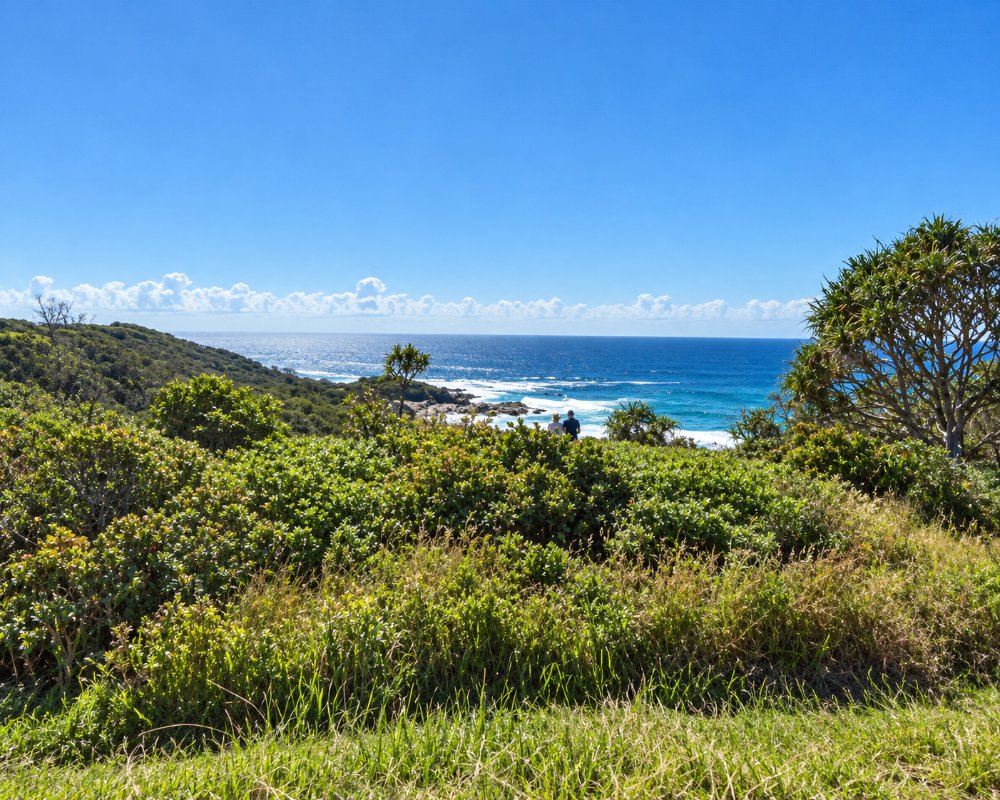
The township is strung along a single road that follows the headland for about three kilometres, with houses and holiday units stepping down wooded slopes to the beaches. There is no real centre, only small clusters of shops, cafes and a pub. To the south, Main Beach runs unbroken for more than 30 kilometres.
Straddie, as the island is known, has a relaxed, barefoot atmosphere, and Point Lookout is where most visitors stay. The island is also known by its traditional name, Minjerribah.
Things To Do in Point Lookout
North Gorge Walk
This 1.2-kilometre loop of boardwalk and path circles the headland above cliffs, surge channels and a deep gorge where the swell rushes in. It is one of the finest short coastal walks in Queensland. Turtles, dolphins and manta rays are regularly seen in the clear water below, kangaroos graze on the grassy slopes, and a blowhole sounds on bigger seas. Allow 45 minutes and go early or late in the day.
Whale Watching
Each year thousands of humpback whales pass close to the headland on their migration, heading north from June and returning with calves until November. Because the continental shelf is near, they can often be seen breaching a few hundred metres from the rocks. The lookouts along the gorge walk and the headland above Main Beach are the best vantage points, and no boat is needed.
Beaches
Cylinder Beach is the favourite for families, a sheltered cove with gentle waves, patrolled in season, with a camp ground and picnic lawns behind. Frenchmans and Deadmans beaches are small, beautiful coves below the headland, reached by steps and unpatrolled. Main Beach is the long surf beach to the south, patrolled near the headland and open to four-wheel-drives with a permit further along. Swim between the flags, as currents are strong.
Surfing
Point Lookout has surf for all levels. Cylinder produces a classic right-hand point wave on the right swell, and Main Beach offers powerful beach breaks. Surf schools run lessons, usually at Cylinder or Home Beach, and boards can be hired.
Diving and Snorkelling
Rocky reefs just offshore are among the leading dive sites in southern Queensland. Manta rays gather in summer, grey nurse sharks in winter, and leopard sharks, turtles and schools of fish are present all year. A dive operator at Point Lookout runs boat trips and courses.
Fishing
Anglers fish from the beaches for tailor, bream, dart and whiting, and from the rocks for bigger species. The run of tailor in late winter is an annual event. Rock fishing here is dangerous in any swell.
The Cook and Centaur Memorials
Opposite 19 Mooloomba Road, near the start of the gorge walk, a monument marks the naming of Point Lookout by James Cook, who sighted the headland from the Endeavour on 17 May 1770. Point Lookout also has a memorial to the hospital ship AHS Centaur, sunk by a Japanese submarine on 14 May 1943 about 23 nautical miles east-north-east of the point, the greatest loss of life from a submarine attack in Australian waters. The memorial was unveiled in 1994 and faces the sea where the ship went down.
Where To Stay
Point Lookout has the widest choice of accommodation on the island.
Holiday apartments and resorts along the headland offer self-contained units with pools and ocean views, a short walk from the beaches. Hundreds of private holiday houses, from old fibro shacks to architect-designed homes, are let through island agents and suit families and groups.
The beachfront camp grounds at Cylinder Beach, Adder Rock and other sites are run by the island’s traditional owners, with powered and unpowered sites and some glamping tents. They book out months ahead for school holidays.
The island hotel has rooms and villas, and there is a small resort of cabins set in bushland near Home Beach. Prices are highest and minimum stays apply over Christmas, Easter and the winter school holidays.
The Straddie Hotel on East Coast Road, reopened in December 2025 after a nine-month refurbishment, has hotel rooms and larger ocean-view apartments above Cylinder Beach. Nearby, Claytons on Cylinder on Mooloomba Road has beachfront apartments with a private sand track down to the beach. Anchorage on Straddie, a beachfront resort on East Coast Road, has its own restaurant, gift shop and board hire, and The Islander Holiday Resort sits in bushland across the road from Home Beach, where kangaroos often graze on the lawns. Allure Stradbroke Resort, also on East Coast Road, has architect-designed beach shacks and villas of one to four bedrooms.
Samarinda, on Samarinda Drive about 200 metres from the gorge walk, has a pool and ocean-view balconies, and next door Whalewatch Ocean Beach Resort has three-bedroom apartments with a heated pool and gym. Pandanus Palms on Cumming Parade has two and three-bedroom villas, and backpackers and divers stay at the YHA in Manta Lodge on Dickson Way. Of the camping grounds, Adder Rock has 35 powered sites, seven ensuite cabins and Eco Island tents, Cylinder Beach has eight powered van sites, and Home Beach is a small ground with ten powered sites. Fuel is sold at the Point Lookout Roadhouse on Dickson Way.
Eat & Drink
Dining is casual. The island hotel, set on the headland with a broad deck over the ocean, serves bistro meals and is the place to be at sunset. A handful of cafes along the main road do breakfast, coffee, burgers and fish and chips, and a long-running gelato shop near the gorge walk is a tradition after a swim.
A bakery, a small supermarket and a seafood shop supply those who are self-catering, and a bowls club and surf club serve inexpensive meals. Several places close early in the week outside holiday periods, so check ahead.
The Straddie Hotel reopened in December 2025 with a reworked main bar pouring Straddie Brewing Co beers, a bistro menu of local oysters, seafood platters, parmies and steak, an all-weather deck with a retractable roof, and a summer kiosk for early coffee and breakfast. Six Beaches Fish Grill and Bar, at 29 Mooloomba Road, grills local fish and mixes cocktails with sea views, with light bites and live music on Sunday afternoons; it is closed on Tuesdays and Wednesdays outside the summer holidays. Fishes Cafe and Bakery, opposite the gorge walk, serves all-day breakfasts, fish and chips, burgers and Straddie seafood.
Oasis on Straddie on Dickson Way pairs Mexican food with woodfired pizza and cocktails, and runs a free shuttle bus. The Prawn Shack, a small turquoise shack on Mooloomba Road, is known for its prawn rolls, and Whale Tail Gelati makes its gelati on the premises. The bowls club’s Curlew Kitchen does bistro meals, with the Fever on Straddie coffee van out the front in the mornings, and the surf club’s Point Bar opens to the public on weekend afternoons. Foodworks Point Lookout on Endeavour Street is the supermarket, and the Point Lookout Roadhouse sells fuel, ice, bait and takeaway.
History
North Stradbroke Island is the country of the Quandamooka people, who have lived on and around Moreton Bay for many thousands of years, and Point Lookout is known as Mulumba. In 2011 native title over much of the island was formally recognised.
James Cook named the headland as he sailed past in 1770. A lighthouse reserve and fishing shacks were the only buildings until the 1930s, when the first guesthouses opened. Sand mining, long the main industry of the island, ended in 2019, and tourism is now its mainstay.
Getting to Point Lookout
Vehicle ferries and fast passenger ferries run from Cleveland, on the mainland, to Dunwich on the western side of the island, taking 25 to 50 minutes. Cleveland is about 45 minutes by car or an hour by train from central Brisbane, with a shuttle bus to the ferry.
From Dunwich a bus meets most ferries for the 20-kilometre trip to Point Lookout, about 25 minutes. Bringing a car makes it easier to explore the island, and vehicle ferries should be booked in advance.
Experiences
- Island
- Nature based
- Relaxation
Popular Activities
- Beach
- Caravan and Camping
- Diving
- Fishing
- Surfing
- Swimming
- Wildlife
About Point Lookout
- Locality: Urban locality
- Point Lookout Postcode: 4183
- State: Queensland
- Region: Brisbane
- Latitude: -27.42764
- Longitude: 153.53624
- Elevation: 38m
- Timezone: Australia/Brisbane
