
East Melbourne, VIC
East Melbourne is the elegant, leafy suburb that begins where the city grid ends. In the space of a few blocks it holds the Melbourne Cricket Ground, the state’s Parliament, the largest church in Australia, two of the city’s finest public gardens and some of its best preserved Victorian streets. It is one of the smallest suburbs in Melbourne and one of the most rewarding to walk.
Known For
- The Melbourne Cricket Ground, the spiritual home of Australian sport
- Fitzroy Gardens and Cooks’ Cottage
- Parliament House, St Patrick’s Cathedral and grand Victorian terraces
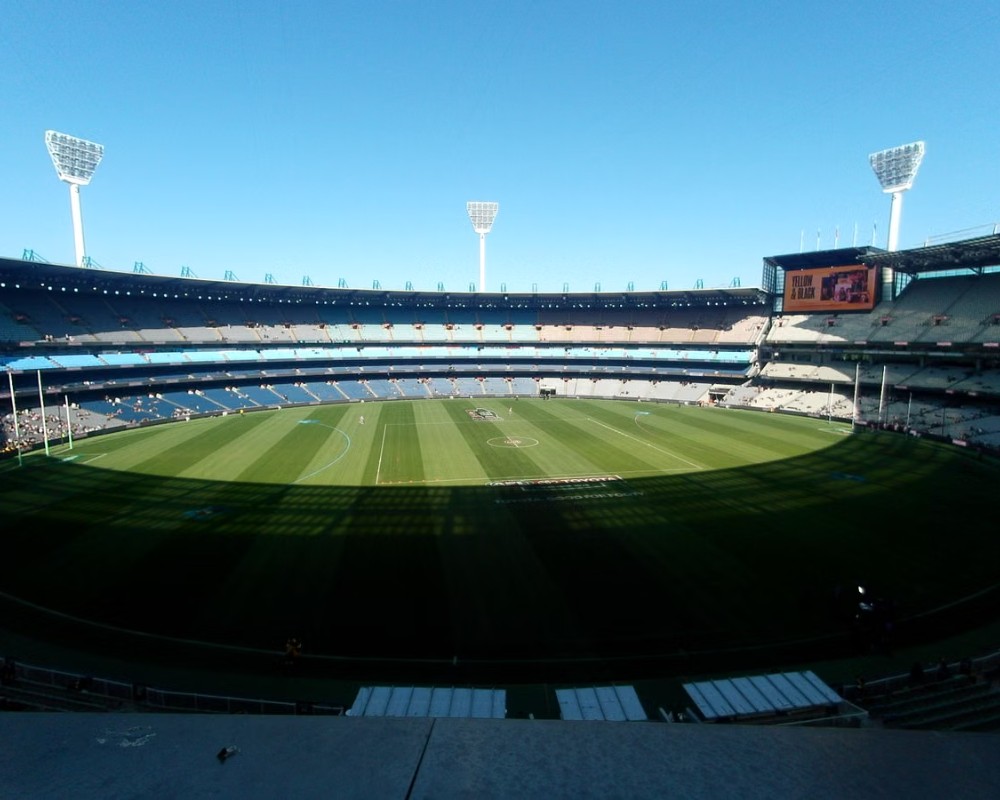
The suburb is bounded by Spring Street and the city on one side, and by the parkland around the MCG on the other. Between them is a quiet residential quarter of bluestone mansions, iron-laced terraces and plane trees that has changed remarkably little in a hundred and fifty years.
Most visitors to Melbourne come here for a specific reason, usually a match at the MCG or a walk through the gardens, and are surprised by how much else there is. It is an easy ten or fifteen minute stroll from the centre of the city, most of it under trees.
History and Heritage
East Melbourne lies on the Country of the Wurundjeri Woi-wurrung people of the Kulin Nation. The high ground above the Yarra was a camping and meeting place, and several scarred trees, from which bark was cut for canoes and shields, still stand in Yarra Park and Fitzroy Gardens.
A Government Reserve
When Melbourne was surveyed in 1837, the land east of the grid was set aside for public purposes rather than sold. The colony’s first superintendent, Charles La Trobe, built his cottage at Jolimont, on the southern edge of the area, in 1839. Over the following decades the reserve was divided between parks, churches, government buildings and a select residential subdivision.
Parliament, Cathedral and the Establishment
Gold rush wealth in the 1850s paid for buildings on a grand scale. Parliament House was begun in 1856 on the hill at the top of Bourke Street, and the Treasury followed. The Anglican bishop built his residence, Bishopscourt, in bluestone in 1853, and it remains the oldest house in the suburb. Work on St Patrick’s Cathedral started in 1858 and continued, on and off, for more than eighty years. Judges, politicians, doctors and merchants built their homes in the streets between, and East Melbourne became one of the most fashionable addresses in the colony.
The MCG
The Melbourne Cricket Club, founded in 1838, moved to its present ground in Yarra Park in 1853. The first Test cricket match ever played was held here in 1877, between Australia and England. The game of Australian Rules football was devised by members of the club, and its earliest matches were played in the surrounding parkland in 1858. The ground was the main stadium for the 1956 Olympic Games, and it has hosted football grand finals, royal visits, papal masses and rock concerts.
Preservation
In the twentieth century many of the big houses were divided into flats and boarding houses, and some were demolished for hospitals and offices. Residents fought back from the 1960s, and much of the suburb is now protected. One modern intruder has itself become a heritage landmark: ICI House, completed in 1958 on Nicholson Street, was the first skyscraper in Australia to be clad in a glass curtain wall and the building that broke the city’s long-standing height limit.
Attractions in East Melbourne
The sights fall into three groups: the stadium and its park, the gardens, and the buildings along the city edge.
Melbourne Cricket Ground
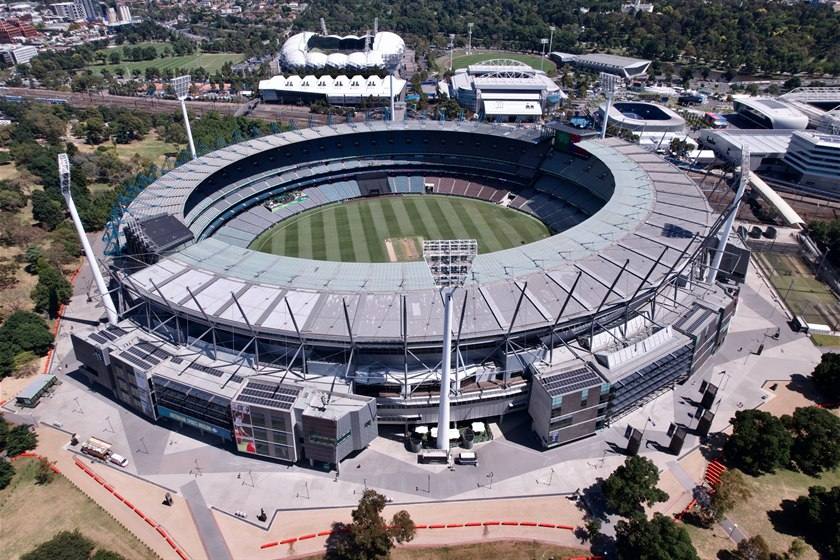
Known to everyone simply as the G, the MCG holds about 100,000 people and is the largest stadium in the southern hemisphere. Seeing a game here is a highlight of any visit. The Australian Football League season runs from March to September and ends with the Grand Final, and the Boxing Day Test match is the centrepiece of the cricket summer. On non-event days, guided tours led by club volunteers take you into the players’ rooms, the members’ Long Room and out to the edge of the turf.
The Australian Sports Museum, inside the stadium, covers cricket, football, the Olympics and much else, with interactive exhibits that let visitors test their own skills. Statues of sporting greats line the paths outside.
Fitzroy Gardens
Laid out from the 1860s, Fitzroy Gardens is a classic Victorian park of sweeping lawns, fern gullies and long avenues of English elms, among the finest surviving in the world. Its best known feature is Cooks’ Cottage, a small stone house built in Yorkshire in 1755 by the parents of Captain James Cook. It was taken apart, shipped to Melbourne and rebuilt here in 1934, which makes it the oldest building in Australia.
Elsewhere in the gardens are a Spanish Mission style conservatory with changing floral displays, the Fairies Tree, a stump carved with fairies and bush animals by sculptor Ola Cohn in the 1930s, and a miniature Tudor village sent by the people of Lambeth in London in thanks for food parcels during the Second World War.
Parliament House and the Treasury Precinct
The colonnaded Parliament House on Spring Street is one of the grandest public buildings of the British Empire, even though its planned dome was never built. Free guided tours run on weekdays when Parliament is not sitting, and the richly gilded chambers are worth seeing. Next door, the Old Treasury Building houses a free museum of Melbourne history, and behind it the Treasury Gardens provide a shady shortcut to Fitzroy Gardens.
St Patrick’s Cathedral
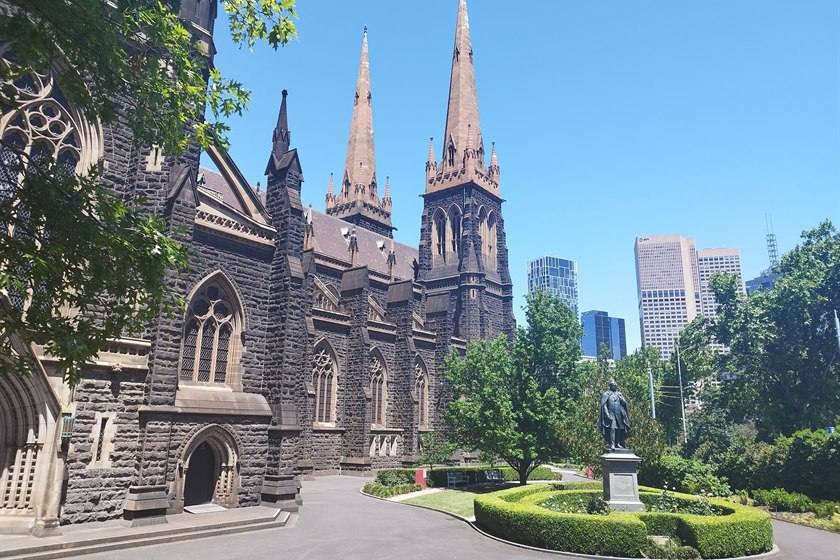
The Catholic cathedral, designed by William Wardell, is the largest church building in Australia and one of the finest examples of Gothic Revival architecture anywhere. Built of dark bluestone, it was consecrated in 1897, and its three spires were finally completed in 1939. The interior is lit by amber glass, and visitors are welcome outside service times.
Historic Streets and House Museums
A walk along Powlett, Hotham and George streets passes some of the best nineteenth century houses in Melbourne, from simple bluestone cottages to towered Italianate mansions. Tasma Terrace, behind Parliament, is an outstanding three-storey terrace row and the headquarters of the National Trust. The Johnston Collection, a house museum of English Georgian and Regency furniture and decorative arts, can be visited by pre-booked tour. The 1893 Eastern Hill Fire Station holds a small museum of firefighting history.
Where To Stay
East Melbourne has only a handful of places to stay, which is part of its appeal. It is quiet at night, yet within walking distance of the city, the MCG and the tennis centre at Melbourne Park.
The Park Hyatt Melbourne, beside St Patrick’s Cathedral and Fitzroy Gardens, is one of the leading luxury hotels in the city, with large rooms and a formal, club-like atmosphere. Pullman Melbourne on the Park, on Wellington Parade, directly faces the MCG across Yarra Park, and many of its rooms look over the ground and the gardens.
Beyond these, accommodation is mostly in serviced apartments and small boutique hotels in converted Victorian houses on the residential streets. Rooms anywhere near the stadium sell out early and rise sharply in price for the football finals in September, the Boxing Day Test and the Australian Open in January.
Pullman Melbourne on the Park reopened in 2022 after a major refurbishment. It has a pool, a gym, a day spa, a suite set up for guests with pets and Cliveden Bar and Dining, and Jolimont station is a couple of minutes’ walk away. On the city side of Spring Street, facing Parliament House, the Hotel Windsor is a grand hotel from the 1880s.
Across Victoria Parade in Fitzroy, the Nunnery, at 116 Nicholson Street, is the budget choice, with dorms, private rooms and a self-contained guesthouse for families and groups, and the StandardX, on Rose Street, is a newer boutique hotel with 125 rooms. Crowne Plaza Melbourne Carlton, which opened in 2026 on Swanston Street, is about 2 km north.
Street parking in East Melbourne is short-term and metered, and on match days the car parks in Yarra Park fill early, so choose a hotel with parking or come by train. The nearest caravan park is BIG4 Melbourne Holiday Park at 265 Elizabeth Street, Coburg, about 10 km north, with powered and ensuite sites, cabins and villas, and trams into the city close by.
Eat & Drink
This is a residential suburb, not a dining destination, and its restaurants and cafes cater mainly to locals, hospital staff and match-day crowds.
The main strip is Wellington Parade, where a row of cafes, pubs and restaurants faces the park. Geppetto Trattoria has been serving traditional Italian food here for decades, and the pubs along the parade fill with supporters before and after games. Around the corner, small cafes on George Street and Clarendon Street are good for breakfast or coffee before a walk through the gardens.
For a wider choice, the restaurants of the city centre are a short walk west, and the pubs and eateries of Bridge Road and Swan Street in neighbouring Richmond are just across Punt Road. Inside the MCG, food and drink are available throughout the stadium on event days. Venues change, so check before making a special trip.
Fitzroy Gardens now holds one of the city’s most ambitious restaurants. Yiaga, opened in October 2025 by chef Hugh Allen of Vue de Monde, serves set menus of a dozen or more courses at lunch and dinner, on tableware made by Australian craftspeople, in a building designed by the architect John Wardle; bookings are essential. Geppetto Trattoria, at 78A Wellington Parade near Simpson Street, is a family-run Italian restaurant that has been on the parade since 1981 and suits a bowl of pasta before a game.
Inside Parliament House, the Strangers’ Corridor restaurant on level one opens to the public for weekday lunches in weeks when Parliament is not sitting, and serves a traditional high tea of scones, pastries and finger sandwiches on some Thursday afternoons; book ahead for both, and bring a card, as the building is cash-free. At the Pullman, Cliveden Bar and Dining is handy for a drink before a match.
For groceries, the supermarkets of the city centre are a short walk west.
Getting to East Melbourne
From the city centre, East Melbourne is close enough to walk. Head to the top of Collins or Bourke Street, cross Spring Street, and continue through the Treasury and Fitzroy Gardens. The MCG is about twenty minutes on foot from Flinders Street Station, along the river or over the footbridges from Federation Square.
Trams run along Wellington Parade from Flinders Street, stopping at Jolimont and the MCG, and along Victoria Parade on the northern side. The Free Tram Zone ends at Spring Street, so you need a myki card to ride beyond it.
By train, Jolimont Station is right beside the MCG and Richmond Station is a short walk from the southern stands. Parliament Station serves the western end of the suburb. On big match days, extra trains and trams run, roads around Yarra Park are closed or congested, and public transport is by far the best option.
Experiences
- City
- Cultural
- Historic/Heritage
Popular Activities
- City Sightseeing
- Food and Wine
- Sightseeing
About East Melbourne
Accommodation In East Melbourne
Discover some of the accommodation in and around East Melbourne
Tours In East Melbourne
Discover some of the tours options around East Melbourne
