
Melbourne Chinatown, VIC
Melbourne’s Chinatown runs along Little Bourke Street in the centre of the city, a narrow strip of red archways, lanterns, restaurants and nineteenth century brick buildings squeezed between the office towers. It dates from the gold rush of the 1850s and is regarded as the oldest Chinatown in Australia and the longest continuously settled Chinese quarter in the Western world.
Known For
- The oldest Chinatown in Australia, dating from the 1850s gold rush
- Dumplings, yum cha and late-night Cantonese restaurants
- The Chinese Museum and the Chinese New Year dragon parade
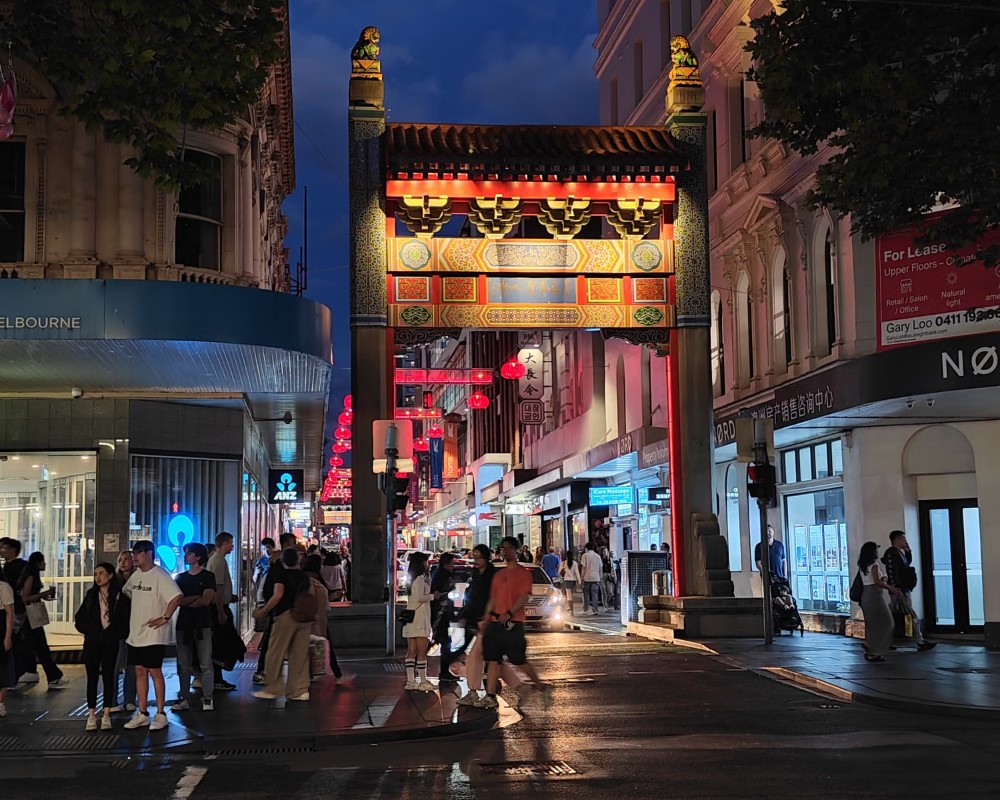
The precinct is small. Its core is the three blocks of Little Bourke Street between Swanston Street and Spring Street, together with the lanes that branch off on either side. You can walk its length in ten minutes, though few people manage to do so without stopping to eat.
What sets it apart from many Chinatowns is its age and its setting. The street is one of the little streets of the original city grid, only ten metres wide, and many of its buildings were put up by Chinese merchants and societies in the second half of the 1800s. It is part of the fabric of central Melbourne rather than a district apart, and it is busy from lunch until the early hours.
History and Heritage
Little Bourke Street lies on the Country of the Wurundjeri Woi-wurrung people of the Kulin Nation. The story of its Chinese community begins soon after the founding of the city.
The Gold Rush
When gold was discovered in Victoria in 1851, the news travelled quickly to southern China. Tens of thousands of men, most of them from villages in Guangdong province, sailed for what they called New Gold Mountain. Many landed in Melbourne and needed somewhere to stay, buy supplies and find news from home before walking to the diggings. Little Bourke Street, then a cheap and unfashionable back street, became that place. Lodging houses, provision stores and gambling rooms opened, and by the end of the decade it was an established Chinese quarter.
Societies, Merchants and Furniture Makers
As the easy gold ran out, many miners returned to the city. District societies, formed by men from the same part of China, built clubhouses that offered lodging, help in hard times and a place to worship. The Num Pon Soon Society building, completed in 1861, still stands and is among the oldest Chinese society buildings in the country. Chinese merchants controlled much of the fruit trade, especially bananas, and by the 1880s the street and its lanes were also crowded with cabinet makers, laundries, herbalists and tea merchants. A Chinese mission church, opened in 1872, survives on the street.
Hard Times
Anti-Chinese feeling grew through the late nineteenth century and was written into law with the Immigration Restriction Act of 1901, the foundation of the White Australia policy. With new arrivals all but stopped and few women among the original settlers, the community aged and shrank. By the middle of the twentieth century Chinatown had dwindled to a handful of businesses and many of its buildings had been taken over for other uses.
Revival
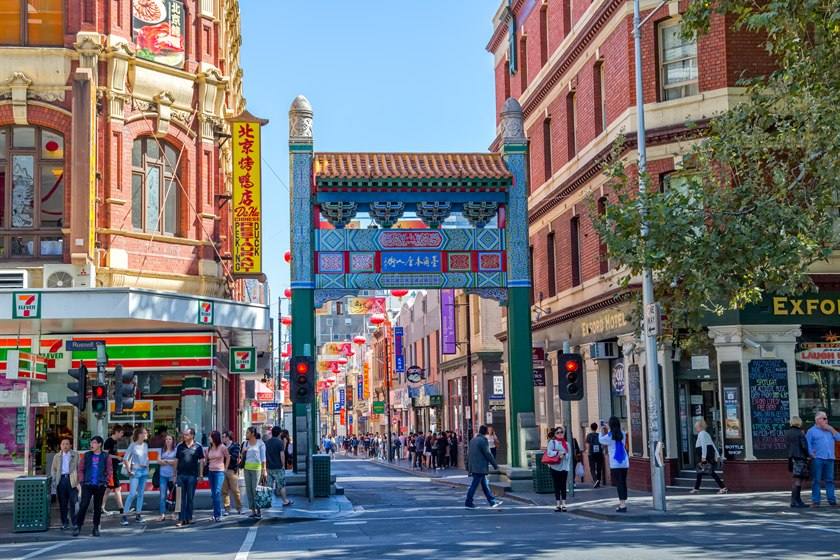
The easing and eventual end of the White Australia policy brought new migrants from Hong Kong, Malaysia, Singapore, Vietnam and later mainland China. In the 1970s, local business leaders and the city council set out to revive Little Bourke Street as a destination. The ceremonial archways that span the street were erected in 1976, restaurants multiplied, and the Chinese Museum opened in 1985. Chinatown is now one of the most visited parts of the city and remains a centre of community life.
Attractions in Chinatown
Chinatown is best explored slowly and on foot, looking up at the facades and ducking into the lanes.
Little Bourke Street and its Archways
Red and gold gateways mark each block of the street, and strings of lanterns hang overhead. Behind the restaurant signs are some fine Victorian buildings, including former warehouses, society halls and shops with Chinese characters still visible in the brickwork. The street is at its most atmospheric after dark, when the neon comes on and the footpaths fill.
Chinese Museum
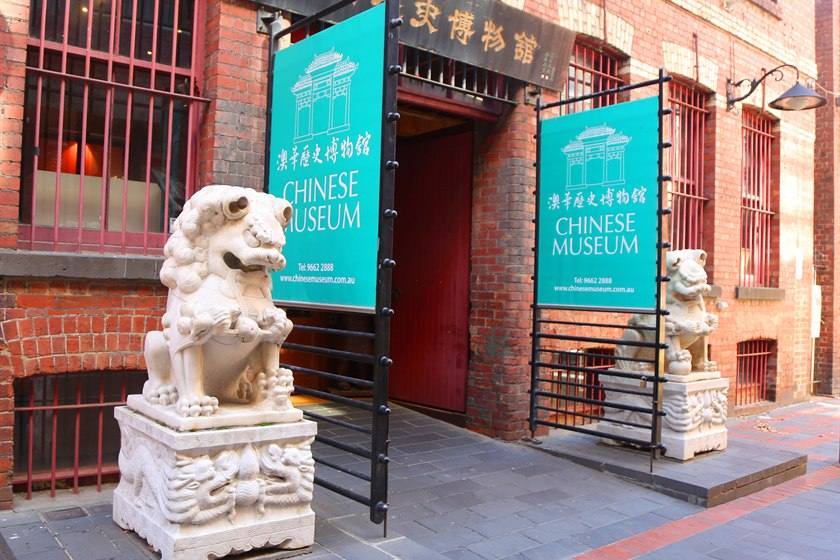
The Museum of Chinese Australian History occupies a former warehouse in Cohen Place, just off Little Bourke Street. Over several floors it tells the story of Chinese people in Australia from the gold rush to the present, with a recreated goldfields scene in the basement. Its most famous residents are the processional dragons, among them Dai Loong and the enormous Millennium Dragon, which is more than a hundred metres long and needs a large team to carry it through the streets. The Facing Heaven Archway outside the museum is modelled on a gateway in Nanjing.
The Lanes
Much of the character of Chinatown lies in its side lanes. Market Lane and Celestial Avenue are lined with restaurants. Heffernan Lane, Corrs Lane and Tattersalls Lane mix eateries with small bars and street art. Some lanes are barely wide enough for a delivery van, and several lead to places you would never find by accident.
Chinese New Year
The biggest event of the year is the Chinese New Year festival, held in late January or February. Little Bourke Street is closed to traffic for stalls, performances, firecrackers and lion dances, and the highlight is the dragon parade, when the great dragon from the museum is woken and carried through the streets. Smaller celebrations mark the Mid-Autumn Festival later in the year.
Theatres and Gardens
Chinatown backs onto the East End theatre district. Her Majesty’s Theatre and the Comedy Theatre are on Exhibition Street, and the Princess Theatre is a block away on Spring Street, which makes the area popular for a meal before a show. At the Spring Street end, the small Tianjin Garden, a gift from the Chinese sister city of Melbourne, offers a quiet place to sit beside a traditional gateway and stone lions.
Where To Stay
There are few hotels on Little Bourke Street itself, but Chinatown is surrounded by them, and staying nearby puts you within a few minutes’ walk of the restaurants, the theatres and the main shopping streets.
Close to the eastern end, the Grand Hyatt and the Sofitel Melbourne on Collins are large luxury hotels, and The Hotel Windsor on Spring Street is the grand old lady of the city. QT Melbourne, on Russell Street, is a stylish design hotel just south of the precinct.
For mid-range stays, The Victoria Hotel on Little Collins Street has been operating since 1880 and is well placed and reasonably priced, and there are serviced apartments and chain hotels on Little Bourke, Lonsdale and Exhibition streets. Rooms facing the lanes can be noisy late at night, especially at weekends, so ask for a higher floor if you are a light sleeper.
At the Spring Street end of Little Bourke Street, Laneways by Ovolo is a small, art-filled hotel with a pet-friendly package, and Lanson Place Parliament Gardens, between the city and the Fitzroy and Treasury Gardens, has a range of rooms up to two-bedroom apartments. Melbourne Place on Russell Street is a newer design-led hotel with the rooftop bar Cleo and Marmelo, a Portuguese-inspired restaurant. On Lonsdale Street, the Hotel Grand Chancellor sits a few steps from the restaurants and theatres, and Mantra on Russell has apartment-style rooms and a pool.
For a tighter budget, the Space Hotel at 380 Russell Street has private rooms and dorms a short walk north of the precinct. Hotel Indigo and the family-friendly Holiday Inn share a building on Melbourne Walk above the Bourke Street Mall, a block south.
Hotel car parks in the city centre have low height limits and will not take caravans or most campervans. Travellers towing a van are better off at the Melbourne BIG4 Holiday Park on Elizabeth Street in Coburg, about 10 km north, or Discovery Parks – Melbourne in Braybrook, about 11 km west, and coming in by tram or train.
Eat & Drink
Food is the main reason to come, and the range runs from cheap plates of dumplings to one of the most celebrated Chinese restaurants in the country.
Flower Drum, upstairs in Market Lane, has been serving refined Cantonese food since 1975 and is famous for its Peking duck and its formal, old-school service. It is expensive and needs to be booked well ahead. At the other end of the scale, Supper Inn on Celestial Avenue has fed late-night diners for decades with congee, roast meats and seafood until the small hours.
Dumplings are a Chinatown staple. HuTong Dumpling Bar, opposite Flower Drum, is known for its soup-filled xiao long bao, made in an open kitchen. Shanghai Village is a cheap, cheerful and chaotic favourite with students, and ShanDong MaMa, in an arcade off Bourke Street, specialises in fish dumplings.
Yum cha is served at several large restaurants at lunchtime, particularly on weekends, when queues are common. The precinct also has Sichuan hotpot, Malaysian, Japanese, Korean barbecue and Thai restaurants, along with bubble tea shops and bakeries.
For a drink, Section 8 is an open-air bar built from shipping containers and pallets in Tattersalls Lane, and Solace, a cocktail and electronic music bar at the end of graffiti-covered Croft Alley, has replaced The Croft Institute, which was fitted out like a science laboratory. Restaurants here open and close often, so check before making a special trip.
Chinatown’s dining now spreads well beyond Little Bourke Street into Russell, Exhibition and Lonsdale streets and the arcades that run through to Bourke Street, and the food covers much of China’s regional cooking, from Cantonese banquets and Shanghai dumplings to Sichuan noodles, Chongqing hotpot and Taiwanese desserts, alongside Thai, Korean and Japanese kitchens. The Midcity Centre at 206 Bourke Street packs dumpling houses, hotpot, ramen and dessert bars into one building. Several of the older restaurants still allow BYO wine, many kitchens run late, and the yum cha queues are longest at weekends and around Lunar New Year.
Cantonese Institutions
Beyond its Peking duck, Flower Drum in Market Lane is known for its baked crab and a chef’s menu that is not printed, and it has been run as a fine diner since 1975. Supper Inn, upstairs at 15 Celestial Avenue, opened in 1977 and has kept its timber-panelled room; regulars order the roast suckling pig, chilli quail or eggplant and salted fish hotpot, and the kitchen serves until about 2.30am. Shark Fin Inn at 50 Little Bourke Street has served Cantonese classics since 1980, with har gao and fried taro dumplings on its yum cha menu. Westlake, at 189 Little Bourke Street, is one of the city’s longest-running Chinese restaurants, licensed and BYO, with yum cha through the day.
Yum Cha and Dim Sum
Crystal Jade at 154 Little Bourke Street serves modern Cantonese food and yum cha at large round tables with tick-off order sheets, and its melon soup comes in a hollowed-out melon. Tim Ho Wan, in the Midcity Centre on Bourke Street, is the Hong Kong dim sum chain that began with a Michelin star, and its baked barbecue pork buns are the dish to try. Secret Kitchen at 222 Exhibition Street sits behind a large curved fish tank, with live seafood, Peking duck pancakes and novelty buns such as pig-shaped custard buns. Chine on Paramount, at 101 Little Bourke Street, serves Cantonese dishes and dim sum overlooking Chinatown Square.
Dumplings, Noodles and Hotpot
Shanghai Street at 146-148 Little Bourke Street is a BYO dumpling house known for its xiao long bao and fried pork buns. China Red, in the Midcity Centre and part of the HuTong group, takes orders by touch screen and is good for chilli wontons and soup dumplings. Sichuan House at 22-26 Corrs Lane serves cheap, fiery Sichuan dishes, and Dainty Sichuan at 149 Lonsdale Street is known for Chongqing noodles and hotpots cooked on burners set into each table. For a late meal, Wong’s Late Night Hot Pot on Little Bourke Street serves Chongqing-style hotpot into the night, while Fishpot in the Midcity Centre uses a fish broth, with wagyu and seafood sent to the table by a hotpot lift.
Modern Asian Restaurants
RuYi, at 16 Liverpool Street off Little Bourke Street, is a smart pan-Chinese restaurant known for Peking duck bao, lychee caramel pork ribs and a strong cocktail list. Longrain at 44 Little Bourke Street has served modern Thai food here since 2005; it closed in 2020 and was revived by chef Scott Pickett, and its banquet includes five-spice pork hock and wagyu red curry. Khao Soi at 107 Little Bourke Street is a cosy Thai restaurant built around noodle soup, Red Chilli House at 119 Little Bourke Street cooks bold southern Chinese dishes, and Bornga, upstairs at 178 Little Bourke Street, is a Korean barbecue restaurant with banquet options for groups.
Bars and Late Nights
Above Section 8 in Tattersalls Lane, Aster is a small bar over two levels with laneway views and DJs. Union Electric at 13 Heffernan Lane mixes cocktails downstairs and has a gin garden on the roof, and Bar Clara is a basement cocktail bar under a neon sign at 87 Little Bourke Street, with a seasonal list. Longsong, upstairs from Longrain, pairs cocktails with bar snacks such as prawn toast and oysters, and suits a drink before or after dinner. Seamstress at 113 Lonsdale Street is a bar and dining room styled on nineteenth-century Chinatown, and StoryVille at 185 Lonsdale Street is a bar and late-night club themed on fairytales.
Desserts, Tea and Snacks
The Midcity Centre is also the place for sweets: BlackBall serves Taiwanese desserts and teas, and Royal Custard Puff sells custard-filled puffs. Sweetie and Moustache, on the fourth floor at 205 Russell Street, is a dessert bar known for its many-layered mille crepe cake, and Dessert Story serves tofu pudding, herbal jelly and crushed ice. Bubble tea shops line the precinct, among them Teaser on Russell Street and Mr Babo Tea, and Taning Lemontea makes fresh lemon tea to order. For a quick bite, Mr Ramen San in the Midcity Centre serves Hakata-style ramen with house-made noodles.
Getting to Chinatown
Chinatown is in the middle of the city and easy to reach. Trams run along Swanston Street and Bourke Street, one block away, and all travel within the city centre is free. Get off at the Bourke Street Mall or Russell Street stops and walk north to Little Bourke Street.
By train, Parliament Station is at the eastern end of the precinct and Melbourne Central is two blocks from the western end. The Metro Tunnel, opened in late 2025, added State Library Station, under Swanston Street at La Trobe Street, and Town Hall Station, under Swanston Street near Collins Street, both a short walk from the western end. From Flinders Street Station it is a ten minute walk up Swanston Street.
Little Bourke Street is narrow and often congested, so driving is not recommended. If you must, there are several commercial car parks on Lonsdale Street and Little Bourke Street, some with cheaper evening rates.
Experiences
- City
- Cultural
- Food and Wine
- Historic/Heritage
Popular Activities
- City Sightseeing
- Food and Wine
- Nightlife
- Shopping
