
Melbourne City Centre, VIC
The centre of Melbourne is a neat rectangle of streets about a mile long and half a mile wide, laid out in 1837 and still the heart of the city. Locals call it the CBD or simply the city. Within its grid are Victorian arcades and Gothic banks, glass towers, theatres, department stores, a great domed library and, hidden between the main streets, the laneways full of cafes, bars and street art that have become the thing Melbourne is best known for.
Known For
- Laneways, arcades and street art
- Coffee, restaurants and rooftop bars
- Grand Victorian buildings, from Flinders Street Station to the State Library
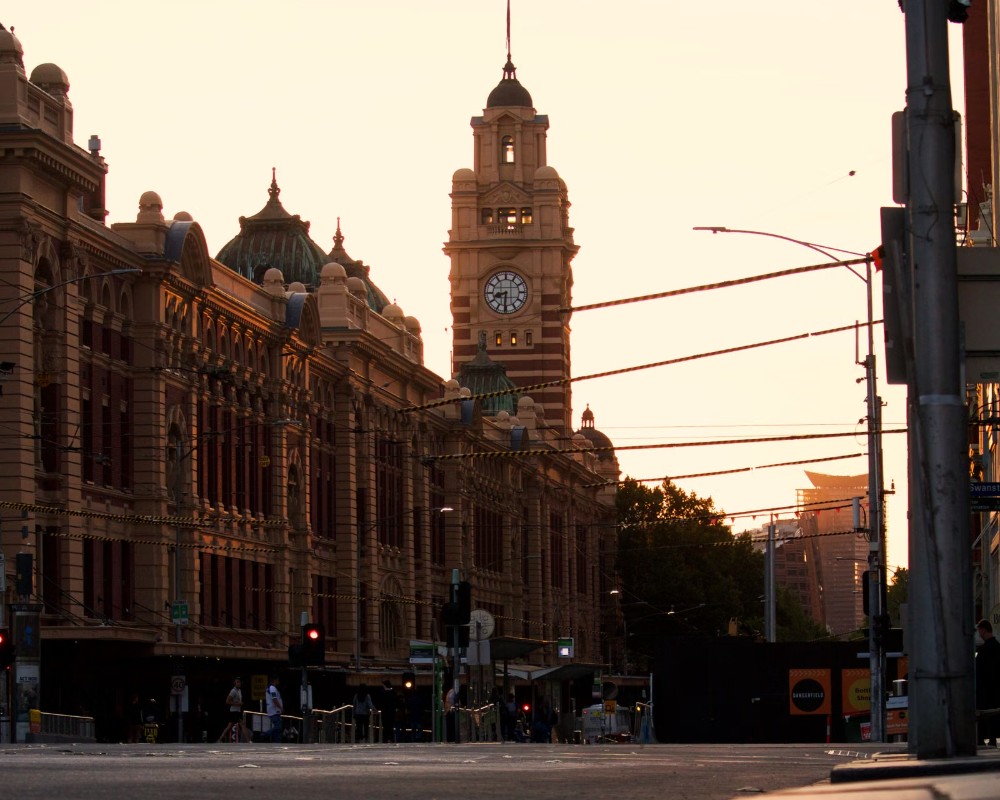
What makes the city centre unusual is how much of its life happens out of sight. The broad streets carry the trams and the traffic, while the best cafes, bars and small shops are tucked down alleys, up staircases and in basements. Exploring on foot, with no fixed plan, is the best way to see it.
The grid is compact and flat, trams within it are free, and almost every visitor to Melbourne will spend time here. It is also the best base for a first visit, with the largest choice of hotels and easy connections to everywhere else.
History and Heritage
The land on which the city stands belongs to the Wurundjeri Woi-wurrung and Bunurong peoples of the Kulin Nation, who gathered along the Yarra, or Birrarung, for thousands of generations.
Founding and the Hoddle Grid
In 1835 two rival parties of settlers from Tasmania, led by John Batman and John Pascoe Fawkner, set up camp on the north bank of the river. Two years later the surveyor Robert Hoddle pegged out a formal town plan. His grid had main streets a generous 30 metres wide, each paired with a narrow service street behind it. These became the little streets, such as Little Collins and Little Bourke, and the lanes that ran off them are the origin of the laneways of today.
Gold and Marvellous Melbourne
The discovery of gold in Victoria in 1851 transformed a modest colonial town. Within a decade Melbourne was the largest city in Australia, and by the 1880s it was among the richest in the world, nicknamed Marvellous Melbourne. The boom left a legacy of ornate banks, hotels, theatres, arcades and public buildings, many of which survive. A financial crash in the 1890s ended the party, but the city served as the national capital from Federation in 1901 until Parliament moved to Canberra in 1927.
Decline and Revival
After the Second World War, people and shops moved to the suburbs and the centre grew quiet after office hours. Many fine buildings were demolished. The turnaround began in the late 1980s and 1990s, when changes to liquor laws made it easy to open small bars, the city council encouraged people to live in the centre again, and the neglected laneways were reopened and filled with cafes. Today tens of thousands of people live within the grid, and it is busy at all hours.
Attractions in the City Centre
There is enough here for several days. These are the highlights, arranged roughly from the river northwards.
Flinders Street Station and Federation Square
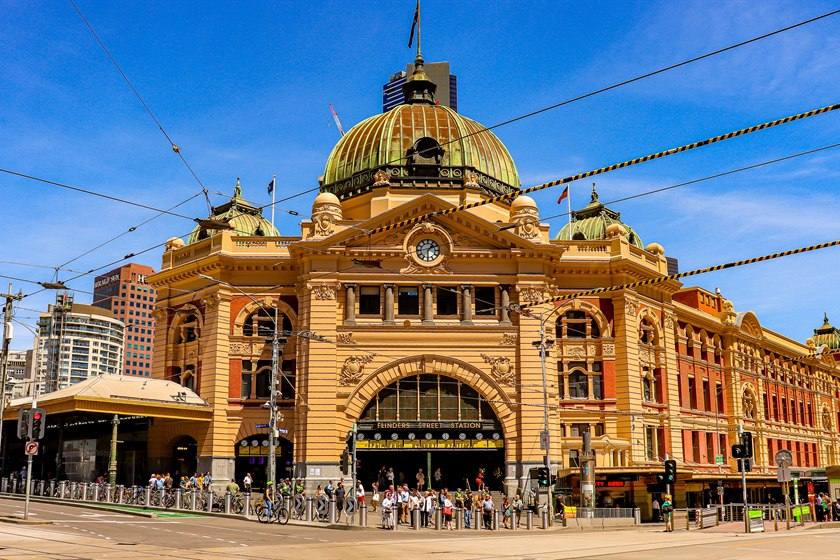
The domed, mustard-coloured station on the corner of Flinders and Swanston streets opened in 1910 and is the busiest in the country. The row of clocks above its entrance is the traditional Melbourne meeting place. Directly opposite, Federation Square is a very different piece of architecture, a cluster of angular buildings around a sloping plaza that opened in 2002. It houses the Ian Potter Centre, which holds the Australian collection of the National Gallery of Victoria, the screen culture museum ACMI, and the Koorie Heritage Trust. St Paul’s Cathedral, with its sandstone spires, stands on the third corner.
Laneways and Street Art
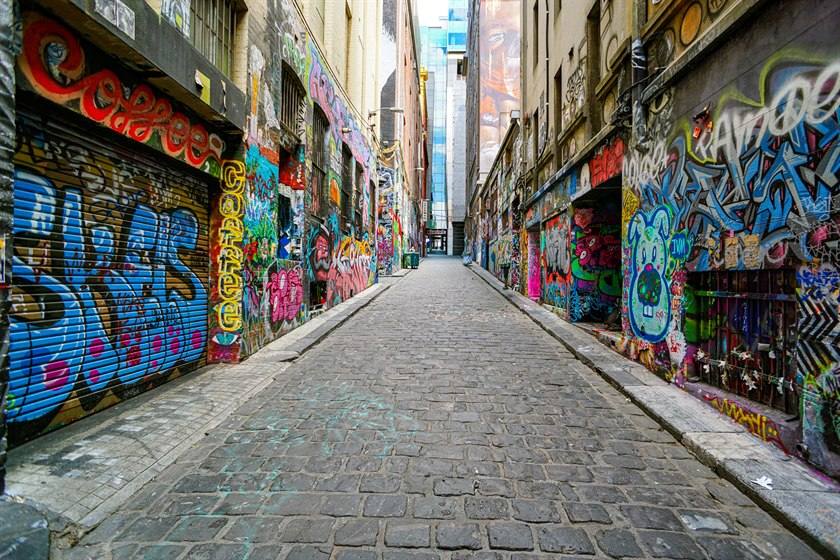
Hosier Lane, off Flinders Street, is the most famous street art site in Australia, its walls covered from ground to roofline in constantly changing work. Nearby AC/DC Lane is named for the band. Degraves Street and Centre Place, running north from the station, are narrow lanes lined with tiny cafes and are as good a place as any to try the coffee for which the city is known. Further north, Hardware Lane is filled with restaurant tables each evening. Guided walking tours are a good way to find the lanes you would otherwise miss.
The Arcades
Two nineteenth century shopping arcades link Collins Street and Bourke Street. The Block Arcade, opened in 1892, has a mosaic floor, a glass canopy and a tea room that has traded for generations. The Royal Arcade, dating from 1870, is the oldest in Australia and is watched over by the carved figures of Gog and Magog, who strike the hour on either side of a large clock.
Bourke Street Mall and Collins Street
Bourke Street Mall is the main shopping strip, closed to cars but not to trams. The former General Post Office and the big department stores are here, and the animated Christmas windows are a local tradition. One block south, Collins Street is the grandest street in the city, with Gothic Revival banks, churches, and designer boutiques at the tree-lined eastern end.
State Library Victoria and Old Melbourne Gaol
The State Library, founded in 1854, is one of the oldest free public libraries in the world. Its great octagonal reading room, beneath a dome that was the largest of its kind when built in 1913, is open to everyone and should not be missed. The free galleries above display the armour worn by the bushranger Ned Kelly. A short walk away is the bluestone Old Melbourne Gaol, where Kelly was hanged in 1880, now a museum.
Queen Victoria Market
On the northern edge of the grid, the market has been trading since 1878 and is the largest open-air market in the southern hemisphere. The meat, fish and delicatessen halls are the highlight for food lovers, and the sheds outside sell fruit and vegetables, clothing and souvenirs. It is closed on Mondays and Wednesdays, and night markets run in summer and winter.
Parliament and the East End
Parliament House, at the top of Bourke Street, has been the seat of the Victorian government since 1856, and free tours run on days when Parliament is not sitting. The streets below it form the theatre district, where the Princess, Her Majesty’s and the Regent stage the big musicals. The nearby Old Treasury Building, built with gold rush wealth, is a free museum of the city’s history.
More to See
Other stops include the Immigration Museum in the Old Customs House, the SEA LIFE aquarium on the river, and Melbourne Central shopping centre, where a brick shot tower from 1889 stands preserved beneath a huge glass cone. The free City Circle tram, run with heritage cars, loops around the edge of the grid and is an easy way to get your bearings.
Where To Stay
The city centre has more hotel rooms than anywhere else in Victoria, at every price.
For heritage, The Hotel Windsor, opposite Parliament, has been welcoming guests since 1883 and is known for its afternoon tea. The InterContinental Melbourne The Rialto occupies a pair of flamboyant 1890s Gothic buildings on Collins Street. Among the modern luxury hotels, the Grand Hyatt, the Sofitel Melbourne on Collins and The Westin are long-established, while The Ritz-Carlton, high in a tower on Lonsdale Street, and the W Melbourne on Flinders Lane are more recent arrivals. QT Melbourne is a popular design hotel with a rooftop bar.
Mid-range and budget travellers are well served by chain hotels, serviced apartments and hostels, particularly around Little Bourke, Lonsdale and Elizabeth streets. The eastern end of the grid is generally quieter and leafier, and the western end is handier for Southern Cross Station. Prices climb during the Australian Open, the Grand Prix, the football finals and the Melbourne Cup carnival.
Eat & Drink
Melbourne takes food and coffee seriously, and the city centre is where much of its reputation was made.
Flinders Lane is the best-known dining street. Chin Chin serves loud, lively South-East Asian food and usually has a queue, Cumulus Inc. is an all-day favourite, and Supernormal does modern Asian dishes. MoVida, on Hosier Lane, helped start the Australian love affair with Spanish tapas, and Gimlet, in a 1920s building on Russell Street, is one of the most glamorous dining rooms in the country.
For a taste of old Melbourne, Pellegrini’s Espresso Bar on Bourke Street has barely changed since 1954 and was among the first places in the city to own an espresso machine. Good coffee is available on almost every block, usually from small independent cafes.
After dark, look up. Rooftop bars are a local speciality, including the one on top of Curtin House on Swanston Street, which doubles as an open-air cinema in summer, and Siglo, which looks across to Parliament House. Many of the best small bars have no obvious sign, so it pays to ask around. Restaurants and bars change often, so check before making a special trip.
Getting to the City Centre
All suburban train lines run to the city. Flinders Street and Southern Cross are the two main stations, and the underground stations at Melbourne Central, Parliament and Flagstaff, together with the newer State Library and Town Hall stations on the Metro Tunnel, bring you closer to the middle of the grid. Regional trains and coaches arrive at Southern Cross, as does the SkyBus from Melbourne Airport, which takes around half an hour outside peak times.
Trams run along most main streets, and travel within the city centre is free. Listen for the announcement that you are leaving the Free Tram Zone, beyond which you need a myki card.
Driving in the centre is not recommended. Parking is expensive, and at many intersections drivers turning right must do so from the left lane, a manoeuvre known as a hook turn that confuses visitors. The bayside suburb of St Kilda is about twenty minutes away by tram.
Experiences
- City
- Cultural
- Food and Wine
- Historic/Heritage
Popular Activities
- City Sightseeing
- Food and Wine
- Nightlife
- Shopping
