
Docklands, VIC
Docklands is Melbourne’s newest inner-city suburb, built on the wharves and rail yards that once made this the busiest port in Australia. Wrapped around the calm water of Victoria Harbour on the western edge of the city centre, it is a place of glass towers, marinas, waterfront promenades and public art, anchored by a 53,000-seat stadium with a roof that closes when the weather turns.
Known For
- Marvel Stadium, home of football, cricket and major concerts
- Victoria Harbour, with its promenades, marinas and waterfront dining
- Bold modern architecture and public art in one of the largest urban renewal projects in Australia
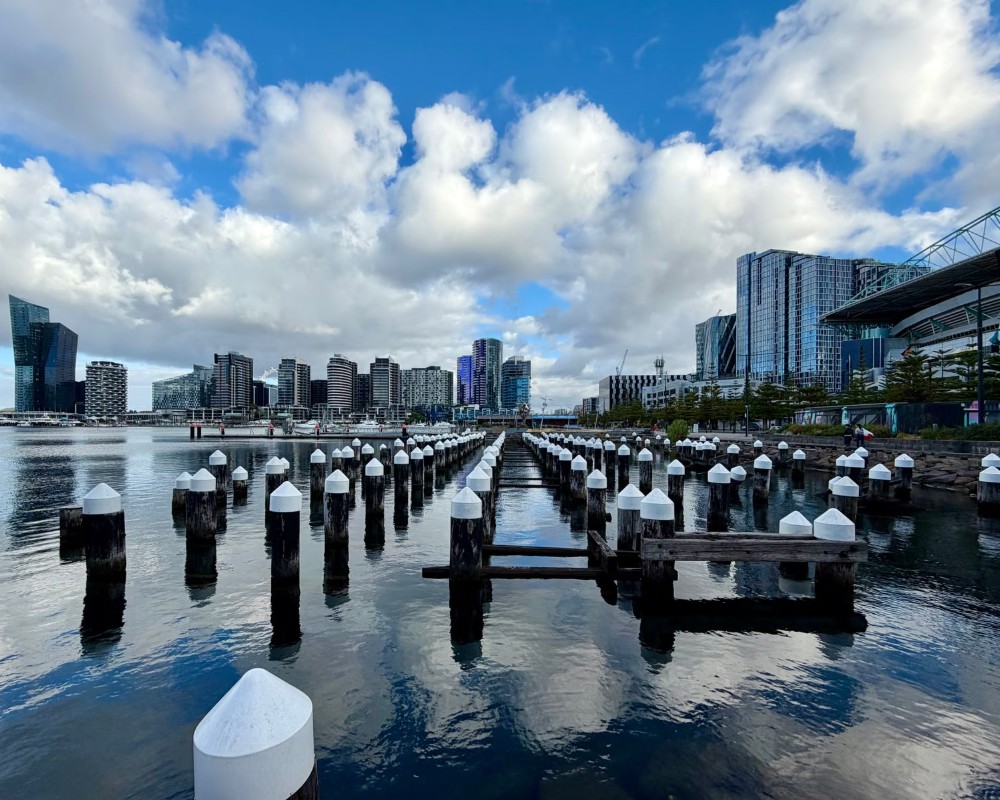
It is fair to say that Docklands divides opinion. In its early years it was criticised as windswept and lacking in character, a collection of apartment blocks without a heart. Two decades on it has filled in considerably, with parks, a striking public library, schools and more than fifteen thousand residents, and it rewards visitors who come with the right expectations.
Do not come looking for the laneway bars and Victorian terraces of older Melbourne. Come instead for a stadium event, a long flat walk or bike ride beside the water, a sunset drink facing west over the harbour, and a look at how a modern city rebuilds itself. Everything is within the Free Tram Zone, which makes it one of the cheapest parts of the city to explore.
History and Heritage
The story of Docklands is one of constant reinvention, from wetland to working port to wasteland and back to waterfront.
The Blue Lake
This is the Country of the Wurundjeri Woi-wurrung and Bunurong peoples of the Kulin Nation. Before European settlement the area west of the future city was a large wetland fed by the Yarra and Moonee Ponds Creek. At its centre was a shallow salt lagoon, later called the West Melbourne Swamp, which early settlers described as a beautiful blue lake fringed with flowering plants and crowded with swans, ducks and other waterbirds. It was an important hunting and gathering place.
Within a few decades of settlement the lagoon had become a dumping ground for the growing town’s waste, and it was eventually drained and filled.
Building the Port
In its natural state the lower Yarra was narrow, shallow and winding, and large ships had to anchor in the bay and send their cargo upriver by lighter. In the 1880s the engineer Sir John Coode designed a solution: a canal that cut out a long loop of the river, and a huge dock excavated from the swamp beside it. The Coode Canal opened in 1886 and Victoria Dock in the early 1890s. More than two million cubic metres of earth were removed to build it.
The dock was an immediate success. By the early twentieth century it handled the great majority of Victoria’s imports, and the surrounding land was covered with cargo sheds, railway sidings, gasworks and cool stores. Central Pier was added during the First World War.
Decline and the Dance Party Years
The arrival of container shipping in the 1960s made the old finger wharves obsolete. Trade moved downstream to new docks with room for cranes and container stacks, and by the 1980s Victoria Dock was largely abandoned. For a brief period in the 1990s its empty sheds found a second life as venues for some of Melbourne’s biggest dance parties.
A New Suburb
The state government set up an authority in 1991 to redevelop the area, and work began in earnest later that decade. The stadium opened in 2000, and the residential precincts of NewQuay, Victoria Harbour and Yarra’s Edge followed. Collins Street and Bourke Street, the two great avenues of the city, were extended west over the railway lines to link the new suburb to the old.
A few fragments of the working port remain. The long brick Goods Shed No. 2, built in 1889, has been restored as offices, and the Mission to Seafarers on Flinders Street, a 1917 building in Spanish Mission style with a distinctive domed gymnasium, still offers a welcome to visiting ships’ crews. Central Pier was closed in 2019 because of structural concerns and the whole pier, sheds included, was removed by October 2025.
Attractions in Docklands
Docklands is spread out, so it helps to think of it as a loop around the harbour, starting from Southern Cross Station.
Marvel Stadium
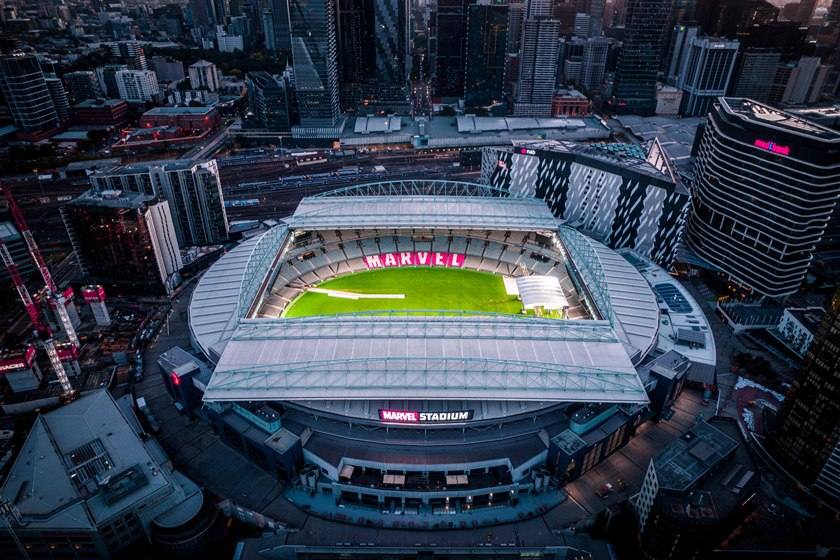
The stadium is the reason most visitors first come to Docklands. It hosts Australian Rules football through the winter, Big Bash cricket in summer, and international concerts and other events year-round. The retractable roof means nothing is ever rained out, and the seating is close to the action by the standards of large Australian grounds. It is five minutes on foot from Southern Cross Station over the Bourke Street footbridge, and the surrounding concourse has been rebuilt in recent years with new bars and places to eat.
Victoria Harbour and the Promenades
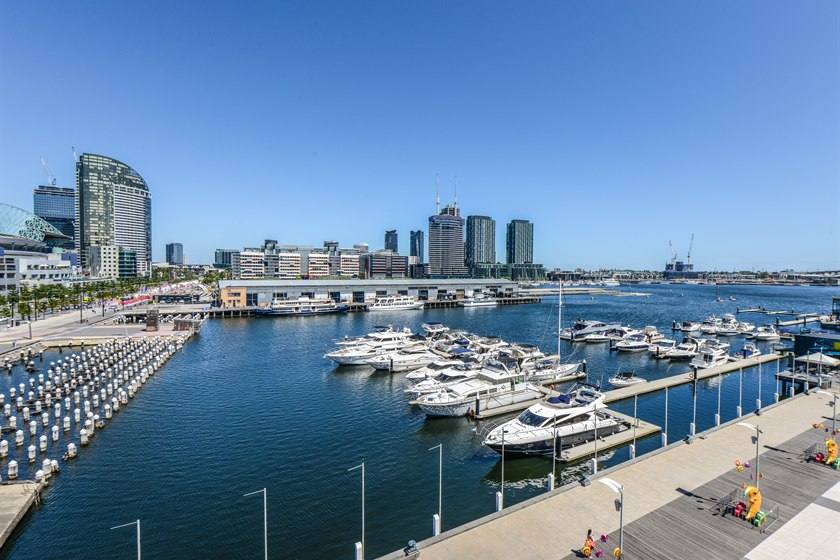
A continuous path follows the water’s edge for several kilometres, from NewQuay on the north side, past the end of Collins Street, to Yarra’s Edge on the south bank of the river. It is flat, wide and popular with walkers, runners and cyclists. Yachts and cruisers fill the marinas, and the evening light over the water can be superb. Self-drive picnic boats, kayak tours and river cruises operate from the harbour at various times of year.
Library at The Dock
Opened in 2014 at the harbour end of Collins Street, this three-storey public library is built largely from engineered timber and recycled hardwood and was one of the most sustainable public buildings in the country when it opened. Inside are reading rooms with water views, a gallery, recording studios and a performance space. It is a pleasant place to stop even if you have no intention of borrowing a book, and the park and playground next door suit families.
Public Art and Bridges
Developers in Docklands were required to spend a share of their budgets on art, and the results are scattered throughout the suburb. The best known is Cow Up a Tree, John Kelly’s bronze of exactly that, on the harbour esplanade. Bunjil, a 25-metre white sculpture of the eagle-hawk creator spirit by Bruce Armstrong, watches over the traffic on Wurundjeri Way. In Docklands Park, a field of tall wind-driven sculptures spins and tips in the breeze.
The Webb Bridge, a curving pedestrian and cycle bridge over the Yarra at the southern end of the suburb, is wrapped in a web of steel hoops inspired by Aboriginal eel traps. It is one of the most photographed structures in the city.
The District Docklands
The northern end of the suburb is given over to a large open-air shopping and entertainment precinct. As well as outlet stores and a cinema, it has an ice-skating centre with two full-size rinks, where you can skate or watch ice hockey, and a number of family attractions. The giant observation wheel that towers over it, the Melbourne Star, closed in 2021 and was due to reopen in October 2026.
Fox Classic Car Collection
Housed in the historic Queen’s Warehouse on the corner of Collins Street and Batmans Hill Drive, this museum displays dozens of rare cars collected by trucking magnate Lindsay Fox, with a strong emphasis on Mercedes-Benz, Porsche and Ferrari. Opening days are limited, so check before you go.
Events
Docklands comes alive for a handful of events each year. The largest is Firelight, a free winter festival held over several nights around the solstice, with fire sculptures, light installations, music and food along the waterfront. The harbour is also one of the main viewing areas for the city’s New Year’s Eve fireworks.
Where To Stay
Hotels in Docklands tend to be newer and better value than those in the middle of the city, and many rooms have water or skyline views. The trade-off is a quieter neighbourhood at night.
The Melbourne Marriott Hotel Docklands, at the northern end, is the most upmarket option, with a rooftop infinity pool and bar looking back at the city. Vibe Hotel Melbourne Docklands and Peppers Docklands are comfortable mid-to-upper range hotels close to the harbour and the stadium, and The Sebel offers apartment-style rooms on the Yarra side.
There is also a very large supply of serviced and privately let apartments, which can be good value for families or groups who want a kitchen and laundry. For stadium events, staying near the Bourke Street or Collins Street end of the suburb puts you within a few minutes’ walk of the gates and of Southern Cross Station. Prices rise sharply on the nights of big concerts and football finals.
Eat & Drink
The dining scene in Docklands is built around its waterfronts rather than any one famous restaurant, and it is at its best on a warm evening when the tables spill outside.
NewQuay Promenade, on the north side of the harbour, has the longest row of restaurants, covering Italian, Greek, Asian, seafood and steak. Most have terraces facing the water and the sunset. Victoria Harbour Promenade, at the foot of Collins Street, has a smaller cluster of cafes, bars and restaurants that is busy with office workers at lunch.
Around the stadium, pubs and casual eateries fill up before and after games, and it pays to book or arrive early on event nights. The District has family-friendly chains and a food court, and the rooftop bar at the Marriott is the pick for a drink with a view. Venues open and close frequently in Docklands, so check current listings.
If you want more variety, the restaurants of the city centre are a free tram ride away.
Getting to Docklands
Docklands is one of the easiest parts of Melbourne to reach. Southern Cross Station, the terminus for regional trains, airport buses and many suburban lines, sits on its eastern edge, and footbridges lead from the station concourse straight to the stadium.
Trams run into the suburb along Collins Street, Bourke Street, La Trobe Street and Harbour Esplanade, and the City Circle tourist tram loops through as well. All of Docklands falls within the Free Tram Zone, so there is no fare to pay if you are travelling from elsewhere in the city centre.
On foot, it takes about fifteen minutes to walk from the middle of the city to the harbour. Cyclists can follow the Capital City Trail along the river. There is plenty of paid parking, including at the stadium and The District, though traffic is heavy on event days and public transport is the better choice.
Experiences
- City
- Cultural
- Food and Wine
Popular Activities
- City Sightseeing
- Cruising
- Cycling
- Food and Wine
- Shopping
About Docklands
Accommodation In Docklands
Discover some of the accommodation in and around Docklands
