
Evandale, TAS
Evandale, Tasmania, is a destination where history meets charm. Located just 20 kilometers south of Launceston, this picturesque village can be reached in about 20 minutes by car, making it a convenient stop for travelers exploring Northern Tasmania. With its rich Georgian heritage and a calendar filled with lively events, Evandale offers visitors an authentic glimpse into Australia’s colonial past.
Known For
- Georgian architecture and heritage buildings
- The National Penny Farthing Championship
- Weekly Sunday market
Evandale’s story begins in the early 19th century, when Tasmania was still known as Van Diemen’s Land. Established as a military post in 1811, the settlement was a key site during the colonization of the island. It grew steadily as free settlers and convicts arrived, transforming the area into a thriving hub for agriculture and trade.
Originally called Collins Hill and later Morven, the town was renamed Evandale in 1836 to honor George William Evans, one of the colony’s most influential surveyors. Evans was known for his work mapping parts of Tasmania and mainland Australia, contributing significantly to the development of infrastructure and settlements during the colonial period.
The Georgian architecture that defines Evandale today began to take shape in the 1820s and 1830s. During this time, the town’s position on the South Esk River made it an important stop for travelers and traders moving goods between Launceston and Hobart. Wealthy settlers and businesses invested in constructing durable, elegant buildings that reflected the prosperity of the era.
One of the town’s earliest landmarks, St. Andrew’s Uniting Church, was completed in 1840 and remains a focal point of the community. Its simple yet stately design is a quintessential example of early Tasmanian church architecture. Other structures, such as the Blenheim Inn and Clarendon Arms Hotel, further exemplify the enduring craftsmanship of the period.
Like much of Tasmania, Evandale’s development was heavily influenced by convict labor. Many of the town’s buildings were constructed by skilled convicts who were assigned to local landowners or government projects. These individuals brought expertise in masonry, carpentry, and other trades, leaving a lasting legacy in the town’s infrastructure.
Convict-built structures, including private homes, public buildings, and bridges, can still be seen throughout Evandale. The town’s well-preserved state makes it one of the best places in Tasmania to explore this aspect of colonial history.
During the 19th century, Evandale became a key center for agriculture. The fertile plains surrounding the town supported the growth of wheat, barley, and other crops, while sheep grazing flourished in the region. Evandale’s position near major transport routes allowed farmers to easily trade their goods, contributing to the prosperity of the area.
The town’s agricultural success was further bolstered by its close proximity to Launceston, which provided a ready market for produce. This economic growth helped fund the construction of schools, churches, and other civic amenities, turning Evandale into a model village of the colonial era.
Evandale has been home to several notable figures in Tasmanian history. John Glover, the acclaimed colonial landscape artist, spent the latter years of his life in the region. Glover’s works, which often depicted the idyllic Tasmanian countryside, have cemented his place as one of Australia’s most celebrated painters.
Another significant figure associated with Evandale is Lieutenant Colonel Henry William “Harry” Murray VC, one of Australia’s most decorated soldiers from World War I. His statue stands proudly in the town, commemorating his extraordinary service and bravery.
Things to Do
Evandale’s vibrant cultural scene ensures there’s always something happening. Each February, the town hosts the National Penny Farthing Championship, drawing competitors and spectators from across the globe. Beyond the excitement of the races, the Evandale Village Fair offers market stalls, food vendors, and live entertainment, creating a festive atmosphere.
For art lovers, March brings the Glover Prize, one of Australia’s most prestigious landscape art awards. Held at the Falls Park Pavilion, it showcases contemporary interpretations of Tasmania’s breathtaking scenery. On Sundays, the local market is a must-visit for fresh produce, antiques, and handmade crafts, capturing the spirit of the region’s creativity.
A visit to Evandale isn’t complete without exploring its standout attractions. The Clarendon House, located just outside the village, is an impressive Georgian mansion surrounded by manicured gardens. It provides a fascinating insight into the lives of Tasmania’s early settlers.
For those seeking unique photo opportunities, the life-sized sculpture of artist John Glover in Falls Park and the statue of Lieutenant Colonel Henry William “Harry” Murray VC on Russell Street are local landmarks that celebrate the town’s connection to Tasmanian history and culture.
Honeysuckle Banks
Below the town, the river flats at Honeysuckle Banks hold the remains of Aboriginal campsites and stone artefacts, and this is where European settlement began. The reserve on Leighlands Road, on the South Esk River, is a quiet spot by the water a short drive from the main street.
Water Tower and Heritage Buildings
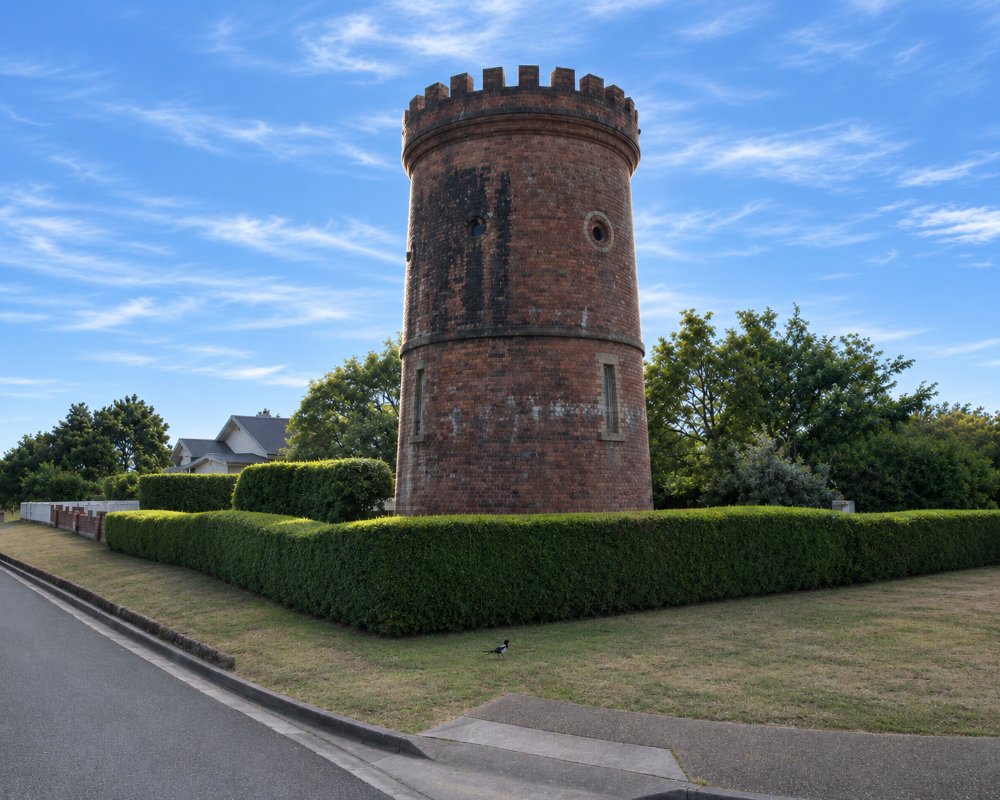
The castellated red-brick water tower, often compared to a rook on a chessboard, is Evandale’s most photographed landmark. A stroll around the village also takes in the Prince of Wales Hotel, built in 1836 and first licensed in 1842, St Mary’s Catholic Church of 1863 and the two St Andrew’s churches, one Anglican and one Uniting.
Visiting Clarendon
Clarendon, at Nile about 8 km south of Evandale, is a three-storey mansion built in 1836 and run by the National Trust. Besides its regular open days it holds events such as night tours in winter and picnic days in the grounds. Its opening days vary with the season, so check before you go.
Where To Stay
Evandale offers a range of accommodations to suit all preferences.
The Arendon Cottage, a beautifully restored 1830s Georgian residence, provides a cozy retreat for travelers. Meanwhile, the historic Clarendon Arms Hotel combines modern amenities with old-world charm, offering comfortable rooms and a welcoming atmosphere.
The Clarendon Arms’ accommodation is now a self-contained cottage with a two-night minimum stay. Arendon Cottage on Russell Street is an adults-only one-bedroom cottage a short walk from the market, and Leighton House, a restored homestead, suits families and groups. More cottages, B&Bs and holiday homes are spread through the village’s Georgian streets.
Self-contained caravans and motorhomes can stay free for up to 48 hours at two council sites, each needing a free permit issued online by Northern Midlands Council. Falls Park Reserve on Logan Road is open on Monday to Friday nights only, because the Sunday market uses it: vans must leave by 10 am on Saturday and can return after 6 pm on Sunday. Honeysuckle Banks Reserve on Leighlands Road is open from November to April. Vans must be fully self-contained, and no grey water may go on the ground. The nearest council dump point is at the Cressy Recreation Ground. For powered sites, the caravan park at Longford is about 15 km west, and Launceston’s holiday parks are about 20 minutes north. Cressy House Estate offers farm-stay accommodation near Cressy.
Eat & Drink
Dining in Evandale is a delightful experience. The Clarendon Arms Hotel serves hearty pub fare alongside a fine selection of Tasmanian wines. Local cafes offer freshly baked goods, coffee, and light meals, making them perfect for a relaxed break between explorations.
The Clarendon Arms Hotel on Russell Street, a pub since 1847, opens from breakfast time for coffee and cake as well as lunch and dinner. Its menu is British pub fare with a twist, changing with the season and built on local suppliers, with Tasmanian gin, whisky and craft beer behind the bar, a fire in winter and a beer garden in summer; it is closed on Mondays. On Sunday mornings the Evandale Market fills Falls Park on Logan Road with more than 100 stalls selling local produce, plants, antiques and second-hand goods, with food and coffee to keep shoppers going.
Five minutes towards Launceston, Launceston Distillery pours its single malt whiskies at Hangar 17 at the airport, with tastings and tours from Monday to Saturday. Perth, 8 km west, has Feast Tasmania for all-day breakfasts and Portuguese tarts, and the Tasmanian Honey Company for honey tastings. For a big supermarket shop and fuel, Launceston is about 20 minutes north.
History
Evandale is in the country of the North Midlands nation of the palawa, and the river flats at Honeysuckle Banks hold the remains of their campsites. Governor Macquarie camped beside the South Esk in 1811, and Captain Andrew Barclay took up the first land grants from 1816. The settlement was called New River and then Collins Hill before it became Evansdale in 1829 and Evandale in 1836, although many people kept using the name Morven. The post office opened on 1 June 1835. The broad-gauge railway from Launceston arrived in 1871, and from 1876 the narrow-gauge Main Line from Hobart met it here, so passengers and goods changed trains at Evandale until the break of gauge ended in 1888. The old school was built in 1889 and extended in 1929.
Getting To Evandale
Evandale’s proximity to Launceston Airport, just five kilometers away, makes it easily accessible for both domestic and international travelers. Whether you’re driving from Launceston or catching a connecting bus, the journey is straightforward and enjoyable, with scenic views of the Tasmanian countryside along the way.
Experiences
- Food and Wine
- Historic/Heritage
- Rural/Country
- Self-Drive
Popular Activities
- Caravan and Camping
- Cycling
- Food and Wine
About Evandale
- Locality: Urban locality
- Evandale Postcode: 7212
- State: Tasmania
- Region: Launceston & North
- Latitude: -41.57127
- Longitude: 147.24734
- Timezone: Australia/Hobart
