
St Albans, NSW
St Albans is a tiny village on the Macdonald River, 20 kilometres up a quiet side valley from Wisemans Ferry and about 95 kilometres from Sydney. Locals call this the Forgotten Valley. Cut off by ferries and winding roads, it has barely changed in a century, and its sandstone pub is one of the most atmospheric in New South Wales.
Known For
- The Settlers Arms Inn, built in 1836
- The quiet Macdonald Valley
- Convict roads and pioneer cemeteries
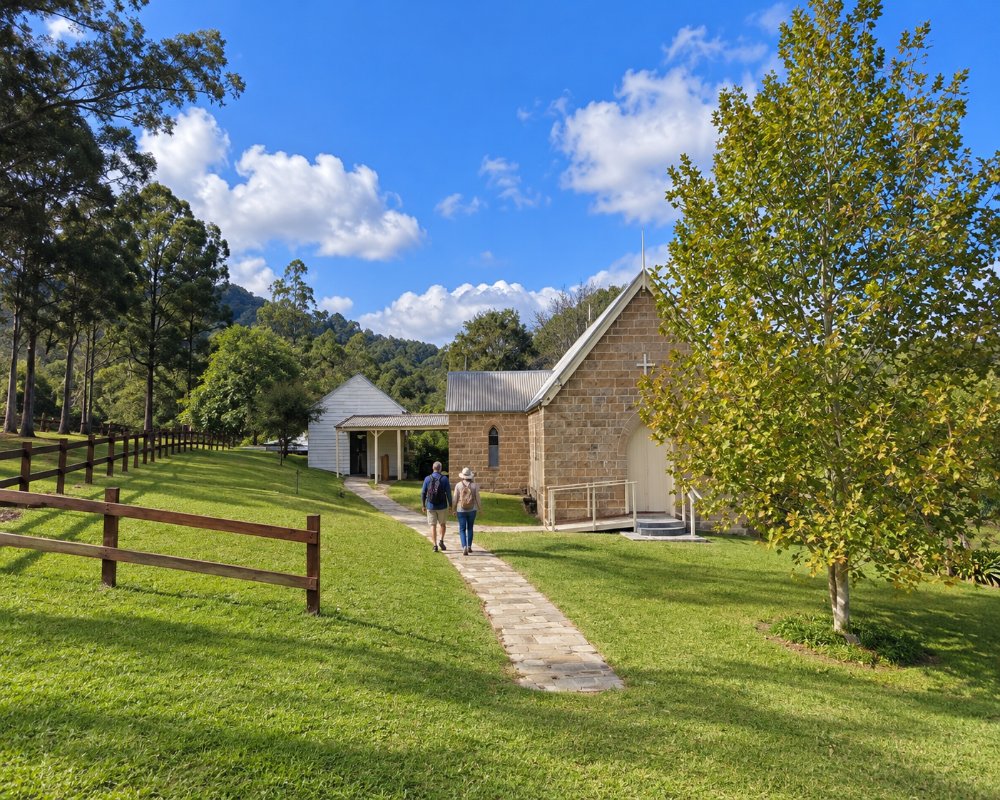
The village is a handful of old buildings around a timber bridge: the pub, a former courthouse, a church, a hall and a few cottages. Paddocks run down to the sandy river, and the forested ridges of Yengo and Dharug national parks close in on every side.
Things To Do in St Albans
Settlers Arms Inn
Licensed in 1836 and built of convict-cut sandstone as a stop for coaches on the road north, the inn is still the centre of the valley. It has low ceilings, open fires and a shady garden that fills with day-trippers and motorcyclists at weekends.
Drive the Valley
Roads run up both sides of the Macdonald River from the Webbs Creek and Wisemans ferries, and together they make a scenic loop past old farms, slab barns and river flats. The eastern road is partly unsealed. Along the way are small pioneer cemeteries, among them the riverside St Albans Burial Ground, founded in 1826.
Old Great North Road
The convict-built road to the Hunter climbs out of the valley near here. Walkers and mountain bikers can follow long sections of it through the bush, and the best-preserved stonework is at Devines Hill near Wisemans Ferry.
Folk Festival
Each April the village hosts a long-running folk music festival, with concerts in the pub, the church and the hall and camping on the river flats.
Heritage Buildings
St Albans has a remarkable cluster of old buildings for so small a place: the Court House and police lock-up of 1890, now holiday accommodation whose old cells are bathrooms; St Alban the Martyr Anglican church, a stone church of 1897 that replaced a timber chapel of 1843; the stone St Joseph’s Catholic church of about 1845, restored as a guesthouse; Price Morris Cottage on Upper Macdonald Road, a timber and wattle-and-daub cottage of 1837 where Welsh Methodists met, now on the State Heritage Register; and the heritage-listed Macdonald River bridge.
St Albans Folk Festival
The festival is held over the weekend nearest Anzac Day, with folk and bush music, dances, workshops, poetry and a Saturday KidsFest with maypole dancing. Concerts fill the pub, the church and the hall, and many people camp on the river flats; the 2027 festival is on 23 to 25 April.
Mogo Campground, Yengo National Park
NPWS’s Mogo campground, in the bush north-east of the valley, has 10 marked tent sites with toilets, barbecues and picnic tables, a short walk from the car park. It is remote and not suitable for caravans, and the nearest store and fuel are about 45 minutes away at Kulnura, so bring all water and firewood.
Where To Stay
The inn has a few rooms, the old courthouse takes guests, and there are cottages, farm stays and bush camping grounds along the valley.
More accommodation is available at Wisemans Ferry.
The Settlers Arms Inn at 1 Wharf Street has four double rooms, each with an ensuite and air conditioning, though it no longer allows pets (from 22 June 2026). The St Albans Courthouse, the 1890 court house and lock-up, is now self-contained accommodation for groups and families, with log fires, a full kitchen and old cells converted into bathrooms, and the same owners let the St Albans Stables and the St Albans Homestead. Campers use the riverside flats across the road from the pub, but there are no shops or fuel in the valley, so bring everything with you. NPWS’s Mogo campground in Yengo National Park has 10 tent sites, and Mill Creek campground in Dharug National Park, near Wisemans Ferry, takes small caravans and camper trailers. The nearest caravan park is Del Rio Riverside Resort beside the Webbs Creek ferry, with powered sites (some on concrete slabs for caravans), cabins and a cafe. No dump point is known in the valley; tow in via St Albans Road from the Webbs Creek ferry, as the eastern Settlers Road was flood-damaged in 2022.
Eat & Drink
The Settlers Arms serves lunches and dinners, and the inn’s Coffee Hut serves coffee and light breakfasts from 7am on weekends and public holidays. Bring anything else you need, as there is no general store to rely on.
The Settlers Arms Inn is the valley’s only pub and the only place to eat. It opens every day except Christmas Day from 10am, until 10pm on Friday and Saturday and 9pm on other nights, and its bistro serves Australian country-style meals seven days a week until 8.30pm. There are open fires in winter, a big beer garden with fire pits and live music every weekend, and on weekends and public holidays the Coffee Hut opens from 7am to 11am. There is no general store and no fuel in St Albans, so fill up and buy supplies at Wisemans Ferry.
History
The valley is Darkinjung and Dharug country. Settlers moved in from the Hawkesbury River in the early nineteenth century to run cattle and grow grain on the fertile flats, and a village called Macdonald grew up at the head of navigation. It was renamed St Albans in the 1840s. Floods repeatedly stripped the farmland and silted up the river, and the population drifted away, leaving the valley much as visitors find it now.
The village was surveyed in 1837 as the Village of Macdonald, at the navigable limit of the Macdonald River, and renamed St Albans on 26 January 1841, with the first land sales in July 1842. Big floods came in 1867, 1889, 1913 and 1949; in 1889 the water rose to the eaves of the Settlers Arms, covered the bridge and washed away five houses and the police quarters.
Getting to St Albans
Drive to Wisemans Ferry, cross on the Webbs Creek ferry and follow St Albans Road up the valley. Allow about two hours from central Sydney. There is no public transport.
From Sydney, take the M2 and Old Northern Road to Wisemans Ferry, turn left onto River Road and cross on the free Webbs Creek ferry, which runs around the clock except from 2am to 3am daily and on the first Tuesday morning of each month, then follow St Albans Road about 20 km up the valley. The inn puts the trip at about 1.5 hours from Sydney or the Central Coast.
Experiences
- Cultural
- Historic/Heritage
- Rural/Country
- Self-Drive
Popular Activities
- Caravan and Camping
- Driving
- National Park
- Sightseeing
About St Albans
- Locality: Rural locality
- St Albans Postcode: 2775
- State: New South Wales
- Region: Sydney
- Latitude: -33.29093
- Longitude: 150.97026
- Elevation: 9m
- Population: 158
- Median Income: $27820
- Area (Sq/km): 107.432
- Timezone: Australia/Sydney
Accommodation In St Albans
Discover some of the accommodation in and around St Albans
