
Stirling Range National Park, WA
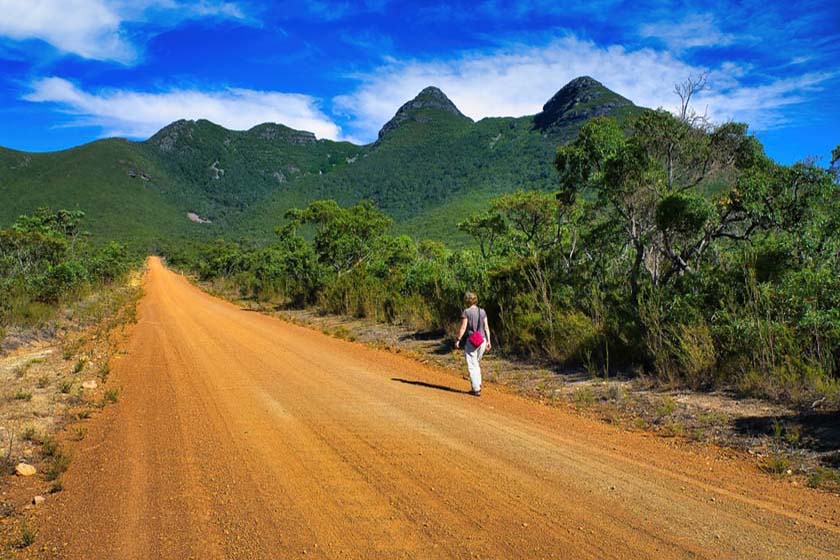
Stirling Range National Park protects a dramatic chain of peaks rising abruptly from the farmland about 100 km north of Albany and around 400 km by road south-east of Perth. Covering about 116,000 hectares, it is home to Bluff Knoll, at 1,098 m the highest peak in the south-west of Western Australia, and to one of the richest collections of wildflowers anywhere, with more than 1,500 flowering plant species, at least 87 of them found nowhere else.
This is the Country of the Goreng and Menang Noongar people. The range is called Koikyennuruff, meaning mist moving around the mountains, and Bluff Knoll is known as Bular Mial. Cloud often wraps the peaks, and in most winters a light dusting of snow falls on Bluff Knoll, one of the few places in Western Australia where this happens.
Known For
- Bluff Knoll, the highest peak in the South West
- More than 1,500 kinds of wildflowers, including mountain bells
- Rugged peak walks and the Stirling Range Drive

Things To Do in Stirling Range National Park
Bluff Knoll
The summit trail is about 6.8 km return and takes three to four hours. It is steep, with many steps, and the weather can change quickly, so carry warm, waterproof clothing even in summer. Start early to avoid the afternoon heat in summer and the weekend crowds. On a clear day, the views stretch to the Southern Ocean.
Other peaks
Toolbrunup Peak, Mount Trio, Mount Magog, Talyuberlup and Mount Hassell are all steep, rocky climbs with superb views. The Stirling Range Ridge Walk is an unmarked multi-day route for experienced walkers only, who should register before setting out.
Stirling Range Drive
This 42 km drive, mostly on graded gravel, links Chester Pass Road and Red Gum Pass Road, with lookouts and picnic areas along the way. It is not suited to large caravans in wet weather.
Wildflowers
The park is at its most colourful from September to November, when orchids, banksias and the remarkable Darwinia or mountain bells are in flower. Ten species of mountain bell grow here, and all but one are found nowhere else.
Wildlife
Look for kangaroos, emus and many birds, including Carnaby’s black cockatoos. Kangaroos often graze beside the park roads at dawn and dusk, so drive slowly.
Snow
Light snow falls on Bluff Knoll in most winters, and heavier falls, such as those in 2022 and 2025, draw crowds from across the state.
Where To Stay
Moingup Spring Campground, near Chester Pass Road, was destroyed in the 2019 and 2020 bushfire and reopened in November 2025 with seven unpowered gravel sites, a flush toilet and a camp kitchen; there is no drinking water, booking online is essential, and park and camping fees apply. Pets and campfires are not allowed in the park.
On the northern boundary, Stirling Range Retreat, opposite the Bluff Knoll turn-off, has powered and unpowered sites, cabins, chalets, a dump point and a small shop, and Mt Trio Bush Camp and Caravan Park, on a working farm at Amelup, has powered and unpowered sites, hot showers and a camp kitchen. Fuel is available at Amelup, Mount Barker, Cranbrook and Albany.
Eat & Drink
There are no cafes in the park. Stirling Range Retreat has a small shop, and Mount Barker, Cranbrook and Albany have pubs and cafes.
History
Matthew Flinders sighted the range in January 1802 and named it Mount Rugged. In 1835 J.S. Roe named it after Governor James Stirling, who never visited. The national park was gazetted in 1913. A lightning fire in December 2019 and January 2020 burnt about 40,000 hectares, a third of the park; Bluff Knoll reopened in May 2020 after repairs.
Getting to Stirling Range National Park
The park is about 400 km south-east of Perth, around four and a half hours’ drive, and about an hour and a half north of Albany via Chester Pass Road. Cranbrook and Mount Barker are the nearest larger towns.
September to November is the best time, for wildflowers. Autumn brings stable weather for hiking, and winter is cold and wet, with possible snow. Summer has very high fire risk, so check Parks and Wildlife alerts before you go.
Experiences
- Active
- Caravan and Camping
- Eco Tourism
- Environmental
- Food and Wine
- Mountain
- Nature based
- Rural/Country
Popular Activities
- Bush Walking
- National Park
- Wildlife
About Stirling Range National Park
- Locality: Rural locality
- Stirling Range National Park Postcode: 6338
- State: Western Australia
- Region: Margaret River & the South West
- Latitude: -34.38117
- Longitude: 117.97176
- Elevation: 278m
- Area (Sq/km): 1121.623
- Timezone: Australia/Perth
Accommodation In Stirling Range National Park
Discover some of the accommodation in and around Stirling Range National Park
