
Burra, SA
Burra is an old copper town on the Barrier Highway, 156 kilometres north of Adelaide, and one of the best preserved nineteenth century mining towns in Australia. Between 1845 and 1877 the Burra Burra mine, known as the Monster Mine, was among the richest copper mines in the world and for a time kept the young colony of South Australia solvent.
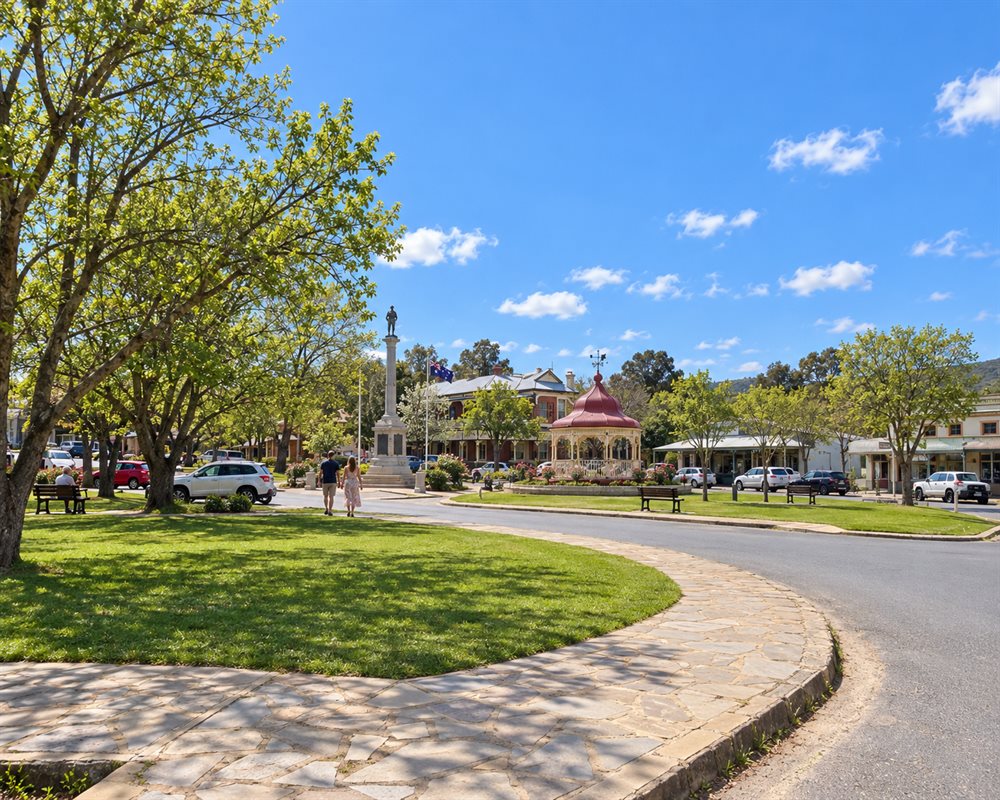
When the miners left, very little was pulled down. The stone cottages, chimneys, engine houses, gaol and churches are still here, scattered along Burra Creek through what were once separate townships with names such as Kooringa, Redruth and Aberdeen. About 900 people live in the town now, and the whole of it is a State Heritage Area.
Burra sits in bare, rolling sheep country on the edge of the outback, east of the Clare Valley vineyards. It is a natural overnight stop for anyone driving the Barrier Highway to Broken Hill, and deserves a full day.
Known For
- The Monster Mine, Morphett’s Enginehouse and the open cut
- The Burra Heritage Passport, a key to locked historic sites
- Miners’ dugouts, Redruth Gaol and Paxton Square Cottages

Things To Do in Burra
Burra Heritage Passport
The best way to see the town is with a Heritage Passport from the visitor information centre in Market Square. You are given a key and a guidebook and set off on an 11 kilometre driving trail of 46 sites, letting yourself into the locked ones. In 2026 the passport cost $35 for adults and $30 for concession holders, with children free, plus a refundable deposit on the key. Allow at least half a day.
The Monster Mine
The mine site on the hill above town has the restored Morphett’s Enginehouse, with a museum inside, the powder magazine, tall chimneys and a lookout over the flooded open cut, which was worked again from 1971 to 1981.
Redruth Gaol
Built in 1856, this was the first gaol in South Australia outside Adelaide. It later became a girls’ reformatory and was used in the 1980 film Breaker Morant. You wander through the cells on your own.
Miners’ Dugouts
In the early years as many as 1,800 people lived in rooms dug into the clay banks of Burra Creek to avoid paying rent to the mining company. Floods drove them out, and two of the dugouts have been preserved.
Market Square and the Museums
Market Square is the centre of the town, with the visitor centre, the Burra Jinker, a huge wagon once hauled by 40 bullocks, and a small museum open on weekend afternoons. The Bon Accord Mine Museum, in the buildings of a mine that never found copper, opens most mornings. Malowen Lowarth is a furnished miner’s cottage in the Paxton Square row.
Art Gallery and Railway Station
The Burra Regional Art Gallery, in the 1860 post and telegraph office, opens in the afternoons. The restored 1883 railway station has a display on the Diprotodon, the giant marsupial whose bones were found nearby.
The Midnight Oil House
About three kilometres north of town, beside the Barrier Highway, a ruined farmhouse stands alone in a paddock. It appeared on the cover of the Midnight Oil album Diesel and Dust in 1987 and has been photographed ever since. It is on private land, so take your picture from the roadside.
Red Banks Conservation Park
About 15 kilometres east, partly on unsealed road, Red Banks is a landscape of red gullies and mallee where the bones of Diprotodon and other megafauna have been found. A five kilometre loop walk takes about two hours. The road is impassable after rain.

Where To Stay
Paxton Square Cottages, a row of miners’ cottages built in 1850, are let as self-contained units and are the most atmospheric place to stay. The Burra Motor Inn sits beside the creek, the Burra Hotel, Bon Accord Hotel and Royal Exchange Hotel have pub rooms, and there are a number of heritage cottages and farm stays.
The Burra Caravan and Camping Park is on the creek in Bridge Terrace, a two minute walk from Market Square, with about 30 powered sites, unpowered grass sites, a camp kitchen and a dump point, and it takes larger rigs. The Burra Showgrounds, on the northern side of town, offers cheaper powered and unpowered camping with a caretaker collecting fees. Bush camping is available at Red Banks and, free of charge, at Burra Creek Gorge on the Worlds End Highway.
Paxton Square is run with the caravan park as one precinct, with studio, one-bedroom and two-bedroom cottages in the 1850s row, a guest barbecue and fire pit, and pets on request. For a heritage stay on your own, the restored 1883 railway station has a one-queen-room B&B suited to couples, with a log fire and breakfast provisions. The Bon Accord Hotel also lets its Coach House, a restored 1875 stone stable, and a long list of private miners’ cottages are let as holiday homes, among them the Sunday School Cottage near the centre, Copper Mine Cottage from 1846, Dove Cottage and Butterworth Mill, a converted 1874 flour mill.
The Commercial Hotel has eight queen and family rooms with shared bathrooms, and the Burra Hotel on Market Square has budget pub rooms. The Burra Motor Inn has 20 ground-floor rooms over the creek, with parking for trailers and larger vehicles.
The showgrounds in Hall Terrace have 23 powered sites, a basic amenities block and a second dump point. Red Banks Conservation Park, 15 km east on unsealed Eastern Road, has 10 free unpowered sites that take caravans, with pit toilets; dogs are not allowed. Yellowie Retreat, about 40 km from town on a working farm at Canowie, has restored shearers’ quarters.
Eat & Drink
The pubs are the mainstay. The Bon Accord Hotel serves lunch and dinner every day, and the Royal Exchange, the Commercial and the Burra Hotel all do meals. Waters Burra Bakery is the place for a Cornish pasty, a nod to the miners who came from Cornwall. St Just Cafe opens daily for breakfast and lunch, and Mog’s Cafe and Cafe 67 are other choices. There is a roadhouse on the highway for fuel and takeaway.
Burra eats well for a town of its size, and most places sit within a few minutes’ walk of Market Square. The Bon Accord Hotel in Park Lane has an open fire in winter, local wines and whisky, and a full country breakfast if you book ahead. The Royal Exchange Hotel in Best Place, Burra North, has a big beer garden with a playground; it does lunch and dinner from Tuesday to Saturday. The Commercial Hotel in Commercial Street runs a bistro of pub classics and a coffee bar from Wednesday to Sunday, and the Burra Hotel on Market Square serves pub favourites with some seasonal dishes.
For daytime food, Mog’s Cafe at 25 Commercial Street opens early for build-your-own breakfasts, breakfast burgers and cakes baked on site, and St Just Cafe at 5 Commercial Street does home-style cooking and cakes. Cafe 67, in an 1848 building on Market Square, draws motoring enthusiasts and has outdoor seating. Waters Burra Bakery at 16 Commercial Street bakes its bread and cakes on the premises, and Cook’O’Burra on Market Square does pizzas, hot food and rolls from Tuesday to Sunday. Copperhouse Estate, a small Burra winery making shiraz, riesling and sparkling wine, is poured at the Burra, Commercial and Bon Accord hotels.
Burra has a supermarket in Commercial Street, and the Burra Ampol Roadhouse, also in Commercial Street, sells fuel, coffee and eat-in or takeaway meals every day.
Day Trips from Burra
North along the Barrier Highway, Mount Bryan and Hallett lie under the highest peak of the northern Mount Lofty Ranges, with the birthplace of the polar explorer Sir Hubert Wilkins out to the east. Further on are the old railway towns of Terowie and Peterborough.
South-east, the Worlds End Highway leads to Burra Creek Gorge, a red gum camping reserve on the Heysen Trail, and on to Robertstown and Eudunda. West of Burra the road runs through Farrell Flat to Clare and the wineries, about 40 minutes away, with the heritage village of Mintaro a short detour. Booborowie, in a broad farming valley, is 25 kilometres north-west.
History
Burra is on the country of the Ngadjuri people. Copper was found by shepherds in 1845 and mining began that September. The South Australian Mining Association laid out the company town of Kooringa in 1846, and other townships grew up around it, peopled by Cornish miners, Welsh smelters, Scottish and English tradesmen and German farmers. By 1851 Burra was the largest inland town in Australia.
The mine closed in 1877 and the town turned to serving the surrounding sheep stations. The railway arrived in 1870 and the townships were formally joined under the name Burra in 1940. In 1979 conservation experts meeting here adopted the Burra Charter, which still guides the care of heritage places across Australia.
Getting to Burra
Burra is two hours from Adelaide by the Barrier Highway through Gawler, Tarlee, Riverton and Saddleworth, or a little longer through Clare. The highway is sealed and good for caravans, and continues north-east to Broken Hill, about 360 kilometres away. Fill up here if you are heading that way, as towns are far apart.
Experiences
- 18-35's
- Eco Tourism
- Historic/Heritage
- Relaxation
- Rural/Country
- Self-Drive
Popular Activities
- Bush Walking
- Caravan and Camping
- Driving
- Food and Wine
- Golfing
- Horse Riding
- Shopping
- Sightseeing
About Burra
- Locality: Urban locality
- Burra Postcode: 5417
- State: South Australia
- Region: Clare Valley
- Latitude: -33.68247
- Longitude: 138.93832
- Elevation: 470m
- Population: 1103
- Median Income: $25584
- Area (Sq/km): 440.794
- Timezone: Australia/Adelaide
Accommodation In Burra
Discover some of the accommodation in and around Burra
